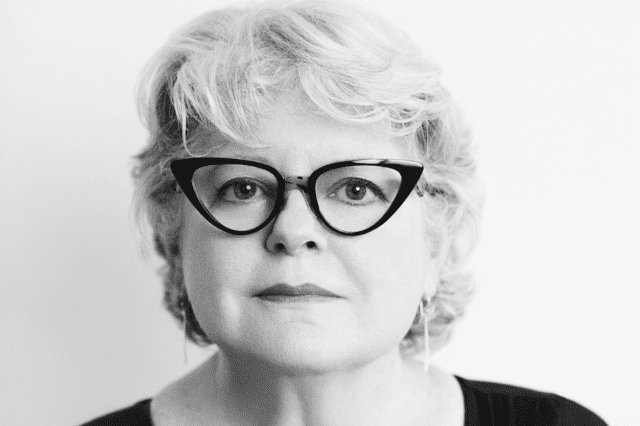
For the past six months or so, Kathleen McInnis has been guiding the film teams selected for CONNEXT 2023 towards the magic moment when they pitch their projects to the great and the good of the international film community.
“We started the process in May. I came in June and I did an all-day workshop which focused on voice and why voice is so important and how voice translates in the business economy of cinema,” she explains of her Flemish mission. During the summer she remained in close contact with the project teams via Zoom before a week of rehearsals just prior to CONNEXT.
“None of them had really thought about their films in the way that I was asking them to think about their films. So this becomes a process. It becomes a way of looking at your film from a different perspective, putting yourself in the position of audience.”
“I believe firmly in what I call the Cinematic Trinity, which is filmmaker as artist, audience at the other end, and in the middle the industry as conduit. You need all three parts of these to be engaged in the process of visual storytelling,” McInnis underlines. “And this was the first time for many of these filmmakers that they had brought audience into their process before the film was [started].”
But it’s also about delivering the message as effectively as possible to that part of the industry that the film teams need to target most at a given moment, she points out. “What do we need to shine a spotlight on, so that your specific audience will be able to see what they need to see in order to hear the story you want them to hear?” McInnis explains her rationale. “If you’re not done with funding yet, then you need financiers to come in. So what do they need to see that’s going to make them feel comfortable about taking out their pocketbooks and writing a cheque? What do they have to know? Because that’s different to what a sales agent might need, and that’s different to what a festival needs, for sure. And so we start there. I ask them [the project teams] to start with their goals.”
As a producer, lecturer, curator, festival director and top publicist, McInnis is what many would refer to as a multihyphenate. Where does she believe her professional priorities fundamentally lie, and how are these channeled for the benefit of the film teams?
“My focus is always the emerging world cinema filmmaker. How do I help them merge their creative and their business development using their films on the festival circuit? How do I help them?” she responds. “I happen to have this background in festival programming and running festivals. I happen to have this background in publicity and marketing, and so I can bring that to bear. I’m also a filmmaker, which I can bring to bear. I started acting when I was ten, and my degree is in acting, so I can bring that to bear. But it all comes full circle back to what I am doing. I’m trying to help emerging filmmakers, world cinema filmmakers – shorts, first and second features usually – and those are world cinema filmmakers usually outside of the US…I’m really trying to help them understand that it’s the translation of their creative language into the marketing language that brings their work to audiences. And I am trying to do it in a way that empowers them to not just retain power, but to actually gain power and be empowered from having that knowledge.”
She continues. “In my more strident moment I would scream from the rooftop, ‘quit abdicating your power, quit giving away everything you’ve worked for because you think your job was done when you finished the last shoot, when you did the last edit.’ So many of you are not prepared for yourself or your films to go out on the market on their journey to audience, and you don’t even know what you’re missing because you’re not prepared.”
McInnis is an avowed fan of documentary and refers to “pivotal moments” when she first encountered such films as Capturing the Friedmans [Andrew Jarecki], My Architect [Nathaniel Kahn] and The Monastery: Mr. Vig and the Nun by Pernille Rose Grønkjær. “These are pivotal films where I’m watching work that is moving me the same way any great mainstream or foreign film would move me. The same as any narrative film would move me, sometimes even more so. And I say to myself, I’m not dissecting it as a documentary. I’m dissecting it as a story that has great emotional truth to it.”
“Today…we have quite a strata of different styles of documentary,” McInnis continues. “And that to me seems like it has a lot to do with money. It has a lot to do with access, has a lot to do with exhibition possibilities. And that has a lot to do with sort of ever narrowing circles of people making decisions about certain kinds of storytelling.”
But the McInnis way is “to bust open all of those lanes,” she stresses.
“I like it when lanes are bigger and open and there is more chaos, bringing more stories into our world view that we haven’t seen before,” she insists. “So I am that person who seeks out those independent documentary filmmakers. I’m not the person usually who’s tasked with selling an HBO doc or even a Netflix doc, as great as they are – there’s other people to do that. I’m the person who is lucky enough to get invited onto the doc teams where I can bring something vital to their process. They feel it, they see it, they like it, they want it. And together we get to move forward to get to audiences.”