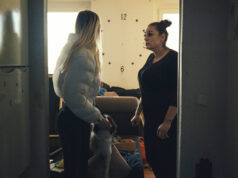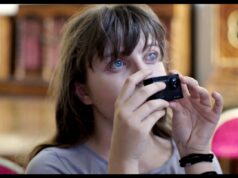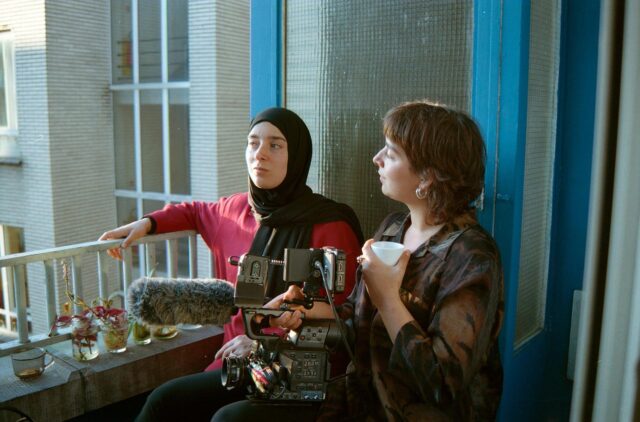
Filmmaking duo Zohra Benhammou and Romy Mana met in unusual circumstances. Both worked in the same coffee bar in Brussels. The two baristas felt “an immediate connection.”
“At that time, I was writing by myself but we talked a lot about the film,” Zohra remembers. Ana + yek, screening online at CONNEXT, is a very personal project for her. She features in it alongside her twin sister, Sanaa, with whom she shared an apartment in Brussels. While Zohra was pursuing her career as a filmmaker, her sister was beginning to turn to Islam, the religion they both grew up with.
“I felt I was too close to the subject. I needed someone who [could] take a distance [from it], to guide me into the story,” Zohra explains why she was so keen to work with Romy.
The directors came from similarly complicated family backgrounds. Zohra felt she might be losing her sister to her new religious beliefs. Romy had issues of her own. Her father had died. Her mother was suffering from a mental health condition. Both were therefore suffering.
Romy saw her role as co-director as being to allow her friend “a safe space to explore the narrative,” and to stand “beside” Zohra as she went through a difficult episode in her life.
“It was very important to have Zohra’s gaze on her sister. It felt very natural that Zohra would be holding the camera and that whenever it would be necessary that she needs to be in front of the camera, then I would take the camera,” Romy explains how the co-directors shared shooting duties.
Early on, Zohra had tried to stay out of the film. She didn’t want it to be about her. “The story actually started as a film about my sister – and me filming my sister,” Zohra notes. “I felt the need to film my sister because I felt something was going to change. There was something I wanted to explore…there was, somewhere, a story but I didn’t know what the story was yet.”
Zohra simply started recording moments when she and her sister were eating and talking together in the apartment. They had always had a very close rapport but there was a growing distance between them.
The film was shot over roughly four years. “But there were also moments that I was not able to film because I was too emotional, so there are gaps in the filming,” Zohra says. “There was a rupture and I needed one year to recover from a big change…I thought I knew my sister but then there was this change. It felt like she changed. But if I look at it right now, she didn’t change. She is still the same as so many years ago…I think I was also afraid of the Islam coming closer to me. It is something I grew up in and also something difficult for me to place.”
As young children and near identical twins, Zohra and Sanaa were very, very close. “We shared a room, we shared a bed. We had one bed. We slept together. We had our own language that we invented. If someone called Sanaa, I turned my head.”
Romy knew Sanaa even before she befriended Zohra at the coffee bar. “We were climbing buddies,” she explains their passion for indoor mountaineering. This meant she didn’t feel like an outsider when she began to film the sisters at such close quarters. “I felt very accepted. There was this warm embrace…”
At times, Romy felt she was playing “a supporting role” in bringing the sisters back together. “It didn’t feel voyeuristic but more facilitating.”
Neither Romy nor Zohra went to film school. “It was not my aim to make a film but I felt there was something inside [me] that I wanted to explore,” Zohra says of the compulsion she felt to make the documentary. “I had some friends who did film school and they encouraged me to put my story on paper and to make a film out of it.”
At first, Zohra wasn’t comfortable with the formal side of filmmaking. She was in an emotional state. “Doing this technical stuff of filming and sound was very difficult for me to manage,” she admits. “[But] in this moment, it was not possible to ask a DoP to shoot because of the intimacy of the subject and the relationship between me and my sister. For me, the only possible way to make this film was with Romy who was very close to Sanaa and to me – and could enter into our relationship and share a space.”
Zohra wasn’t looking for glossy, perfectly framed images. She wanted emotional honesty. “When we look at the film now, we can be frustrated but we also accept the images how they are…”
Producer Elisa Heene of Mirage was an early champion of the project. Financial supporters include Flanders Audiovisual Fund (VAF) and broadcaster Canvas.
Ana + yek is now being submitted to festivals. The two directors will continue working together. While working on the documentary, they started writing a fiction film. This has the working title of Cabane.
“It’s about childhood; about three sisters exploring the possibilities of going beyond the borders of their apartment in a high-rise building in Brussels,” the directors explain.
The new feature is still in the “writing phase…we will dive into the writing and research and take time to explore.”
And, yes, Sanaa has seen the documentary. “She saw different versions and she was very impressed and happy with it. It is a difficult process to see what we would use in the film and what we could not. At certain moments, she was hesitating about images where she didn’t wear her headscarf…but I think now she is detached from the film and very happy with the result,” Zohra observes.
Romy agrees, talking of how Sanaa overcame the “insecurities” she felt during the first half of the film and the happiness she feels with her husband in the latter part of the documentary. “It’s like, OK, these are these decisions [she has made], she stands by them and they fill her with joy.”