In Orlando von Einsiedel’s documentary Convergence, which launches globally on Netflix October 12, we are transported back to those grimmest of days, a mere eighteen months ago, when the world shut down, and all of a sudden our lives were governed by fear, incomprehension and the most acute sense of uncertainty.
Days when, as we turned to our political betters for guidance and leadership, whether in the UK, Brazil, the US or China, what seemed most evident was rampant opportunism (remember the award of PPE contracts?), corporate greed, indecision and the denial/erosion of personal liberties.
But as director Orlando von Einsiedel notes, there was a quite separate reality playing out in parallel. “When I looked around my community, just on my streets, there were these beautiful acts of altruism and community. And then on social media, you had people volunteering to help the NHS and people risking their lives to help offers, and all sorts of really beautiful acts.”
At the same time a lot of commentators were saying how this enforced shutdown was an opportunity for meaningful change in the world, Von Einsiedel remembers, whether economically or socially, experienced individually or as part of a global collective.
“So those two elements were really the beginning, the kind of foundations [of the film], and almost immediately we knew that the way, the only way we wanted to make this was in a global collaboration with directors from around the world, filming in their own communities and working together on that basis.”
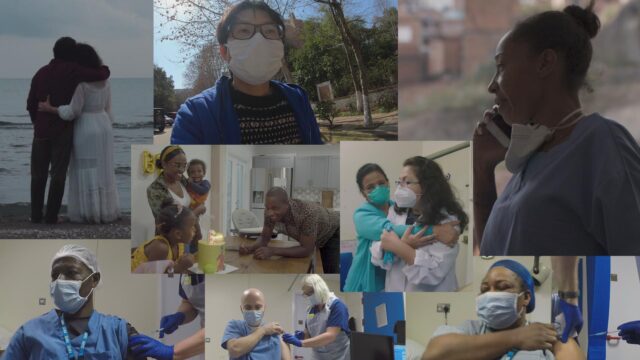
Convergence tells nine very human stories across eight countries; from Renata, a paramedic in a poverty-stricken Sao Paulo favela to Armen Henderson, a Miami doctor/activist turned BLM activist following the murder of George Floyd, to the London-based Syrian refugee Hassan, who proudly volunteers to work as a cleaner for the NHS. The film also follows the (now legendary) Dr Sarah Gilbert, who helped develop the Astra Zeneca vaccine, and even gets into offices of the World Health Organisation, an institution much aligned by hostile governments during the pandemic, as its top brass looked to determine Covid policy.
And then there’s Sara and Mohammad, a gentle, somewhat poetic Tehran couple filming their isolation, dealing with illness, and their own tragedy.
“I think their story in the film [that of Sara and Mohammad] is actually the one that is the experience of most people around the world,” says director Von Einsiedel. “Most of us weren’t on the front lines working on COVID wards. Most of us were stuck at home being scared, watching the news, not sure, [thinking] is the fruit we brought in from the supermarket safe and, I suppose, finding love and support from, if not our neighbours, then the immediate family around us.”
But Convergence is more than just a series of kindly, warm, human responses to the pandemic. It is also about grass roots activism, as evidenced by Hassan’s viral post to UK PM Boris Johnson which ultimately reversed government policy that discriminated against migrant NHS workers denied bereavement insurance. Doctor Armen wages a tireless crusade to protect the homeless on the streets of Miami both from the pandemic and the volatile natural elements, and Renata faces up to militia and their riot shields as she demands 24/7 access to drinking water with fellow protesters.
“What we’ve ended up in a real way documenting is the failure of government,” says the director. The film may have started off as a response to the virus but then the protagonists “very quickly, [ended] up responding to the flaws in society that COVID has exposed and rising up to plug those flaws and fight for change. I think that is, in the end, what the film really is.”
Von Einsiedel says that making the film was a difficult experience as, like everyone else, he was isolating, living in a bubble, dealing with ill family members while all the time receiving, assessing and ordering what was, at times, harrowing and emotionally wrought footage from his global contributors.
“Spending all day working on it and watching very difficult material too, I mean that definitely took an emotional toll,” he says. But I think all of us, we drew a lot of strength, and were buoyed ultimately by the material and the work of our wider team and our co-directors [and] what they were doing. I think every day there were tears but there was a lot of inspiration too.”
As a viewing experience, are we ready to re-immerse ourselves so soon into that life-changing period of recent history? Yes, Von Einsiedel underlines, but “it’s a difficult thing to revisit,” he concedes.
“I think we’ve tried to not make a film about Covid per se. We’ve tried to make a film about humans and our commonalities rather than the things that divide us. And you know, I hope that is a way to punch through with this film. I also hope watching it and feeling that shared reality of what we’ve all been through together can in some ways be a cathartic experience,” he ends.
Directed by: Orlando von Einsiedel
Co-Directed by: Hassan Akkad (UK), Amber Fares (US), Alexander “Lali” Houghton (Peru), Guillermo Galdos (Peru), Juhi Sharma (India), Lieven Corthouts (Belgium), Mauricio Montiero Filho (Brazil), Mohammad Reza Eyni (Iran), Sara Khaki (Iran) and Wenhua Lin (China)
Produced by: Amy Hobby, Dan Cogan, Laura McNaught Orlando von Einsiedel