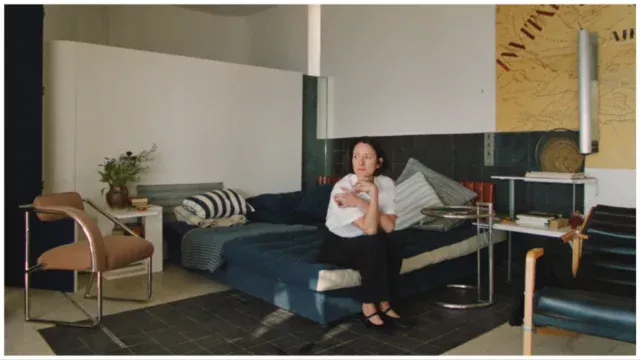
Beatrice Minger and Christoph Schaub’s delicious and elegiac feature documentary playing in CPH:DOX Main Competition tells the story of a dream house (a ‘refuge’) on the Côte d’Azur that was designed and built in 1929 by the reclusive female Irish aristocrat Eileen Gray, but which was then appropriated by none other than the legendary 20th Century architect Le Corbusier.
Gray co-created the house with architecture journalist Jean Badovici, who was her male lover for an intense few years. The name of the house – E.1027 – was a code which indicated their affection for each other in fusing their initials. E was for Eileen, 10 represents J, the 10th letter of the alphabet, 2 for B and 7 for Gray. The house was, for her, “the place I’d been longing for all my life,” a “spiritual extension,” a “relief.” where she could be alone and at peace, just her and Jean and the sea.
But then the “wind changed,” we are told in the film. The Riviera became the must-go place for the smart set, and for libertine artists who enjoyed excess. E.1027 assumed prime stop-off status on the tour, to the dismay of Gray, a woman who would always choose seclusion over company. Her house was a paean to taste and discretion, where she could feel “protected and free,” not a place that had to be continually tidied up after nights of mad partying.
And so she left both the house and Jean, never to return, even though she moved to another house a mere 20 minutes away. In retrospect, “the place I had been looking for didn’t exist, it was elsewhere,” she concluded.
When the architect Le Corbusier, who knew Badovici, visited the house after her departure he was immediately entranced by it. “It allures and calls me, and embraces me in its motherly arms…The house is more than architecture. Its beauty is hurting me,” he wrote.
But whereas for Eileen, a house “is an envelope that surrounds us delicately, protects us from the environment,” for Le Corbusier “the house is a machine to live in,” we are further told in the film.
On her calm walls he proceeded to painted vivid murals, channelling the inner Surrealist he wanted to be, and little by little he took on stewardship of the house, even building a hut 20 metres up the hill behind it. What’s more, when folk assumed that the house was his creation, he would never disabuse them of that notion, we hear.
Directors Minger and Schaub further tell the house’s story right up to the modern day, through the period of its possession by German soldiers during WW2, its walls used for target practice; the squatters, the murder in the kitchen, the house’s descent towards dereliction, then its reclamation and repurposing as a museum, which it remains to this day.
E.1027 – Eileen Gray and The House by the Sea, produced by Swiss Philip Delaquis and sold by Rise and Shine, is imbued with a rich arthouse aesthetic with three actors playing out the story both within the actual house and on a Swiss soundstage. Judicious use of archive (at times projected onto the face of Natalie Radmall-Quirke, who plays Eileen) conjures up the wild and artistic Paris of the late 1920s, and introduces us to the real Eileen Gray in the 1970s as she reflects, in her nineties, upon that period of her life that was at first so wonderful, but then so troubling.
The initial idea was to make a film with Le Corbusier as the main character, director Beatrice Minger explains to BDE, and she was approached by producer Philip Delaquis and co-director Schaub to offer input as a “third party” to determine if there was a story that hadn’t yet been told about the man. When she came across the story of Eileen Gray and the E.1027 house she was mesmerised.
“Very quickly it became clear that if we make a film about architecture…then so many different layers manifest [themselves] in this one house, and so we should really make a film about this house,” she says. “Then of course, I went on and researched more about Eileen Gray, and the more I learned about her, the more I practically fell in love with her because she’s such a fascinating character.”
Minger quotes a saying among the Eileen Gray ‘scene,’ told to her by Jennifer Goff, a curator at the National Irish Museum and an authority on the woman. She told me at the beginning, “Beatrice, be careful because if you enter the Gray zone, you’ll never get out of it.”
At the heart of the film is an unresolved conflict, Minger writes in her notes, between Gray and Le Corbusier over his, what some may see as, violent and crass treatment of the house. She concedes that Le Corbusier may have been encouraged by Badovici to paint the inner murals. Indeed, Le Corbusier himself seemed to think that he was adding value (to use modern parlance) to the house, painting his own artworks onto an existing masterpiece. But for Minger, this interpretation doesn’t rest well. She feels “an unease and an outrage,” she underlines to BDE, at Gray’s clear vision being so fundamentally violated. “I feel very strongly that this is wrong, but trying to rationalize it, it isn’t that easy.”
The house is now a museum, and has been carefully and tastefully restored (although the contentious murals remain). It was also one of the core locations for the film, used in tandem with a Swiss soundstage on which many of the film’s scenarios were played out.
“You can’t spend the whole time in there,” Minger says of filming in the relatively small house. “You have to leave, so you can come back and look at it from a different angle or a different perspective. At first, we’re going through the house from her [Gray’s] gaze. And then we change the point of view to the male gaze, if you will, with Le Corbusier.” Also, there were both time and financial restrictions to shooting within the house.
The production therefore had to “trust” to an intuition that the story could also be told in parallel on the soundstage in Basel, where much of the dialogue is spoken. “[Throughout] the progress and process of the film, it became more and more clear how this space actually should look and how it should feel …and what function it should perform in the end…[This] wasn’t at all clear from the beginning. It was really a little bit of an adventure, a leap of faith,” Minger says of their decision to tell the story across two very different stylistic locations.
But within that space the actors were “really brilliant, I think they did a beautiful job,” Minger stresses, further opining how Natalie Radmall-Quirke “just became Eileen Gray.”
She further tells how, when the shoot in the E.1027 house wrapped, the two female “guardians’ of the museum approached the director and Natalie with tears in their eyes and said that “Eileen Gray had returned.”
“Which was of course for us, and for Natalie too, the biggest compliment you could possibly receive,” Minger ends.