In Natxo Leuza’s shocking and visually striking Black Water, selected for CPH:DOX HUMAN:RIGHTS Award, Lokhi lives with her husband and two daughters in Mongla, a small town in southern Bangladesh which is devastated by the rising flood waters that have resulted from climate change.
“You can’t fight the water. It will take everything in the end,” Lokhi says to her husband. When battling the elements indeed proves to be impossible, the family flees to the capital Dhaka, one of the most populated and polluted cities in the world. But the city’s numbers are swelling on a daily basis, with people arriving on packed trains from the devastated rural areas. As we follow a cast of protagonists that also include an unheeded prophet and a radio climate change campaigner, the film speculates as to how long Dhaka can bear this enormous burden, given that the eventual displacement of people is estimated at somewhere between 10 and 30 million, which would result in the largest migration in human history.
“I discovered that 17% of the country’s southern coastline, the mangrove area – known as the lungs of Bangladesh – will be submerged by climate change,” director Leuza tells BDE of the research he undertook for the film. “I was deeply shocked to think that the lungs of one of the most polluted countries in the world would be under water and millions of people would be forced to move. It was a unique, apocalyptic scenario, a time bomb waiting to explode. Moreover, Bangladesh is already suffering the ravages of climate change. It is on the front line and acts as a lighthouse where everyone is watching, because whatever happens in Bangladesh will affect every country in the world.”
The sense of danger is palpable within the film as the horrendous and enormous weather approaches. “The images of the great storm are truly shocking,” says Leuza. “They were recorded by the Pollobi, daughter of Lokhi the protagonist, and they really are breathtaking. They captured the fury of Cyclone Remal, which hit the area on May 27, 2024. We arrived three weeks later and did not have the opportunity to film storms of that magnitude, but it was very fortunate that Pollobi and a BRAC NGO worker managed to do so.”
“Lokhi told us several stories about cyclones and big storms that she had to face alone, real horror stories. She spoke of roofs being ripped off by the wind, of water rising up to her neck, of screams in the dark…In one such storm, a neighbour rescued her from a certain death. Every time I see a big storm, I remember their stories,” Leuza adds.
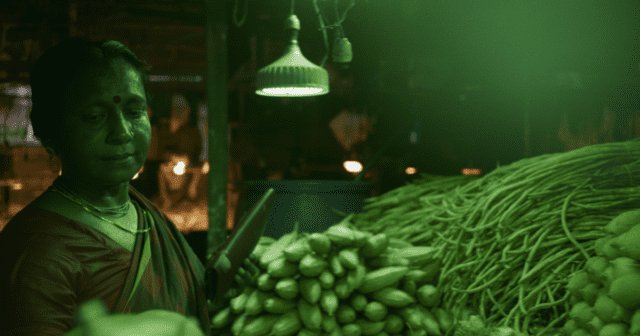
Of course, this makes for dynamic and highly dramatic visuals. Yet there is lyrical counterpoint as we follow Lokhi in the city, living in a shared tenement with her sister’s family, haggling in the local vegetable market and taking a job as a seamstress within a clothes factory. “My intention was to make a film that would warn about the great challenge facing humanity, but always from an artistic perspective. I wanted to create poetic atmospheres that would invite the viewer to dive into the story in a deeper way. These images are fundamental to my cinematic approach. For me, a story without art becomes a mere reportage. I need my films to reflect my personal vision of what is happening, to find that unique way of telling things.”
Leuza invokes the myth of Cassandra – the doomed priestess whose doom-laden prophecies of doom are ignored – in the character of the megaphone-wielding Roy, who was also forced by climate change to abandon his rural existence. “Roy goes through a transformation that begins in his village, where crops are destroyed by salt water and heavy river flooding. In those moments, we only hear his thoughts, until he leaves everything behind and flees like thousands of others to the big city,” says the director.
“The shock of arriving in Dhaka is enormous. He is forced to accept precarious and highly polluting jobs, both for him and for the environment, entering a spiral of poverty, social vulnerability and environmental degradation, which makes his head explode. He finally decides to speak out and shout his prophecy to humanity. His messages sound apocalyptic, incomprehensible, and many laugh at him when he launches them. However, we all know that they are real warnings, which will come true if we do not take action. Roy’s story, like Cassandra’s, is symbolic of those who see a catastrophe coming, warn of it, but are ignored.”
There are other activists in Dhaka whose approach to advocacy is more structured, such as the broadcaster Shakila Islam who declaims of people in the west, “they’re killing us here so they can live over there.” She organises a climate protest to express loudly her concerns, but as to whether these are heard within the corridors of power or commerce is highly questionable.
Production company En Buen Sitio has applied to the Climate Story Fund to kickstart an Impact campaign. “In the scope of the COP30, we would like to position the film as a call-to-action for policymakers, make them feel the pouring rain. People that have watched the film told us that it is very sensorial, it gets into your skin, you really feel the urgency we are working with; and at the end of the day the people up there are the ones that can make the biggest impact,” the Company writes.
Leuza, meanwhile, articulates the essence of his film and the dilemma at its heart. “I wanted to address one of the problems that concerns me most at the moment, something that affects us all. I wanted to do it from the perspective of a developing country, where the poorest communities are responsible for only a fraction of global emissions, yet suffer the greatest impact. We face the risk of ‘climate apartheid’, where the richest pay to escape overheating, hunger and conflict, while the rest of the world suffers.”
Black Water is selected for the European Film Promotion (EFP) and CPH:DOX EUROPE! On Demand initiative designed to boost the visibility of European documentaries in the North American market.