

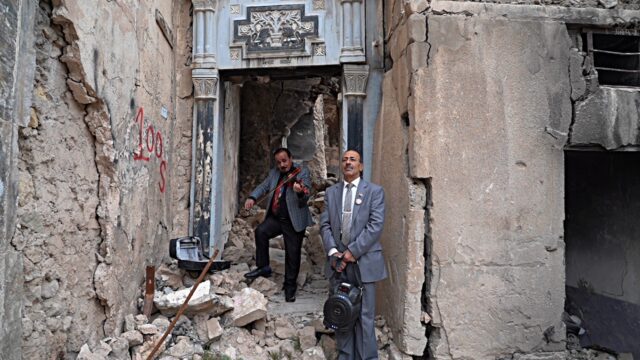
Set against a backdrop of a city (Mosul, Iraq) blasted by war and ISIS occupation, The Lions by the River Tigris tells a story both of stubbornness and regeneration as Fakhri, a passionate collector of artefacts, sets his heart on a marble doorframe owned by Bashar. But Bashar, a fisherman by trade who grew up in what looks like a palace, won’t sell. He is equally determined that it remains where it is – even if the house that surrounds it is now in ruins.
Fakhri is a meticulous, sometimes vain, ex-soldier whose house is a sanctuary for Iraqi artefacts, which he adds to whenever he can. We are reminded in the film that during ISIS’ violent occupation of the city (2014-17) artworks and symbols of idolatry were summarily smashed to pieces by the occupiers. Even now, restorers in the city museum are painstakingly working to right the wrongs of the past, but much is beyond restoration.
Fakhri’s best friend is Fadel who plays the fiddle but whose performances were punishable by death during the same occupation. So he vowed that once the city was liberated he would bring music back to the city, which he does by playing his violin among the ruins, its sound amplified by the speaker that Fakhri holds aloft.
But at the heart of the documentary is the negotiation between Fakhri and Bashar over the doorframe, which bears the lion motif of the film’s title. Bashar’s wife can’t see the point in keeping it, although his father (also a fisherman) retains fond memories of the house whose stunning beauty we see in old photographs. Bashar is also a self-proclaimed protector of all the ruined houses within the vicinity, chasing away looters and pelting them with rocks.
What’s more, his house had been commandeered by ISIS during occupation, so among the ruins he finds a plethora of objects, from bones to photographs to suicide vests. “For him, time had stopped and that struck me,” says Zaradasht.
Fakhri, meanwhile, gets the experts in, measures up for the doorframe’s removal and also commissions a tiny model of it which he eventually gives to Bashar as an act of kindness, or as a peace offering, or as a bargaining chip. At one point, Fadel the fiddler urges Fakhri to back off, accusing him of a level stubbornness matched only by Bashar.
But the question remains, with the torrential rains due any day, can the house (and its much-desired doorframe) survive the inevitable new wave of destruction? Will there be a doorframe left to even haggle over?
Iraqi director Zaradasht Ahmed was researching a film on the missing Baghdad battery, a series of Iraqi artefacts, when he visited Mosul and came across the characters in his film. That said, when he first arrive his heart sank. “I was really shocked to see the level of the devastation and the destruction of all these old houses. I didn’t know the old city was so big and so heavily damaged. So that was the beginning and the story evolved from there,” he tells BDE.
“Look for characters to research, try to understand and digest, and then think how to put together a story that involved and engaged people, and would touch them,” he explains his rationale.
In the same way that doorframe remains resolute amongst all the destruction – “standing tall all the time,” Zaradasht puts it – so do Bashar and Fakhri. It is the archetypal irresistible force encountering the immovable object, and as to whether there is an eventual victor, one will have to watch the film to find out.
The director could see the emotional and metaphorical value of Bashar’s tragic story and the glorious family home that he had lost. But it wasn’t enough to hang a feature doc on. It was when Fakhri and Fadel entered the scene that Zaradasht knew he was in business.
“The moment I saw them was just like I was in a romantic film, because they were so elegant, so well dressed and beautiful people,” he says. “I’m from Iraq originally. It just reminded me of a time that does not exist anymore. It was a wonderful feeling to meet them and they were all what I wish for. At first I thought maybe Fadel and his music was the one who could help bring about the story of Bashar, but then I went to Fakhri’s house, which was an experience in itself with his old photos [many of which are portraits of Fakhri himself] and with all these antique pieces that he’s been collecting. I then felt, okay, now I can make a film with many dimensions, with many deep layers.”
And every time he returned, he would encounter another dramatic development in the story. “When you work as a filmmaker, you know how to tell the story. You have the tools and then you only need the ingredients. Then which meal are you going to make? And how good will it be? It’s a matter of how to put it all together and how to build it.”
Will there be an impact campaign for the film? Maybe, maybe not. Zaradasht will certainly look to raise funds to help rehouse Bashar and his family, but beyond that, he’s not so sure.
“Probably some good ideas will come, but I’m a filmmaker, I’m not an activist one hundred percent. I’m use my film as activism, but I’m not an activist. I don’t have the strategy for that. I just focus on the quality of what I’m doing, focusing on the visuals, focusing on how to bring out that story and then maybe meet along other people that can also can help, who can come with good ideas. Other things than that I, don’t know right now.”
Zaradasht further reflects on how the destruction of infrastructure and artefacts, as practised by ISIS and others, is not only an act of warfare but a process of cultural terrorism. “Hospitals are no longer a holy place; holy places are no longer holy places. Nothing is an exception, everything is a target. And the more you hate your enemy, the more you go into wiping out their identity. These are permanent damages, these go into the identity of a whole nation.”





