When Covid-19 forced the cancellation of a performance by the leading Swedish Cullberg dance company, esteemed US choreographer Deborah Hay was determined that the show should go on in Stockholm, even without an audience.
Hay wanted the performers to experience something similar to what she experienced earlier in her career when not one soul turned up for one of her solo performances. For Hay, this had been a Damascene moment. Instead of being devastated, the experience was, for her, revelatory, and she danced “as she never danced before.”
“That night something happened to me that completely changed the way I think of myself as an artist,” she says in Marcus Lindeen’s Dear Dancer, which chronicles the rehearsal period running up to the performance of the Stockholm show.
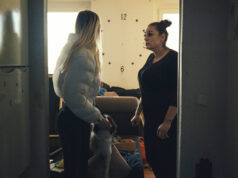
In the film, Hay (in lockdown in Texas) directs her performers online. She shows on a huge screen, like a deity, her eyes following the movements of the dancers in Stockholm. She also gives ‘material for experiment’ to the dancers via a letter, requesting that they dance in response to a series of questions or propositions, such as ‘what if every cell in your body has the potential to perceive time passing,’ and ‘what if every cell in your body has the potential to see what your eyes see.’
Hay is genial and kind and possessing of a Buddhist-like intensity, and suggests that, “staying with the questions is a lifetime’s project and the only real value of the experiment is to keep it going, even if you are the only witness to your dancing.” Within the immediate context of the film this is especially telling, as the final dance, when eventually performed, is not witnessed by the technicians in the theatre, who were asked to leave. Most pertinent is that it was not even recorded for the purposes of Lindeen’s film. The only witnesses to the performance were the dancers themselves.
Lindeen, whose The Raft won Dox:Award Competition in 2018, was recruited to make the new documentary after impressing the Cullberg company with his pitch. They had received public funding for the performance and wanted to create a permanent and creative record of the event (even if this did not include the actual performance). The director had previously made the short film Dear Director in response to a letter written by a fan to Ingmar Bergman, and so he understood the power of the letter motif and its potential as a narrative framing device, something he felt was necessary to apply to his new film, given the ephemeral and abstract nature of the dance form he was describing.
Hay herself is a supremely intelligent woman whose pronouncements on dance could have been lifted from any philosophical tome, and in archive we see a hapless interviewer floundering as she fails to comprehend the choreographer’s flow of words. Director Lindeen was also admiring of her intellect, even if their approaches to artistic expression differ radically.
“I read her books and sometimes I had a hard time grasping her universe because she’s really thinking about art in a very different way from how I was thinking about it,” he says. “My approach is so much more storytelling and narration and hers is almost like Buddhism…it’s more spiritual. It’s like being more in the body, like in a kind of state of being, it’s almost like meditation. Like, you try to trick your system to create new form or new patterns, new movement to kind of force yourself into not making the same patterns.”
The challenge was therefore to transpose her particular aesthetic to the medium of film. Dance is, of course, a sublimely cinematic subject, with movement, grace and vigour. All this is in evidence during the practice sessions that Lindeen shoots, rendered even more dramatic with the giant figure of Hay in attendance on screen. He also sources fascinating archive of Hay’s brilliant performances over the years, and in interview. What’s more, he records personal testimonies from some of the dancers, which are touching and instructive. One dancer misses the sense of touch as a result of isolation. Another talks of the dancer’s vulnerability in ‘surrendering to the potentiality of what could happen’. Yet another remembers dance as ‘escape’ when she was performing as a young girl before Communist Party dignitaries in Poland.
Lindeen himself explains why this project took on particular importance during lockdown. “I think to me it’s been more the existential dimension of creating art,” he says. “To be curious about what it is to be an artist. I mean, that sounds very grand, but it’s like to say that it can be something almost spiritual… to see other dimensions when you start to look beyond just seeking gratification from an audience.”
Which is why his curiosity was piqued by Cullberg and Hay’s proposition. “We think that we need the audience, but if we take them out, [then] what does the practice of art mean to us?” he ends.