Photo: Ville Hakonen ®WackyTieFilms
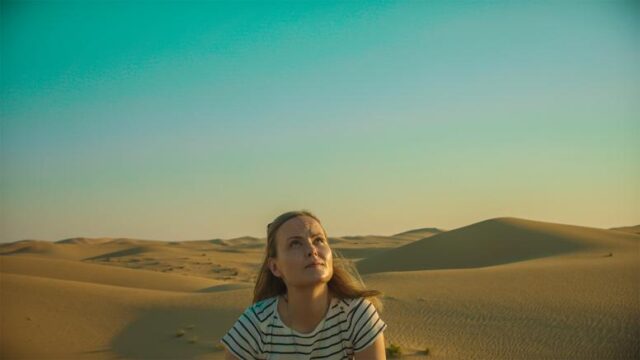
When Finnish filmmaker Tuija Halttunen looks up at the clouds, she sees herself. As she explains, “I strongly feel that I am part of this world in physical levels in many ways. Clouds have a life span like we do. We can see a summary of our choices during our lives in those clouds. They are combination of tiny, tiny droplets. I wanted to get into the film somehow this idea that every choice we make has a larger impact.”
That poetic metaphor inspires one aspect of her feature documentary How to Kill a Cloud, which has its world premiere in the Nordic:Dox Competition at CPH:DOX. The film follows Finnish scientist Hannele Korhonen as she takes part in an ambitious rain enhancement project undertaken by the United Arab Emirates.
The film explains the science of clouds but is much more about human stories — how Korhonen is a fish out of water as a female scientist working in the traditionally male spaces of the UAE and the science world; and examining the human ethical dilemmas of geo-engineering.
Director Halttunen has been fascinated by clouds for more than a decade – she randomly picked up a book about clouds to read on a long train journey years ago – but it wasn’t until she heard about Korhonen’s work that she knew how to explore clouds on screen. “What really struck me is that of course it’s about clouds and science and ethics but it’s also about this woman in this very male world, in the UAE and in the scientific community.”
“Even more fascinating than the scientific journey is exploring the ethics.” she adds. “I think that’s something I try to do in all my films, I look at ethics and also like to explore how power affects people,” says the filmmaker, whose past credits include shorts Bandage and Heaven and Earth as well as features In The Depths of the Mind and the Prix Europa-nominated Neighbours.
How To Kill A Cloud questions the ethics of a rich territory like the Emirates having the money to manipulate clouds and increase rainfall, potentially taking water away from another place. The director asks, “Is it the scientists’ responsibility to take account of all the questions or just make the science?”
She found some interesting parallels with rain enhancement science within the film world “Who is paying for scientific research, who is paying for a film to be made? Do we have to take account [of] possible consequences or just fulfil our ambition?”
“We humans have to explore, it’s in our nature,” the filmmaker continues. “Science is a very human thing and of course we don’t want to stop that. I’m not against science.” But she does fear for the consequences if there are no international regulations to prevent abuse. “I think the only way to handle research like this with the atmosphere is to create international rules and regulations that everyone has to obey, because as often happens when people invent something, it tends to end up being a weapon and a means of getting power or control over others and of course that truly worries me.”
Incorporating enough science about clouds and the atmosphere but not going too far into the detail to lose a general audience “was a tricky task,” the director says, with which she was helped by editor Jussi Sandhu. “In the beginning I knew I wasn’t going to make a science film, but you do have to tell something of the science. But if we went too far, the audience wouldn’t understand and would be falling asleep. It was a balancing and we took a long time in the edit.”
The film, produced by Niina Virtanen, Ulrik Gutkin and Pasi Hakkio for Tampere-based Wacky Tie Films in co-production with Copenhagen Film Company, was part of dok.incubator and previously pitched at IDFA Forum 2019. Backers include the Finnish Film Foundation, AVEK – The Promotion Centre for Audiovisual Culture, The Church Media Foundation. Rise & Shine World Sales handles international sales.
The film was shot over three years in Finland, Vienna and in the UAE. It took a persistent Halttunen over a year to get the necessary permits to shoot in the Emirates. There were sometimes strict regulations to what she could shoot and how (especially outside of the science conferences), but she notes that “everyone in the UAE was very polite, they were very, very nice to us showing amazing hospitality and everything was well organized. We appreciate the co-operation the rain enhancement program showed us.”
Halttunen hopes the audience for the film will come away feeling as connected to clouds as she is. “I want them to see clouds differently… I would be very happy if people see and ponder the ethical questions, but I’m glad in the end if they can relate the story to themselves, and think about their own choices and their own ambitions and where their choices leave them.”