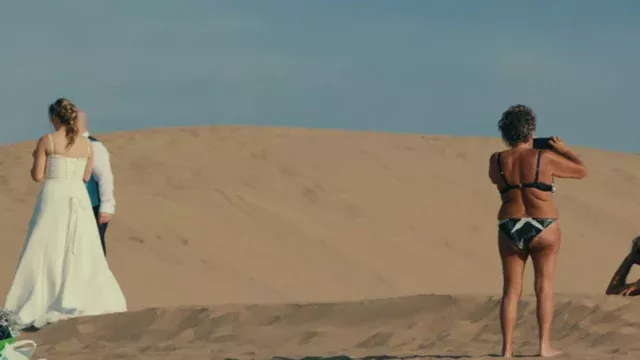
It’s a good subject for a documentary: the different groups that populate the holiday island of Gran Canaria. Especially those who are not part of the four million short-term tourists visiting the eternally sunny paradise each year. Even the volcanic eruption threatening the Canary Islands during filming doesn’t really disturb the life of Gran Canaria’s residents.
There are the long-term residents, and there are the people who work there. There are those who spend half a year on the island (and half a year off), and there are the members of the LGBTIQA+ community who find a warm welcome here. And then, after little over half an hour, a boat full of African refugees arrives. It’s a shock, after having seen the island and the story so far presented in such a different light. I was therefore more or less expecting the documentary to take a turn here, examining the confrontation between these two very disparate groups, one flying south, one boating north, both seeking, in one way or another, a better life.
Instead, Danish director Mette Carla Albrechtsen shows us former refugees who are now working in the island’s tourist industry. It’s a rather hopeful picture, suggesting Gran Canaria can absorb whoever lands on its shores.
Albrechtsen interviews a migrant who smiles as he tells how his mother didn’t want him to leave because she feared for his life crossing the ocean, but he made it anyway. Another migrant tells of his own fears at sea, the small boat dwarfed by waves “like hills” crashing down on them. But he also made it, and now he sweeps the terrace before the next group of tourists arrive.
These little vignettes are sensitive and I would have liked to see more of them.
The first time we see the refugees arriving, however, is filmed in a much more distant and impersonal way. The camera is static, presumably on a tripod, and the frame is relatively wide. One by one, African migrants disembark from the boat, being met by border guards all dressed in white full-body suits, their faces fully covered, their eyes behind plastic shields. It’s a hygienic precaution, but also a shockingly inhuman welcome for people who’ve just narrowly escaped death and are, at least some of them, severely weakened.
Such framing can be seen as emphasising the impersonal, distanced, clinical reception these refugees are given.
And the fact that this same kind of framing is used throughout A Place in the Sun can at least partly be justified as creating an a priori equivalence between all the groups portrayed in the film. So that there is no judgement or hierarchy, only observation.
Still, it’s a stylistic choice I’m generally hesitant about. I’ve stated before in these pages how such an a prioristylistic rigidity can undermine a documentary’s own humanity. If you’re always at a distance, always removed, framing your subject preferably from head to toe, and often solitary or at least in rather empty environments, it becomes like watching a stage, a play, something slightly removed from our reality and somehow inherently slightly absurd.
Why this last effect occurs is an interesting question and not one I can fully answer here now. But it suffices to look at the framing of the three great Northern European auteurs of sad yet humorous absurdity, Roy Andersson, Aki Kaurismäki and Alex van Warmerdam, to see how strong this effect can be. It’s as if this distanced, static camera position, combined with a relatively bare mise-en-scène, automatically caricatures whatever it captures.
And I don’t think that’s what Albrechtsen set out to do. The interviews, at least, feel warm and friendly. These are people who are happy to share their situations with her – even painful ones, where coming to Gran Canaria was more of a negative choice, fleeing failure or violence.
But when the opening image of the documentary shows a lone, middle-aged, nude man, slowly gathering his things on the beach, with rows upon rows of deserted beach chairs, until he wanders off into the distance, it feels as if we’re entering Ulrich Seidl territory. Now with Seidl, there is always something he wants to expose or uncomfortably confront the audience with about his subjects. But, crucially, he is well aware of the potentially ridiculing effect of this technique – indeed, he is often accused of it, in my opinion usually unfairly – and counters it with his so-called ‘Seidl tableaus’, images in which his documentary subjects look back, straight at us, owning their own bodies, spaces and attitudes, and owning the fact they are being filmed.
A Place in the Sun lacks such a sense of recognition of the distancing effect of its stylistic conception, which the director in the press notes describes as filming ‘what an alien would experience if it landed on the beach (…) and just looked at the human race’. I think she has succeeded in doing just that, but the result inevitably feels as if we, in that alien position, are removed from her subjects’ humanity.
I still have the impression of having got a good overview of the atmosphere of Gran Canaria and its social make-up, and I also still think it’s a fine subject for a documentary. But I would have preferred more interviews and a less alienating cinematic approach.
Denmark, 2024, 80 minutes
Director Mette Carla Albrechtsen
Production Bullitt Film, Tambo Film
Producers Rikke Tambo Andersen
Cinematography Frigge Fri, Maria Von Hausswolff
Editing Charlotte Munch Bengtsen
Sound design Lars Wignell, Gustaf Berger
Sound Lars Wignell, Andreas Mellkvist
Music Hans Appelqvist
With Danny Bjørn, Birgitte, Marta, Eugene, Vlad, Frank & Eva, Sulaiman, Papi