A spectacular delve beneath the Greenland ice sheet, Lars Ostenfeld’s memorable film Into the Ice (Rejsen til Isens Indre) – which opens this year’s CPH:DOX – is both a treat for the eyes but also a wake-up call (if one were needed) for the scale and consequences of the climate crisis.
By focussing on three leading glaciologists whose work is to gather and analyse important data that will help us understand exactly what we’re dealing with (and where, indeed, we need to go in the face of rising sea levels across the globe), the film is an often visceral journey into an icy world that can offer up many answers….though perhaps mainly worrying ones.
The film opens with a glorious overhead shot of ice-blue meltwater rivers flowing through a barren landscape. In the voice-over, Ostenfeld syas: “The Greenland inland ice harbours a secret – you can see our future in it…meltwaters form every summer and disappear every winter. Water vanishes into a hole called a moulin believed to continue hundreds of meters vertically into the ice…and that’s where I’m going…”
The director is in search of answers as he sets out with three of the world’s leading glaciologists: Alun Hubbard, Dorthe Dahl-Jensen and Jason Box. Each venture beneath the ice in a different way and each offers the filmmaker an illuminating, enthralling and provocative glimpse into a chilly world rarely encountered, given the tendency of other scientists to rely on satellites and technology rather than old-fashioned exploration. Ostenfeld adds: “We know ice is melting and the seas are rising…we all know that. But how fast it is happening, no-one knows, even though that may be the most urgent question to answer right now.”
First up is American Jason Box, an internationally esteemed glaciologist and professor at the Geological Survey of Denmark and Greenland, and based in Denmark. He prepares his tent in his apartment with the help of his young daughter, but out in the ice he drills deep through the surface as he develops his hypothesis that some of the mechanisms of global heating are also counteracting the loss of ice and rising sea levels. With rich irony, during a two-day wind storm he shelters in his tent with an open copy of Frank Herbert’s Dune by his side.
His small-scale operation is a juxtaposition to Danish Dorthe Dahl-Jensen, a world-renowned figure within glaciology and climate research who, with her extensive team, has carried out specialised drillings with the purpose of retrieving ancient ice. Analyses of this ice have brought invaluable knowledge about climate change throughout the past 100,000 years, and this knowledge is crucial if scientists are to predict the consequences of climate change in the future.
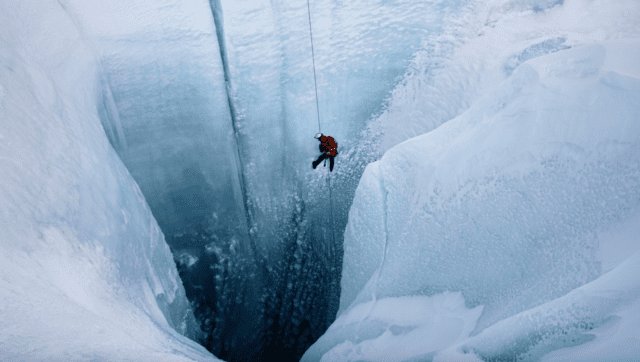
At the half-way point, though, the film heads into more adventurous territory as Ostenfeld joins British professor in glaciology Alun Howard who is leading a study aimed at proving for the first time that the melting of the Greenland ice sheet is caused not only by rising temperatures but also by excess late summer rain. Dropped from a helicopter onto the Greenland ice sheet, Howard, along with Claus Kingsgaard, a former pilot in Royal Danish Air Force and head coach in Artic survival, and Ostenfeld, look to explore a large moulin to explore the ice-melt theories.
Howard explains why there have been no extensive physical observations of moulins. “They are quite strange and intimidating places to go,” he says. “Inside every glaciologist – or most field glaciologists – there’s a bit of an adventurer…and this is what it is about for me – the beauty of ice and glaciers and studying them.”
As the scientist starts to descend the moulin on a rope, he laughs how ‘it is a big fucking hole,’ before admitting that he isn’t too sure how deep it actually is. And as he descends he describes the beauty of the icicles. The next day Hubbard and Kingsgaard decide that weather is too warm to allow Ostenfeld to join them, but with Kingsgaard filming they descend some 180 metres. It is the “longest descent I have ever done,” says Hubbard. It is genuinely incredible, the most beautiful space, like nature’s own cathedral, temple or shrine.
But while the views are quite beautiful, the science is, of course, worrying. As Ostenfeld concludes: “We must listen to the scientists, those who say we have no time for hesitation. Nature is trying to tell us something.”
Denmark, Germany, 2022, 86mins
Dir/scr: Lars Henrik Ostenfeld
Production: Hansen & Pedersen, Kloos & Co. Nord, Danish Film Institute, Filmfyn
Producers: Malene Flindt Pedersen, Stefan Kloos, Signe Skov Thomsen
Cinematography: Lars Henrik Ostenfeld
Editor: Marion Tuor
Music: Kristian Eidnes Andersen