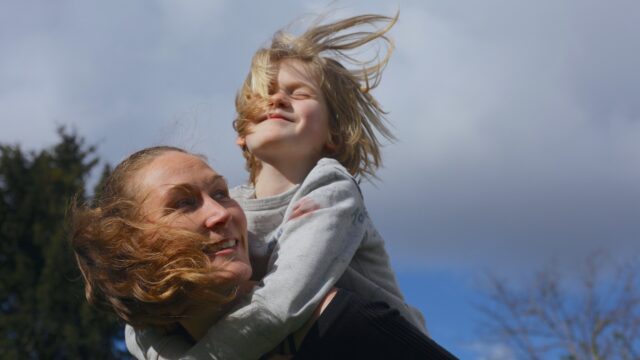
A warm-hearted and delightfully moving mother-and-son story, All That Remains To Be Seen (Mod de blindes verden) manages to be both informative and gently uplifting as it details the story of a blind mother and her seven year-old son whose own vision slowly starts to fade, a new and challenging life opening up before him.
Director Julie Bezerra Madsen tenderly engages with the blind Christina Nahnsen as she reaches a challenging point in her life. The film opens with her at a dance where she is at ease on the dancefloor with various dance partners. Later, out on the street, she seems equally at ease navigating her route with the use of an illuminated cane.
She is not completely blind, but her eyesight is extremely minimal. And the eyesight of her seven-year-old son Silas is also diminishing. He is a boy full of energy and enthusiasm, happy to playfully help guide her through bustling streets (“oops” he says as he almost leads her into a wall) and keen to defend her from other children who mock her.
Tearfully she says to a friend: “I just don’t want him to feel abnormal. We were the same age, Silas and I, when we were diagnosed…I was ousted and bullied…and no one wanted to hang out with me anymore.”
The film follows this delightfully connected mother and son as he takes his medicals tests, has fun with friends and does his best at school. The pair talk to other children and parents and he explains: ”So it’s kinda like there’s a murderer inside my eye, killing that thing called the retina piece by piece. And when it’s all dead, everything is black.” Kids then wear darkened goggles to have a sense of what life is like for Silas.
The film asks plenty of questions. Christina wants to do everything she can to help her young son in his gradual transition towards sightlessness – but how? And how do you create a good life for yourself in spite of visual impairment? She has tried it herself, and chooses from experience to give him as many unforgettable experiences as possible while he can still see.
Together they learn from each other how to navigate a world of people, obstacles and roadblocks. But there’s also a lot of emotional work ahead of them as Silas’ vision fades. And so she tries to prepare him for a new life in which he will have to rely on his other senses, but which is still a life of dance and travel and love.
Together they go on trips. Whether it is whale-watching (she advises him to stay near other adults with children as they will point out when a whale emerges) or wandering by waterfalls, where the sound and spray offer a tangible sense of the natural beauty.
She is naturally proud of his development and ability to adapt. Medicine and social awareness has changed and he seems able to adjust more to his changing situation more easily than she did years before. He is delightfully self-contained – playing with other children on a climbing frame he explains why things may be harder for him. “I have a visual impairment,” he calls out.
Julie Bezerra Madsen’s sensitive and poignant film is about a very special kind of mother-son relationship as this pair are uniquely bonded together. As he calls out to his mother as they walk along a pathway together: ”Rule number one…fuck what they think!” She warm-heartedly repeats: ”Rule number one…fuck what they think!”
The film is elegantly and compassionately made by Madsen, and special credit should go to Janne Laine for her sound design work. In the credit block there is a special mention for Silas’s classmates…where engagingly one Heidi Halgred Jensen gets two hearts next to her name.
Denmark-Finland, 2022, 71mins
Dir: Julie Bezerra Madsen
Production: Good Company Pictures, Avanton Productions
International sales: DR International Sales
Producers: Sonja Lindén, Katrine Sahlstrøm
Cinematography: Julie Bezerra Madsen, Mads Kongerskov
Editor: Signe Rebekka Kaufmann
Music: Laurits Hyllested
With: Christina Nahnsen, Silas Holm Sorensen