Picture courtesy of CPH:DOX
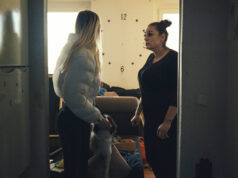
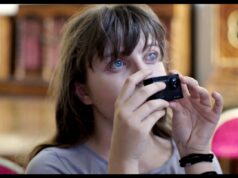
British filmmaker Ben Rivers and French musician and artist Félicia Atkinson are yet to meet in person – but audiences at CPH:DOX last week enjoyed an unusual collaboration between the duo. Atkinson provided new voice-over and musical accompaniments for two of Rivers’ films, Urth (2016) and Look Then Below (2019). The soundtracks were performed ‘live.’ Rivers was too busy with other work to travel to Copenhagen but he made time to speak to Business Doc Europe.
Rivers, an award winner at CPH:DOX in 2011 with his film Two Years at Sea, explains that he and Atkinson have long admired each other’s work. “I’ve listened to her music a lot and apparently she has seen my films before.”
Rivers had actually approached Atkinson when he was making Look Then Below which was shot in the catacombs of Wookey Hole Caves in Somerset. “I got in touch with her with the idea that she would make the soundtrack, the music for the film,” he remembers. “But at the time, she was extremely busy, working on a new album and various other things I think. So she couldn’t do it, but she suggested her friend, Christina Vantzou, who ended up making the soundtrack.”
Even so, Rivers and Atkinson stayed in touch. They continued discussing doing a live soundtrack to one of Rivers’ films, eventually choosing Urth and Look Then Below which were part of a trilogy of “speculative films” named ‘Urthworks’, which the filmmaker had made with American sci-fi writer, Mark von Schlegell. (The other film in the cycle is 2010’s Slow Action).
“It was a really nice way to involve her [Atkinson] in a project that she couldn’t do in the first instance – and to re-think these soundtracks. Voice is so important a part of her work.”
With Urth, Rivers gave Atkinson full licence to completely “re-do the soundtrack, including the words.” He presented her with the film file without any sound, trusting in her skills and judgement. “She has this very nice French accent, speaking English in these quite whispery tones. They [the words] really merge with the musical sounds.”
In Look Then Below, there were a few more restrictions. This had been a challenging film to shoot for the obvious reason that the caves are very dark. Rivers was working on 16mm film with very sensitive shots and very slow frame rates.
“It [Wookey Hall] also has these very fun colours which I thought I would use, reds and blues and green,” the director remembers. He also tried to shoot some footage in an ice cave in Austria. “It was amazing for the eye but impossible to film,” he says of those murky surroundings. “I went back home a little empty-handed…all the ice shots in the film, they’re all actually shot in my fridge. The freezer was broken and so it kept on growing these amazing ice forms.”
Rivers made a new mix of the film for Atkinson, getting rid of all the music and most of the layers of sound but kept certain elements including poems that had been performed by a choir in the Somerset caves. “And then Felicia had that soundtrack which she would work with and add on top as she saw fit…in practical terms, I was really happy to give over to Felicia and let her do her thing.”
Rivers is hoping to bring the ‘live’ versions of the films with the Atkinson soundtracks to the UK.
The director’s experimental films blur the lines between fiction and documentary – one reason why they turn up both at doc events like CPH and at festivals like Locarno and London.
“I am happy to show it [the work] in documentary festivals…I’ve done so for years,” Rivers reflects. “[But] for me, I make films. Other people put them in their relevant boxes. It’s quite nice if you can straddle different worlds because then it helps the films move around and opens up these questions of what is documentary. I’ve always been in that school of thinking that everything is a documentary – and everything is a fiction.”
He cites an old quote (which he thinks may come from Jean-Luc Godard) that a “fiction is a documentary of a film being made.” Rivers also points out that documentary was defined in the days of Scottish documentary guru John Grierson as “the creative use of reality.” In other words, he doesn’t feel burdened with a responsibility to represent reality in a slavishly naturalistic way.
Rivers’ work is handled in the UK both by distributors like Anti-Worlds and by art institutions. His films are supported by international arts agency LUX.
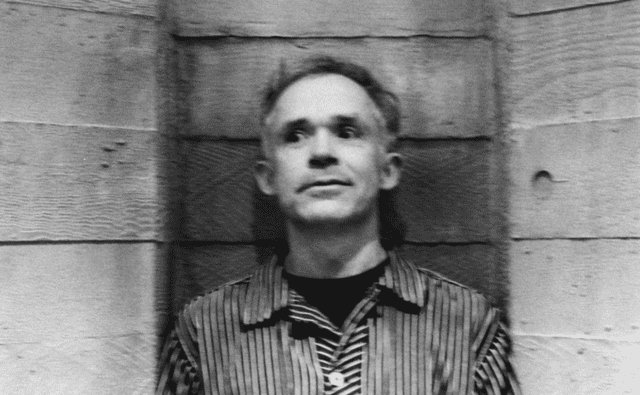
Now, the director is working on a loose follow up to Two Years At Sea, which was about Scottish hermit Jake Williams, who has been living on his own in the middle of Clashindarroch Forest for well-nigh four decades. “I’ve stayed friends with Jake…we’ve talked about making another film for years. Then 10 years came around [since the original] and we thought it was a good idea.”
The project, which is in the process of being financed and which has the working title ‘Bogancloch’ (taken from the name of where Jake now lives), was a Kodak-Silverway prize winner at FIDLab Marseilles last year.
Rivers also has another film planned, Mare’s Nest, about a group of kids living in Menorca. “And there are no adults left living in the world, just anarchic children performing avant-garde plays…” he explains a project he has written and which has a flavour of Lord Of The Flies.