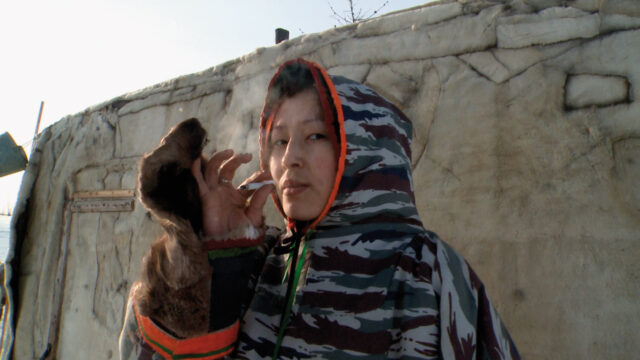
It’s so much bigger on the inside. On the outside, the nomadic sleigh cabin on the endless snowy plains of northern Russian, looks small. About the size of a car. It’s grey, patched with cloth. One tiny window, one rickety door. It looks too small even for one person, but Ivanna lives there with five children – her good-for-nothing husband is staying in a town nearby (where he drinks too much and gets into fights). Her smallest child is still a baby. Seen from the outside, it just wouldn’t seem to fit. For a short while maybe, but not for a life.
But on the inside, although it’s tight, it all makes sense. The children are completely used to running around the red-hot stove, playing with knives and lighting matches – although I held my breath more than once. And Ivanna manages to fit everything in: eating, sleeping, cooking, washing and playing. It is cramped, objectively speaking, but also warm and cosy.
But when a snowstorm rages, the effects are reversed. From the outside, the small cabin now looks like a rock, firm against the howling winds. Inside however, the whole house is shaking and looks ready to be ripped apart. The children however don’t seem to mind. Although one of them does decide to distract the baby by shouting a song into its face, over the storm’s deafening roar.
Scenes like these have a great sense of presence. Filming is unhurried, allowing the eye to wander, seeing their possessions, seeing the way life functions within this traditional dwelling of the nomadic Nenets people, and appreciating the many textures that make up the closed space – which is flooded by blinding light (and one assumes biting cold) every time the door opens and another child enters or leaves. We get to feel Ivanna’s existence, in this location, in this family, before we hear the first of the relatively few descriptions she gives of her life in voice-over.
This is her life – but is this all there is to it? Ivanna is a stern mother who constantly keeps everyone in check, managing to run a household under harsh conditions and with little money. But she is also a strong and lively presence, who loves to sing and who questions tradition. She drives a sleigh better than us men, says a Nenets man appreciatively to his young son, as Ivanna steers the reindeer through a sharp bend. She radiates a strength and energy for which her life seems too small.
She seems bigger on the inside.
Ivanna had to leave school at fourteen, when it was discovered she was pregnant by Gena – father of her children. Now, her children are getting bigger, literally outgrowing the little cabin. Her oldest daughter is singing and dancing in front of a mirror and dreams of going to a disco. Meanwhile, the nomadic life no longer seems economically viable. Not enough reindeer, not enough money. Ivanna has to make a choice.
The pressure to leave for the city, to send her daughter to school, to let her have the life that Ivanna herself had to leave behind, is too strong. But it is also something Ivanna dreams of for herself. Having their own apartment, a regular life. As a viewer, I feel little doubt that she would manage no matter what situation she would find herself in. And that, if only life would put her somewhere which is right for her, she would thrive. I’m not sure she is already there as the film ends, but Life of Ivanna shows that she will not rest until she and her children are where she wants them to be.
Director Renato Borrayo Serrano (Film for Carlos, 2017) has chosen an interesting variation on the traditional approaches of cinéma vérité and Direct Cinema. He doesn’t interview Ivanna (although he does film some conversations she has with others which may have been instigated by the crew), but he also doesn’t pretend the camera isn’t there. Although we never hear crew members speak, there are many small moments where their presence is acknowledged – especially by the show-stealing children, who steal a glance or simply walk up to the camera to show something or dance in front of it. This gentle breaking of the fourth wall in an observational documentary actually pulls us in even more, I believe, by strengthening our sense of being there.
Serrano’s film follows the adage that the best way to learn about people in general is to look at one person very carefully. Because the deeper you look inside one individual, the more of the outside world, and of all people, and all of life you’ll find reflected. For life is so much bigger on the inside.
Russia/Norway/Estonia/Finland, 2021, 80 minutes
Director Renato Borrayo Serrano
Production Ten Thousand Images, Baltic Film Production, Illume Oy, Ethnofund Film Company
Producer Vladislav Ketkovich
International sales CAT&Docs
Script Daria Sidorova, Renato Borrayo Serrano
Cinematography Daria Sidorova, Renato Borrayo Serrano
Editing Inge-Lise Langfeldt, Renato Borrayo Serrano
Sound design Israel Bañuelos
Music Timo Steiner
With Ivanna Yaptune, Yaroslav Yaptune, Yulianna Yaptune, Andrian Yaptune, Aleksandr Yaptune, Efim Lyrmin, Aleksandra Momde, Gennadi Yaptune