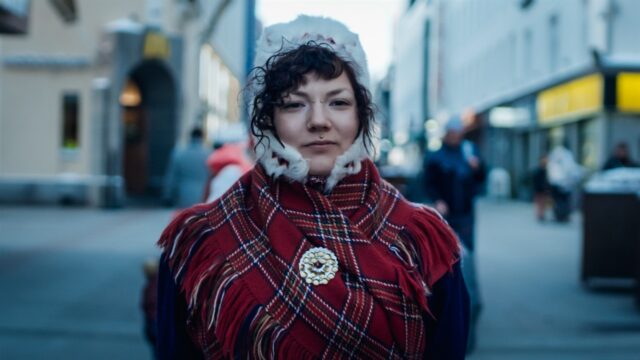
Finnish director Suvi West didn’t just want to tell the story of the mistreatment of Sámi people in Finland – she felt the need to tell it, she explains to Business Doc Europe. “I felt like I didn’t have any other choice,” she underlines of her film selected for the Hot Docs/EFP Changing Face of Europe programme.
“This film started five years ago. The political climate had gotten so hostile, there were a lot of decisions being made that threatened the Sámi culture and Sámi societies,” she explains. In fact, she was meant to be working on another project but abandoned that to make Eatnameamet (Our Silent Struggle).
“I wanted to bring knowledge to people so they could understand the situation more,” West explains. “In the Finnish school system, they aren’t teaching about Sámi people, they don’t want to deal with the history.”
West calls Eatnameamet her “most openly political film”; it examines the complicated history and current relations between the Finnish government and the indigenous Sámi people. The documentary doesn’t only look at historical, colonialist wrongs over hundreds of years, but also examines troublesome events taking place today, including the Finnish government working on a new law regarding the Sámi Parliament. (The Sámi people, who currently number about 100,000, live across Finland, Norway, Sweden and north-western Russia.)
West, a River Sámi who now lives in Helsinki, initially thought the film would be of interest mostly to Finnish viewers, but ahead of the film’s international premiere at Hot Docs she recognizes its wider themes as well. “These situations happen to other indigenous people as well, that’s universal,” she says. And it’s even bigger than that: “What’s common with all people is that we protect and fight for something that we love. That’s something anyone can relate to, whether you are a mother, or an activist, the same feeling is there.” There are also global topics highlighted in the film, such as exploitation of natural resources, over-tourism and climate change.
Janne Niskala of Oulu-based Vaski Filmi produces, and backers include the Finnish Film Foundation, YLE, Promotion Centre for Audiovisual Culture, The Church Media Foundation, International Sámi Film Institute, Kone Foundation and The City of Helsinki.
At home, West has seen the film already start to change some attitudes in Finland, after it screened at DocPoint and Tampere. There has been an active social media campaign led by impact producer Emmi Nuorgam and, West adds, “Finnish media is giving us a lot of attention, which doesn’t also happen a lot…We have received a lot of support and love from Finnish viewers, which is really important.”
After shooting for five years, she had a wealth of material and pays tribute to her editor Markus Leppälä. “I needed a Finnish editor with fresh eyes to help me see what is important and what is not.” (She should also rely more on her own “intuition” of what to include, she says.)
West shot so much material (she had 80 hours of footage and interviews) that she is now preparing a series that will use more of the material. “It will be a small mini-series that I want to give back to the community,” she explains.
West, who is also researching her Masters’ thesis about Sámi representation on film, made sure that the film’s visual style didn’t continue the practice of “othering” the Sámi. “I wanted to focus on the activism, the politics, not showing Sámi people with their reindeer doing a joik [traditional song].”
In addition to going into usually-closed political meetings, the film also includes some stunning footage (Anssi Kömi serves as cinematographer) showing the amazing lands where Sámi people live. “I wanted to show what this whole thing is about, it’s not just about who can wear the Sámi dress. If you talk about Sámi rights you have to talk about the land rights. When we talk about colonialism, it’s also about land and water and protecting that for the next generations.”
West’s past films include Me and My Little Sister and Under Two Skies as well as creating the TV comedy Märät Säpikkäät — all of which touch on her Sámi heritage. Up next she is working on both fiction and documentary projects, the latter offering a more personal angle on topics introduced in Eatnameamet. “This film is the truth part. I hope the next part is more about reconciliation.”
Eatnameamet is one of the ten films selected for the Changing Face of Europe programme at Hot Docs, organised by European Film Promotion.