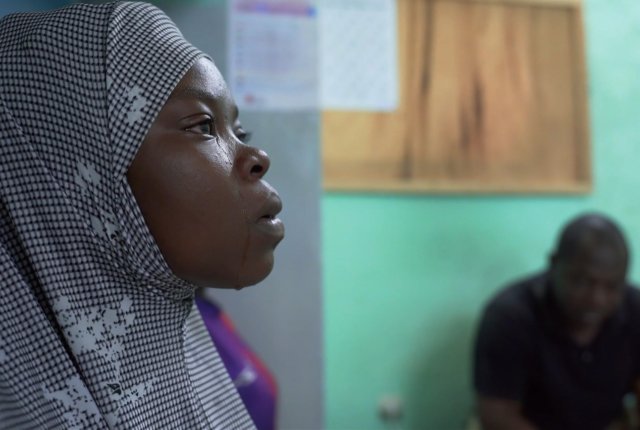
The Last Shelter is both heart-warming and heart-breaking in telling the story of the House of Migrants, a shelter for stranded African travelers in the Malian city of Gao. The film also reflects on the many wars in Africa (without mentioning them explicitly) that cause the enforced and ongoing diaspora. In this home for the homeless, lives touch each other in passing, dreams are crushed or revived.
Filmmaker Ousmane Zoromé Samassekou dedicated his film to his uncle Amadou, who left his home 32 years ago without leaving a trace. But in the first scenes of the film the director does find a trace: a rusted sign in the ground near the shelter indicating Amadou Boubacar who died here in 2006. With the help of the inhabitants of the House of Migrants, a new grave is made, in bricks this time to keep the memory alive.
It is a cathartic moment for the director before he turns his camera on his protagonists: two girls from Burkina Faso who have just arrived at the centre with their backpacks and a firm belief in a better future in Europe. We follow them into the basic building, where they are appointed a room before even being interviewed by the staff. You can tell they’ve already been through a lot, as they are unwilling to disclose even the most basic information. Only after the house co-ordinator Eric Alain Kamdem tells them about the experience of a fellow traveller – who was sold in Algeria for sexual services by someone she trusted – do they seem to grasp the seriousness of their situation.
Esther is sixteen years old and the one who opens up most – she tells how she left her dysfunctional family and home with a solemn oath never to return. Her story is revealed in fragments as the quietly observing camera, held by Samassekou, watches her in her room with friend Kadi, lying on their make shift beds, trying to learn English and making friends with Natacha who has been here for five years.
The camera also captures the activities of the living room, where people hang in front of the television, offering them a window on worlds far away – such as WWE wrestling or a nature documentary on Canal +, showing birds and their enviable ability to travel effortlessly wherever they want to go. The inhabitants of the shelter are stuck in their lives, waiting for something to happen: a convoy taking them home, or a smuggler taking them to their dream destination. The waiting creates an almost serene atmosphere, which is sensitively captured by Samassekou, not only through his close-ups of Natacha playing herself at chess, but also in the beautifully composed shots of corridors, windows and stairs.
Apart from the people living and working in and around the House of Migrants, the director creates space for another silent but unavoidable protagonist: the Sahel dessert, always lurking in the back of the travelers’ minds as a literal obstacle to overcome, but also serving as a metaphor for the almost impossible challenges these people have overcome. The smugglers brag about how they have conquered the monster, with a hand drawn map to show for it.
Samassekou presents the desert in all its beauty, vastness and deadly unpredictability – he lets the sun rise over the golden sand, camels walk in sloping sand dunes, a ripped shirt clings to a lonely, dust-covered bush and a sand storm wipes out all the light and signs of life. The incredible shots of the desert are at times accompanied by voices of the migrants, at other times by an ominous soundtrack.
The Last Shelter puts a face to the vast numbers of displaced people in Africa, without adding unnecessary drama or delivering an overstated message. The lyrical film allows you observe people slowly gaining trust, making friends and finding the energy to try and make some of their dreams come true. In the end, Esther decides she wants to travel on, despite the very visible dangers lying ahead. A testimony to human courage and the need to dream.
France, Mali, South Africa, 2021, 85’
A Generation Africa Project
Written and directed by Ousmane Samassekou
Cinematography Ousmane Samassekou
Sound Adama Diarra, Jean-Marc Schick
Editing Céline Ducreux
Original music Pierre Daven Keller
Producers Estelle Robin You (Point du Jour – Les films du balibari) Andrey S. Diarra (DS Productions), Don Edkins, Tiny Mungwe (STEPS)
Produced by Point du Jour – Les films du balibari
In co-production with DS Productions (Mali) STEPS (South Africa) Arte GEIE
International sales: STEPS – South Africa