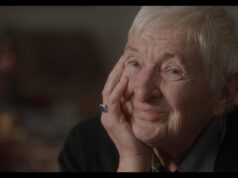
As she faces up to her terminal illness, award-winning documentary maker Heddy Honigmann takes a change of pace and tone, and embarks on a spiritual journey into her past. The film may may eschew organised structure but it nevertheless serves as a remarkable farewell that is gently moving, but never maudlin, allowing her to fully reveal the woman who has, in previous works, remained so often behind the camera.
Accompanied by her loyal husband Henk, and with a small team that also includes her son Stefan van de Staak, she heads back to Peru, the country of her birth, to revisit people and places that have been so vital to her life, and along the way also revisits many of her acclaimed films. The journey finds room for humour and compassion along with tears and frustration, but ultimately helps weave together a generous and life-affirming film.
Told by her long-time producer Pieter van Huijstee that this film will see her as both protagonist and director, she admits that she has never known so little about what one of her upcoming films would be about. “You ask me what I’m doing,” she says early on. “I don’t know.”
But there is a clue to this in the title. It forms part of the Antonio Machado poem. “Caminante, no hay camino, se hace camino al ander,” which translates as “Traveller, there is no path to follow, you make your own way as you walk.” In essence, the film’s story will be found in the journey.
In Peru she sits with her sister amidst photographs of their parents and grandparents. Their Jewish father Victor was born Witold Honigmann Weiss in Vienna, Austria, and escaped the Mauthausen concentration camp in 1942, fleeing to Russia. He eventually moved to Lima, Peru, in 1954 and went on to become an acclaimed comic book artist, creating ‘Supercholo’, one of the country’s best known comic characters.
As they chat, Heddy finds that her sister doesn’t want to be drawn into discussion about Victor. Heddy says: “He was a horrible man because he had gone through horrible things.” But, often surprising to her, as she chats with friends she knew as a child it seems they often had a different perception of him. Her memory of old friend Lolli is that her father banned him from playing with her, but according to Lolli he saw Victor as a second father.
She meets with school friends, wanders (by wheelchair and walker) the seafront of Lima and even manages to find her old family home with the help of a driver…only to find that the woman running the house won’t let her in for a final look. She talks with friends and students about many of her films, such as Metal and Melancholy, Crazy, O Amor Natural and The Underground Orchestra, and observes the links and references to her life. She meets up with actress Johanna ter Steege, who starred in her 1995 drama Goodbye, with footage charmingly recreating a classic scene of her on a bicycle.
The film sees her return to the Netherlands, the country where she has spent most of her adult life, having become a Dutch citizen. She and her son visit hospital and she admits to tiredness. Rather delightfully, as she chats in her home she turns to her son Stefan, who is behind one of the cameras, and asks him if she has been a controlling mother. But while she admits that cancer is a challenge, she seems most happy in a shot of her and husband Henk sat on the sofa, both engrossed in their books.
Recipient of the Hot Docs Outstanding Achievement Award in 2007, Heddy Honigmann has delivered her most personal film to date. As she confronts her complicated familial past and revisits her films, No Hay Camino sees her take part in a delightfully unplanned meditation on life, family, art and relationships. Her delight in asking questions and finding truths still shines through and helps make this latest – and perhaps last – film rather special.
Netherlands, 2021, 92mins
Dir Heddy Honigmann
Production Pieter van Huijstee Film, NTR
Producer Pieter van Huijstee
Screenplay Heddy Honigmann, Kristien Hemmerechts
Cinematography Adri Schrover
Editor Ruben van der Hammen, Jessica de Koning
Music Florencia Di Concilio