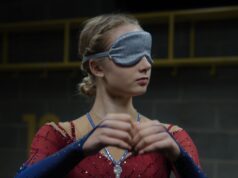
Because The Other Profile, which has its world premiere in CPH:DOX Dox:Award competition, is a documentary thriller, with some satisfying twists and turns, reviewing it presents some problems. Any spoiler of a twist, any revelation I reveal, will diminish your enjoyment of the thriller elements. I will proceed, therefore, as carefully as possible.
We start the film – so no spoilers here – with our director, Armel Hostiou, showing us a fake profile created in his name, using his photos, by someone in Kinshasa. This person organises auditions in the Congolese capital as ‘film director Armel Hostiou’. Exclusively for women, it seems. And apparently with no intention of ever making a film.
Next – still no spoilers – we are in Kinshasa, where our director has just arrived, camera in hand, and where two members from the artists’ cooperative Ndaku Ya La Vie Est Belle – Peter Shotsha Olela and Sarah Ndele – are willing to host and help him. The latter in particular is a winning presence, with her laid-back attitude and sharp, often political,commentary on Hostiou’s insecure actions. Because as he says at the beginning: he doesn’t know anyone or anything in the Democratic Republic of the Congo.
By the way, as a portrait of Kinshasa hospitality, experienced off the tourist trail while discovering this vast city, there is already a lot to enjoy in The Other Profile.
As a documentary thriller, with our director and two trusted sidekicks hunting the fake profile owner, The Other Profile delivers. We get the handheld shots from Hostiou’s point of view, who is filming all the time, and there are enough twists and turns in the story. But while we are constantly being led to question what and who is fake in this situation, this general sense of mistrust begins to reflect back on the documentary itself.
This may simply be what always happens with documentaries about deceit – if they are good, they will put you in a paranoid frame of mind. Which will eventually include the whole story and thus the film itself – which should be especially true for a seasoned audience that is trained to question anything that happens in a documentary anyway.
In this case, a lot feels ‘too good to be true’. This might partly be a question of editing. It’s easy to imagine: once one recognises the material for a thriller, it will be hard to resist bending the material to the genre rules. Which will automatically make your film both more exciting and less believable – because the timing and revelations will become too neat. What you have kneaded into shape afterwards will end up feeling like it’s been set up beforehand.
Unfortunately, I cannot be more specific here without ruining part of the fun – and it is fun – of the film. But there are enough examples, both in the general dramatic structure and in smaller, more specific instances, where you might question the plausibility of someone doing this, someone appearing there – especially when those events seem to go against their personal interests, but do move the story along.
Now for the cool part. Because I think that even if it turned out the whole documentary was a fake, I would probably still like it. I can explain why – and I won’t need any spoilers.
Let’s start with the original title, the French Le vrai du faux. It translates as ‘the true of the false’, I interpret it as ‘the original version of the illegal copy’. It’s obviously a much better title than the English one. It immediately raises the question: who is the original and who is the copy? And who is to say? “Look for the fake within. You’ll find him. He’s inside you. He exists, because you exist”, someone tells Hostiou. Therefore, philosophically speaking, Hostiou is the origin of the fake – and inseparable from it.
But it’s not philosophy that I’m after. It’s politics. As the documentary progresses, it increasingly references or comments on the colonial history of Africa and the West. Although Hostiou is French and the DRC was a Belgian colony, these remarks and situations are general enough to apply more broadly. From the start, Hostiou is introduced as naive – not only doesn’t he know anything about the DRC, he falls for obvious scams, he doesn’t recognise Diego Cão as the name of the European ‘discoverer’ (the air quotes are by Ndele) of the Congo estuary, and he often seems so out of his depth as to feel scripted. Seen thus, he represents the uninformed Westerner coming to enforce the law in Africa.
On a more serious note, the film isn’t very protective of the privacy of, for example, the women who had befriended the fake Facebook Hostiou and whose names and photos are shown and mentioned. You could argue that these are public profiles, but there are still levels of privacy involved: someone befriending someone on Facebook does not thereby consent to being featured in, let’s say, a festival screening of a feature doc. Here, Hostiou and his team represent the Western disregard for African people, specifically African women, as having fully equal rights.
Human rights make us angry, someone shouts at Hostiou. Because we don’t have them. “Human rights are for the whites, not for the blacks.”
Elsewhere, it appears Hostiou is not the only French director whose name and photos have been ripped off for fake accounts – and the fact that they only use French directors is ‘because we speak French’. Now, why is that? It’s not their original language. It’s the language they copied. But is that stealing? Is that fake? Did they have a choice?
There is a lot more talk in the film about things being ‘fake’. There are ‘fake cemeteries’ where real chiefs are buried, instead of the ‘fake chiefs’ planted in communities by ‘fake presidents’ suspected to have been installed by foreign powers. “Everything starts at the beginning,” says Ndele to Hostiou, “with the seeds. What got planted in Congolese minds, in African minds in general? What got put in their heads?” It’s colonialism, Ndele notes. The DRC is, in a sense, a colonised copy of Western concepts, politically and economically forced onto an African structure which has been severely damaged in the process. The result is something like a false profile of a country. Where what you see is not what you get. Where you can audition, but there is no film to take part in.
The fake Facebook account, profiting from the cultural capital of a French-speaking white man, almost begins to look like a decolonising revolt. A metaphor for taking back what has been and is being stolen. Even the women who are duped by it can be seen as the victims of a reproduction by colonised minds of a patriarchal economic system that was Western to begin with.
Luckily, the documentary doesn’t spell any of this out. And it’s still possible that, in the editing phase, when the documentary was being moulded into a thriller, Hostiou simply added these other scenes about fakery as interesting context, and nothing more. But I like the idea of digging so deep that you end up at the other end of something, with the whole thing turned upside down. Where the faux is the vrai, the copy is the original, and the documentary about a fake turns out to be a faked version of the truth.
France, 2023, 82 minutes
Director Armel Hostiou
Production Bocalupo Films
Producers Jasmina Sijercic
International sales Lightdox
Cinematography Armel Hostiou, Elie Mbansing
Editing Mario Valero
Sound design Amaury Arboun, Gilles Benardeau
Sound Amaury Arboun, Arnaud Marten
Music Arcan, Cromix
With Armel Hostiou, Cromix Onana Genda Cristo, Sarah Ndele, Peter Shotsha Olela