Oscar-winning director Davis Guggenheim (An Inconvenient Truth) has been in Copenhagen this week with his new feature Still: A Michael J Fox Movie, which has been screening at CPH:DOX. The film [made for Apple Original Films] tells the story of the irrepressible Fox, star of such classic 80s films as Back to the Future, The Secret Of My Success and Doc Hollywood. Fox was diagnosed with Parkinson’s in the early 1990s but carried on acting until 2020.
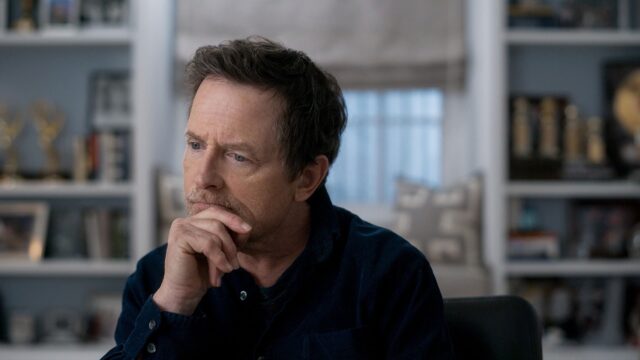
The film includes re-enactments and clips from Fox’s films and footage of him with his family, but core to the doc is a very striking interview in which Fox is filmed in big close-up.
“I had planned not to do any interviews, no talking heads,” Guggenheim remembers. But then, late on during filming, he had his “breakthrough” moment. He had been shooting a commercial (“I have to do other jobs to pay for my documentary habit,” he jokes). Cinematographer Clair Popkin (who had worked on Free Solo) had come up with an ingenious camera set-up which made it look as if the subject was staring directly at the lens – and therefore straight into the viewer’s eyes.
“I thought, wow, I didn’t know you could do that. It was so intimate…I said that’s interesting. In my 30 years [of filmmaking], I’ve never done that before. Let’s just do one day and see how it goes.”
The fearless Fox was up for it. “It became this conversation where I am pushing him, we’re laughing, sometimes we’re crying. I could see his eyes.”
In the final interview, Guggenheim asks why the actor never mentions his pain. “We were very close to finishing, and I just felt like there was something about his optimism that was running out. The film was very similar to what you see now, but without that last interview,” the director says.
Guggenheim comes from documentary making royalty. His father Charles Guggenheim (1924-2002) received multiple awards nominations over his career and won four Oscars.
When he was working on his documentaries, Charles could never have gone back to his subject in the way Davis did with Michael J Fox. It simply wouldn’t have been feasible. New technology has transformed the way documentaries are made. Now it is possible to shoot, edit and then shoot some more if you don’t have what you need.
“More than anything, he was just a wonderful father,” Guggenheim says of Charles. “I think if he saw this movie, he wouldn’t recognise documentaries at all. He’d say what! This is like documentaries from another planet because the rules have changed since he died.”
Guggenheim remains strongly influenced by his father. “What he taught me is expressed throughout everything I do. His mantra is so simple. He would always just say, ‘films are about people, They’re always about people.’”
Guggenheim Sr’s great insight was that audiences don’t go to watch docs about issues. They need the human factor. His son’s Oscar winner An Inconvenient Truth may have contained a lot of information about climate change – but it had a lot of Al Gore too. As Guggenheim puts it, “at its core, it was a story about a guy. It was a redemption story…and the way we talk about Michael J Fox in this movie is all what my father taught me.”
When he was a young man in the 80s, Guggenheim was “kind of indifferent” to Fox. He had seen Back To The Future in college and thought it was “a fun movie” and that Fox was a charming actor. (Now, he regards it as “a perfect movie.”)
When he read Fox’s memoir, his first thought was who could he get to direct a doc version of it. It didn’t seem like a natural fit for him. “But then, suddenly, I was like, wait a minute, this is perfect. I am now 59 and being someone who is frankly a little depressive during Covid, and a little bit sorry for myself…strangely, I found myself wanting what he [Fox] has. His take on life, his gratitude, I’m still trying to figure out and learn. I have everything and I don’t have a chronic disease, and I still feel sorry for myself.”
Guggenheim can’t hide his awe at Fox’s optimism and resilience.
Some critics may write about the documentary as a Parkinson’s movie but that is not at all how its director sees it. “When Michael and I started working together, he asked for only one thing and I asked for only one thing. The thing he asked for is no violins. He didn’t want a maudlin, pitying film about a person with a sickness. And I had a similar instinct. I [said] I don’t want to make a film about Parkinson’s. I think Parkinson’s permeates it, but my hope is that it is a story about any of us who confront our fragility. Parkinson’s, when it does come up, comes up in relation to his experiences in the moment…And at the end, when he’s liberated and has told the world he has it, it talks about how he embraces it by becoming an activist.”
In the film, Guggenheim shows some very intimate moments of Fox with his family. These scenes, which form the emotional core of the film, weren’t scripted or heavily pre-planned. ”The truth is there is no secret to it other than creating a space and stepping back.”
However, considerable labour and thought went into the other parts of the film, for example the re-enactments. “Everyone struggles with how to do them well. The gift with this one was that Michael Harte the editor and I just disagreed fundamentally.”
Harte was a huge Fox fan and wanted to use clips from the star’s films to tell his story. Guggenheim preferred the re-enactment route. In the end, they did a bit of both. “The pieces interwove.”
Now, the director is casting around for future projects. “I am desperate to find the next movie because I had so much fun on this one.”
It’s unlikely, though, that Guggenheim will return to fiction. Earlier in his career, he worked on series like Deadwood and NYPD Blue.
“I know that when you’re a director in television in America, you’re a midwife…I was always a midwife to someone else’s vision. I was David Milch’s midwife,” Guggenheim says of the legendary TV writer and producer. “He would conceive something great and I would help him execute that. My father was my great teacher and David Milch was my other great teacher.” “I am not sure what I’m more grateful for, the day he [Milch] hired me on Deadwood or the day he fired me on Deadwood,” he continues.
“After Deadwood, I started doing my own stuff. I stopped being a midwife. That’s when I started to make my own movies…and all these TV shows really taught me storytelling from another world that I could bring into non-fiction.”