It is tough to strike the right tonal balance when it comes to looking at the impact of poverty on the vulnerable in society, but while Łukasz Kowalski’s humour in his new doc may well be pitch-black at times, the CPH:DOX Next:Wave film is also astutely compassionate as it dwells on staff and customers as they struggle to deal with their harsh lives.
The ramshackle and shabbily engaging pawnshop in the southern Polish town of Bytom may hardly count as a financially savvy operation, but in providing a service for folk struggling to get by it perhaps more importantly acts as a support mechanism and safe haven for people on the margins.
Pawnshops have featured in film and television many times over the years (shows like Pawn Stars and Hardcore Pawnare US television successes and present the lucrative side of the business), but the Polish outfit run by couple Wiesjek and Jola is at the other end of the scale, making barely enough money to pay upkeep bills let alone given staff a good wage. In truth they seem more of a thrift store than a pawnshop in the traditional sense – a place for locals in this once bustling industrial town to sell items or pick up cheap clothes and goods.
The film opens in charming fashion as Wiesjek and shaven-headed employee Tomek sit at a table in the store blowing up balloons. Wiesjek takes a call and has an argument with a customer complaining about a blender he has been sold, before commenting how if the Spring Fair fails he’ll have to close down…
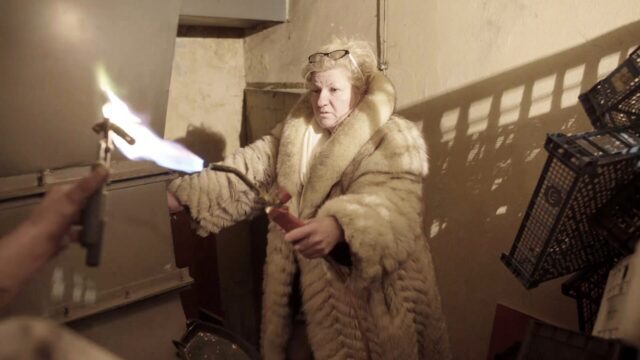
The film flips back to the preceding freezing winter months as Jola (bleach blonde and sporting a massive fur coat to try and keep warm) opens the store, a yellow-painted warehouse-style building in a faded part of town. The shelves are packed with disparate items – from furniture and furs through to skis and saucepans – as the pawnshop sports the motto “we buy and sell almost anything”.
They test the goods they are offered, photograph and measure stock for their website and make sure their shelves are brimming with items, but at the same time rarely seem to make any money. This results in regular arguments between couple Jola and Wiesjek – she is angry that there is barely any cash and that staff have to take a low wage. Meanwhile he seems oddly confident that things will turn around, despite the fact they have frozen pipes and a cash-till that rarely has bank notes in it.
But despite their own precarious circumstances, the staff have compassion for customers. They offer a homeless man soup and bread and a job shovelling snow. They help a woman who spends her nights looking for cans to sell (she gets 80cents for 60 cans), search out a warm coat for a freezing cold young girl and offer support to a woman suffering from domestic abuse.
They also have their own issues. Staff member Roxana is in a new relationship with Tomek, but he is due to serve a six-month prison sentence; Jola and Wiesjek themselves have a combative relationship while youngest staff member Aja (who rarely smiles but seems honest and loyal) has had her own issues with abuse. “We are a family here…I can’t believe this place not existing,” she comments.
With the Spring Fair looming there is newfound summery enthusiasm. As Jola says to Wiesjek: “This will be a huge event…it will help you develop as a businessman,” and as music is played, food offered up and booze passed round, certainly the locals emerge to join in with proceedings. Wiesjek stages an auction (an iron at a knock-down price) and Roxana and Aja take part in a fashion show to display some of the choice clothes available, and while fun is hard it is never quite clear if it brings in much actual money.
But then, it is clear the pawnshop is as much about uniting the colourful – and often vulnerable – local community as it is making a turnover, and certainly this engaging fly-on-the-wall film really allows space for these rich and varied characters. Life may well be tough in Bytom but The Pawnshop at least offers a haven of comfort and support.
Poland, 2022, 72mins
Dir/scr: Łukasz Kowalski
Production: 4.30 Studio, Silesia Film Commission
International sales: Syndicado Film Sales
Producers: Anna Mazerant, Łukasz Kowalski
Cinematography: Stanislaw Cuske
Editors: Adriana Fernandez Castellanos, Filip Kowalski, Jakub Darewski, Kosma Kowalczyk
Music: Krzysztof A. Janczak
With Jolanta Janieszewska, Wieslaw Makowski, Agnieszka Kalinowska, Sandra Rzezniczek (Roxy), Tomek Borek