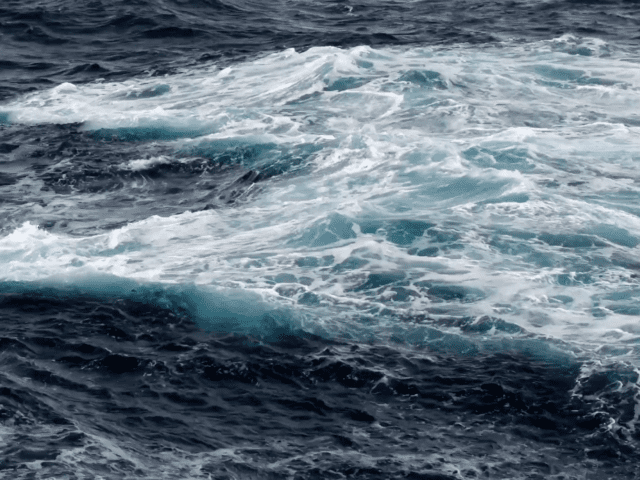
It’s a trip. But what kind of trip? It’s easy to see Abyss, which screens in CPH:DOX’s New:Vision programme, as a psychedelic mind trip, a perfect fit for old-school acidheads. The 10,000 images, mentioned at the beginning of the film, flashing before your eyes at an estimated – by me – speed of about 14 images per second, do seem to invite the viewer to lean back and let it all wash over them. Like a kind of cinematic hallucinogenic.
There are clear similarities in patterns and colours between the images. Every image resembling the preceding one, with patterns, textures, and the distribution of shapes and colours as the most obvious connections. Which would please the old-school acidhead, perhaps reminding them of the hippie era’s mandalas and liquid projections.
Except that instead of Pink Floyd, we’re listening to Simon Brinck’s soundscapes, which carry us along like industrial-sounding winds mixed with atmospheric static, melodic modulations and ethereal voices. It’s spacey, with a touch of otherworldliness.
But soon something else catches the eye. Something deeper. These images are not just connected formally – although that’s obviously a large part of it – but also seem to echo with meaning. Is that only in the eye of the beholder, a coincidence when formally similar images also happen to include similar contents? Or is the algorithm responsible here – not just visual, but also semantic?
Danish director Jeppe Lange has given co-directing credit to Google’s Image Recognition AI. Its basic function can be tried at home. Go to https://images.google.com, click on the camera symbol within the search bar and add or upload an image. Within seconds, Google will present you not only with webpages where this exact image can be found but also – more relevant to our current purpose – ‘similar images’.
In Abyss, these ‘similar images’ sometimes rush by semi-subliminally, too fast to see what’s happening. More often, the algorithm seems to get stuck on a certain topic for a second or two. Mountains. Faces. Building facades. Of course, these are texturally similar. But the contents of the image also seem to be part of the equation. Like when faces of different animals follow each other, with their eyes in the same place on the screen. Or, conversely, when similar objects follow each other, without having the same position and shape within the image.
The term ‘AI’ has been thrown about a lot in recent years. A cynic might even call it trendy. In general, one should not overrate the ‘I’ of Artificial Intelligence. In the case of Google, a lot of it comes down to pattern recognition. Which is an important basic building block of intelligence, but not so intelligent in itself per se (although an interesting philosophical discussion could be had on the subject).
But even if the search engine does algorithmically add semantic image similarities to the general pattern recognition, the fact that the string of images in the end goes all over the place, from galaxies to single-celled creatures, and from jellyfish to a series of Where’s Waldo’s, strongly suggests it isn’t bound by them. Plus, we cannot know how often the apparent semantics of those connections are only the product of our own associative mind – our own ‘I’, instead of the Artificial one.
I also suspect some human intelligence was involved in the image selection. Or is it a coincidence that the series ends with white images becoming more and more empty? Or that in the full 13 minutes, porn only appears once – and not right at the beginning or at the very end, but around the much more convenient 3/4 mark? Or that those porn performers, like the sexy behinds and mouths seen at earlier points in the film, are overwhelmingly female-bodied? Or, that images of minor skin disorders do not go on to worse and more off-putting diseases, wounds and injuries – the kinds that could possibly scare a festival audience off?
As it is, Abyss very much pulls the audience in. With associative links between the images which are often not only surprising, but poetic. Such as the poetry of vulvas being followed by flowers. Or barbed wire followed by budding branches. Or the eye on a peacock’s fea
thers followed by the eye of a hurricane on a satellite image. Even if these poetic resonances are fully in the eye of the beholder, that doesn’t make them any less lovely.
In the end, Abyss feels like a different kind of trip. Not a psychedelic one, but a cosmic one – but literally. As if an alien intelligence is sifting through images representative of Earth (like the ones featured on the Golden Records still travelling through Space in the Voyager spacecraft), and trying to make sense of them. Recognising patterns, similarities, perhaps understanding, in some way, images of plants, animals and stars. Grouping images together stylistically: Indian illustrations, Western paintings (as a Dutch film journalist, it’s nice to see that both Rembrandt’s and Van Gogh’s paintings are distinct enough to keep Google’s AI within their orbits for an above-average amount of time). Mixing up photography and illustrations, large and small objects. And with all these impressions slowly getting a feel for Life on Earth.
Which, hopefully, will be as pleasant for those alien lifeforms as it was for this reviewer.
Please note: The film is not recommended for viewers with epilepsy.
Denmark, 2022, 13 minutes
Director Jeppe Lange, Google’s Image Recognition AI
Producer Jeppe Lange
Editing Jeppe Lange
Sound design Simon Brinck
Music Simon Brinck