A community of Congolese plantation workers turning art into a tool for land restitution and ecological repair took centre stage at the CPH:DOX Roughcut showcase held on 16 March, as filmmakers Céd’art Tamasala and Renzo Martens presented The Dawn of the Post Plantation. “This film is a tool,” Tamasala underscored. “A tool to get back our land, our dignity and to bring the sacred back into our community.”
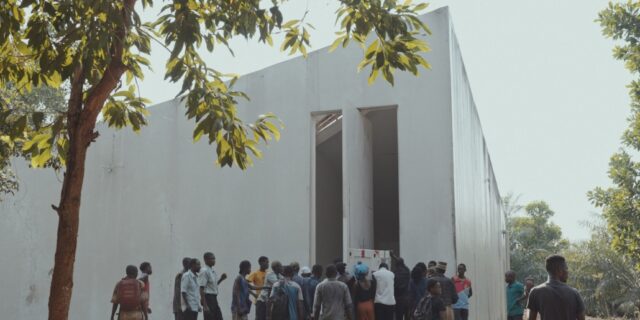
In detail, the 90-minute documentary follows members of the Congolese Plantation Workers Art League (CATPC), based in Lusanga in the Democratic Republic of Congo, as they reclaim land previously exploited by colonial plantation systems and begin restoring the sacred forest that once stood there. Blending art, activism and documentary storytelling, the project examines how cultural production can generate both global visibility and tangible economic resources for a community historically shaped by extraction and exploitation.
Moderated by Screen Scotland’s Dani Carlaw, the Roughcut presentation introduced the creative team and the unusual trajectory behind the film. “You belong to a collective of artists and plantation workers in Lusanga… using art as a way to reclaim land, dignity and the future of your community,” Carlaw told co-director Céd’art Tamasala as she opened the session.
Tamasala represents CATPC, a collective of men and women who were born into plantation labour and who now create artworks using materials tied to the plantation economy—cocoa, palm oil and other commodities historically linked to colonial exploitation.
“We are a collective of many members, men and women, and we make art,” Tamasala told the audience. “With the proceeds of our art we are getting back our own land and bringing back the sacred forest that was destroyed during colonisation.”
The film traces how the collective’s artworks have entered the global art circuit—from Lusanga to Venice, Amsterdam and London—creating a feedback loop in which art sales finance land purchases and ecological restoration back home.
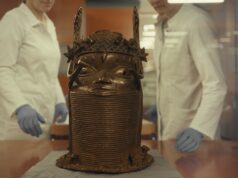
Among the central narrative threads is the return of a significant sculpture known locally as Balot (also referred to as Funji), a symbolic object representing resistance to plantation monoculture regimes. The sculpture, which had circulated through Western institutions, was ultimately brought back to Congo after the collective gained international recognition, including participation in the Venice Biennale.
For Tamasala, the project is inseparable from the collective’s broader mission. “This film is a tool,” he underscored. “A tool to get back our land, our dignity and to bring the sacred back into our community.”
Martens, known for provocative works such as Enjoy Poverty (2008) and White Cube (2020), frames the project as an attempt to transform artistic visibility into real-world change.
“The sculptures that CATPC produces tell their history and their future,” he explained. “But they are also seeds—seeds that bring visibility, credibility and ultimately resources back to Lusanga so the forest can be replanted.”
The story unfolds between Lusanga and major art capitals such as Venice, Amsterdam and London, examining the paradox of a community that must appeal to Western audiences in order to regain autonomy over its own land.
“We can either please the West with chocolate and coffee,” Tamasala said, paraphrasing the collective’s dilemma, “or with a film about liberation. In both cases, there is a process of pleasing global audiences that we need to navigate.”
That tension—between global visibility and structural inequality—forms a key theme of the documentary.
Producer Lea Fels, co-owner of Amsterdam-based production company Scenery, emphasised that while the film may appear to follow a rags-to-recognition narrative, the reality remains far more complex.
“For European audiences the story can look like a fairy tale,” she said. “A community finding its way to the Venice Biennale and becoming recognised as influential artists. But in reality they are living that story out of necessity.”
Fels noted that the project will require a strong impact campaign once completed, aimed at expanding the film’s reach beyond traditional audiences and reinforcing the collective’s environmental and social goals. “This story is bigger than just the fairy tale we are sharing,” she added.
The Dawn of the Post Plantation is currently in post-production, with an expected release in February 2027. The project is structured as an international co-production spanning the Netherlands, Belgium, the Democratic Republic of Congo, the United States, Italy, Indonesia and the United Kingdom.
The film is produced by Scenery, with co-production partners including VPRO, Clin d’Oeil Films, Ma.ja.de. and BBC Storyville. Confirmed financial supporters include the Netherlands Film Fund, NPO Fonds, VAF, VRT, RTBF, ZDF/ARTE, BBC, NRK and SVT, among others.
With a total budget of €1.73 million, the production has secured roughly €1.69 million to date and is seeking additional funding primarily for a final shoot in Lusanga and for the film’s impact campaign.
“We still need to return to Lusanga for one last shoot,” Fels told attendees. “And we’re looking for partners who want to support the impact campaign around the film.”
For Tamasala and the CATPC collective, the stakes extend far beyond completing a documentary. “The plantations destroyed our forests and left the soil exhausted,” he said. “Through our art and through this film, we are trying to decolonise our land and reclaim our future.”
Martens believes the film captures a broader historical shift. “This is a story about a community that uses art to regain its land. Not just symbolically, but materially.”
If successful, The Dawn of the Post Plantation may stand as a rare example of a documentary that not only chronicles social change but actively participates in it.