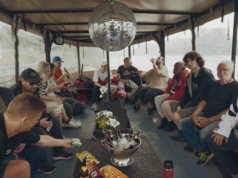
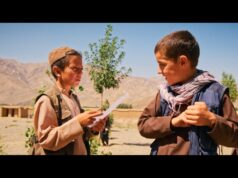
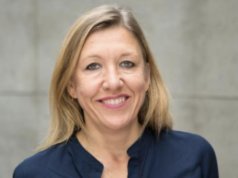
Visionary English poet and painter William Blake famously wrote that if “the doors of perception were cleansed everything would appear to man as it is. Infinite.” That’s a proposition explored in courageous fashion in Swiss director Marcel Wyss’s new feature doc, Open My Mind, a world premiere in CPH:DOX and produced through Lomotion AG.
Wyss isn’t just the film’s director. He is its subject too. He is the one who goes on a phantasmagorical journey, using psychedelic drugs in a therapeutic way, to confront trauma and insecurity in his own life.
“I have been interested in the topic of drugs for a long time. In my earlier films I already explored this subject. I made a film about my brother, who was addicted to heroin [After the Fall], and another film about cocaine use in our society [Work Hard Play Hard],” the director explains what drew him to such mind-bending subject matter.
After his brother died, Wyss became very conscious of his own mortality. He began to think often about what it actually means to die and what might happen afterwards – and this speculation sometimes caused panic and dread in him. Then, one day, he read an article about psychedelic-assisted psychotherapy.
“It said that psychedelics can help people deal with deep fears, including the fear of death. This surprised me, because I had always been very afraid of these substances…but the more I read about the research, the more curious I became. In the end I decided that I wanted to explore this topic myself and make a film about it.”
Early on, the director didn’t intend to make an autobiographical documentary. He was looking for people who might allow him to accompany them on their healing journeys. However, few were willing to allow themselves to be filmed in such a vulnerable situation.
Another idea was to follow a group of “young psychologists who hoped to push psychedelic therapy forward” but, in the editing room, it soon became clear that this part of the story didn’t quite click.
The director therefore decided to become his own guinea pig. At first, he wasn’t comfortable with the required level of self-exposure but eventually he accepted that the film needed the clear “personal focus” that his involvement on the other side of the camera would give it.
“After more than twenty years of making documentaries, many people had trusted me with their personal stories. At some point I felt it was my turn to open up and share my own,” Wyss rationalises the decision.
For obvious reasons, during the psychedelic experiences themselves, he wasn’t able to call the shots. That meant handing over directorial control to his cinematographer, David Röthlisberger, and trusting his team “to capture what was happening.”
The documentary has some very stylised elements including several sequences featuring animation. “I was looking for a way to show my inner world — my fears, my anxiety, but also love and joy…it was very important for me to find a cinematic language that could give access to these inner feelings and thoughts. Animation gave me the possibility to visualise these emotions and inner states.”
Wyss took a psychedelic substance for the first time in Basel as part of a clinical study that was being conducted under strictly controlled conditions.
“Of course, I felt a little uneasy when I swallowed the substance. But before that I had spent about three years researching the topic and learning about psychedelic therapy. So in that moment it was more excitement than fear. The strong fear I had before was mostly gone…”
Ask him if he enjoyed the experience and he gives a reflective and nuanced answer.
“Psychedelic experiences are very intense and complex,” he muses. “They can last many hours and include very different emotions. There can be moments of joy or strong feelings of connection, which are very beautiful…but there can also be difficult and painful moments.”
This, then, wasn’t about pleasure but was more like “deep inner work.” He likens it to running a marathon.
After his experiences in Basel, Wyss is shown travelling to Ecuador to take ayahuasca, a plant mixture that has been used in rituals there for thousands of years. “This approach is very different from Western medicine and is strongly connected to spirituality and tradition.
For me it was a very special experience, but also a difficult one. I took part in two ceremonies, and the first one was especially very challenging for me,” he acknowledges.
At one moment, he became “trapped in a repeating thought that kept coming back again and again. I could not escape from it.” He even briefly began to worry that he had damaged his mind and might end up in a psychiatric hospital when he returned to Switzerland.
“In Ecuador the work with ayahuasca is part of a long cultural tradition. It is connected to rituals, spirituality and community life. In Switzerland the approach is much more clinical and reserved,” he points out the cultural differences. “But during the psychedelic experience itself, your mind becomes very open. In that moment it almost doesn’t matter where you are. The experience creates a very open state of mind, almost like the openness of a small child.”
When Wyss’s young daughters asked him what he was working on, he would tell them that he was testing out medicines that might help people in the future. At the time he was working on the documentary, he was also in couples’ therapy with his partner. She is shown in the film talking very frankly to him about the fragile state of their relationship – and they were eventually to break up. He admits that he sometimes questioned whether he should have exposed himself so much on camera. “But I believe these substances can help people when they are used responsibly. If our story helps someone reflect on their own struggles, then I hope it was worth it.”
During the making of Open My Mind, Wyss was also drawing on his memories of his brother and the documentary about him. “I believe he would support this project. I remember how we sat on the park bench and he said that we should definitely show everything and talk about everything. So, break taboos.”
Does he feel more content now having completed the film, and taken the substances, than when he started?
“I would say that I worry much less today than before, especially about death. I feel more present in my life, especially with my children. I also feel more connected to nature, and I have made peace with the fact that I cannot control everything. The experiences helped me a lot, but it is still an ongoing process. I have to keep integrating what I learned.”
The director doesn’t make lofty claims about what psychedelic therapy can achieve but argues that if substances are used carefully and in the right setting, they can help.
“But it is not an easy process. It takes courage to face difficult emotions and fears.”
The aim in Copenhagen is to sort out distribution. The relative ease with which the financing was put together suggests this is a topic which should engage audiences. The film was supported by several Swiss funding institutions, including the Federal Office of Culture, the Bern Film Fund, Swiss TV, and various foundations.
It’s too early for the director to talk in detail about his next documentary – but he can confirm he won’t be the main character.
“Addiction, especially alcoholism, may become the focus of my next project. But it will definitely not be a personal story. I don’t think I will take on that kind of personal challenge again…”