As the title of Ai Weiwei’s latest film, the word ‘animality’ comes to take on a meaning comparable to ‘humanity’. Not so much referring to our animal nature, but to theirs. The inherent nature and dignity of animals. Like our humanity, their animality needs to be honoured and respected. So what does it say about our humanity if we don’t do this?
Now, Ai never says any of this explicitly. The animal-loving filmmaker, who famously lives with 40 cats (part of the 400 trafficked cats whose rescue he documented in his 2009 film Calico Cat), never voices his own opinion in his film. In fact, the title is never mentioned and Ai’s voice is never heard at all. Animality has a calm, non-judgmental tone. I think animal rights activists, farmers and fishermen could all agree on this. Animality offers observations of the world which can inspire, but do not force opinions. The questions are raised, but remain unspoken.
There are one or two moments where Ai seems to tip the scales by explicitly including a particular opinion. For example, after scenes of a Brazilian cattle rancher, a voiceover notes that eighty per cent of the loss of the Amazon rainforest is due to the growing demand for pasture. But these more opinionated moments are rare.
Brazil is not the only place where Ai’s teams film. Indeed, Animality justifies its broad title by filming all over the world, from Denmark to Mongolia, and from Brazil to China. In this global exploration of one profoundly important and universal theme, Animality recalls not only Ai’s own Human Flow (2017), but also the documentaries of his Russian colleague Viktor Kossakovsky, notably ¡Vivan las Antipodas! (2011) and Aquarela (2018).
And as with Kossakovsky’s films, much of Animality’s meaning is not spelled out, but emerges from the correspondences and contrasts between scenes, with an emphasis on the hypnotic power of the cinematic. Such as when we go from a slaughterhouse for cows in Paragominas, Brazil, to dog carcasses piled up outside a restaurant in Guangxi, China. Clearly, the dead dogs will be harder for most Westerners to swallow, but the unspoken question is: why? Do cows not suffer?
Note that those who can’t stomach cruelty to animals should probably avoid Animality. Although there is a wide range of human-animal relationships on display, some scenes are certainly difficult to watch. From the Chinese enforcers of a law against stray dogs, beating one to death with a large stick, to the killing of a donkey with three hammer blows to the forehead.
But again, an unspoken question arises – at least in my mind. Are these graphic deaths of individual animals really worse than the industrial-scale factory killings of cows, pigs, fish and mink that we also witness? Aren’t we – aren’t I – misled by the relative sterility of these mechanised massacres?
Recurring words in the spare interview fragments, mostly used in voice-over, are ‘tradition’, ‘culture’ and ‘family’ – more than one speaker speaks warmly about following in their father’s and grandfather’s footsteps. These terms all reflect the fact that this is what they have always done. That it’s been passed down and that it’s part of their identity. And when the methods are traditional and small-scale, these words really do ring true. The fishermen of Lembata, Indonesia, may now use an outboard motor, but otherwise their sporadic whale hunts are conducted just as their ancestors did, throwing harpoons by hand from a modest wooden boat. There is a real sense of connection here with the ancient cave paintings of animals and hunters dating back as far as 40,000 years that appear during the opening credits.
In the West, we don’t like to see animals performing in the circus – but their owners point out that thanks to their growing popularity, the number of Siberian tigers is actually increasing: “This is not from releasing them wild. What caused it? It’s the circus boom, uniting animals and the human world, that caused that growth. Isn’t that a kind of protection?” One person working with elephants complains that following a logging ban, there are now five thousand elephants facing “joblessness” in Myanmar and nobody knows what to do with them. Poaching is a real risk. And the elephant handler himself is also out of a job, because “you can’t separate the animal and the human”.
Another unspoken question thus arises: are animal rights activists always focussing on the right targets? Isn’t there an overemphasis placed on highly visible, yet relatively small-scale and culturally deeply embedded cases, such as circus animals or elephants used as labour, as compared to agricultural mass killings for human consumption?
That Ai Weiwei manages to raise so many questions without ever asking them is a testament to the effectiveness of his wide-ranging approach. And the stylistic consistency he achieves is impressive, given that he’s filming in such wildly different locations and working with thirteen different cinematographers.
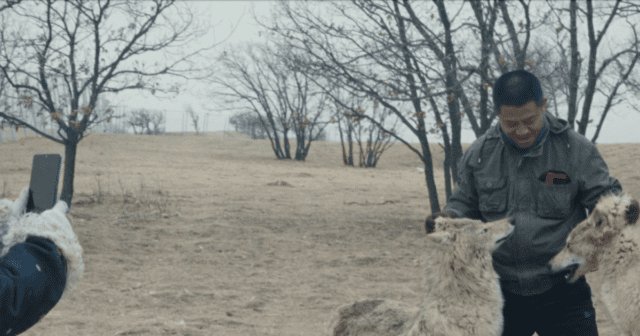
In order of appearance, you will see stray dog hunting in Xinshao, Hunan, China; black-haired yaks in snowy Kham, Tibet; large-scale cattle farming in Paragominas, Brazil; a family restaurant serving traditional dog dishes in Guangxi, China; elephants pulling logs in the Bago Region, Myanmar; camels being whipped through the streets of Cairo, Egypt; traditional bird hunting in Lanshan, Hunan, China; a battery cage for chickens in Hubei, China; a tightly controlled salmon farm in Lofoten, Norway; traditional whaling culture in Lembata, Indonesia; the trade in the medicinal donkey-based ejiao in Shandong, China; the effects of a locust plague in Cholistan, Pakistan; circus animals in Anhui, China; a wolf shelter with tourist accommodation in Inner Mongolia, China; pig culling in Sichuan, China; and mink culling in Vejle, Denmark.
All are presented with the same cinematic splendour of landscapes, similar drone shots from up high, intimate close-ups of workers handling animals (dead or alive), and all – a bold choice – without any music. Ai Weiwei dares to trust direct sound, from the chaotic street noises of Cairo to the silence of the snow-capped mountains of Tibet. And from the growl of a wolf to the terrified squeal of a pig, being thrown alive into a mass grave of diseased swine during a government-ordered cull.
Germany, 2025, 122 minutes
Director Ai Weiwei
Production Ai Weiwei Production
Producers Ai Weiwei
Cinematography Fernando Cavalcanti, Mehdi Hassan, Tuki Jencquel, Andreas Johnsen, Okie Kristyawan, Kasan Kurdi, Li Dongxu, Ma Yan, Markão Oliveira, Ouyang Yong, Guilherme Perez, Yin Quan, Zhang Zanbo
Editing Niels Pagh Andersen
Sound Merio Falindra, Isabel Muñoz, Salomão Oliveira