

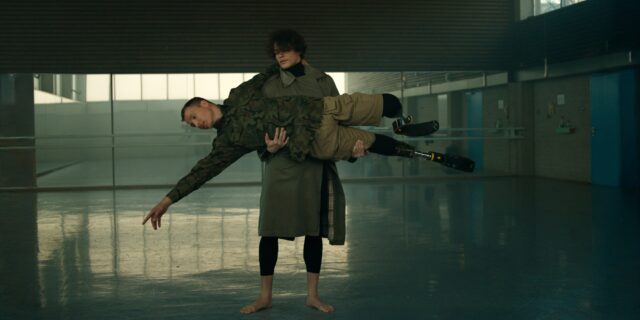
In Miriam Guttmann’s feature doc Front Row, produced by Scenery and which world-premieres November 16 at DOC NYC, sixty exiled Ukrainian dancers take to the world’s stages under the banner of the United Ukrainian Ballet Company. They perform in London, Amsterdam and Los Angeles, their presence serving as a continual reminder that international support is needed for their country in its continuing fight against Russia.
But each of the dancers has family and friends at home, and many feel a terrible sense of guilt that while they are pounding the boards in the free capitals of the West their comrades at home are fighting on the frontline. This feeling is compounded when, on tour, they meet Sasha, a soldier who lost both legs in the war. Young, funny and clever, Sasha is as intrigued by the dancers and their talent as they are proud of him and his bravery, and he becomes a symbol for each of them and the family members they have left behind.
However, in what seems like a gesture either of utter madness or extreme solidarity, the double-amputee is invited to perform onstage in Los Angeles as part of a long and complex dance routine that requires sublime skill, timing, strength and precision. The film then builds towards a truly heart-in-the mouth climax as Sasha’s moment of reckoning approaches.
“I’ve always wanted to include the medium of dance in my films because I danced ballet myself for 15 years,” Dutch director Guttmann comments. “As a documentary filmmaker, I am always looking for multi-layered, character-driven stories with a strong sense of urgency. And this story distinguishes itself by interweaving the current war in Ukraine with the power of art. The dancers used their talent as a way to preserve their humanity, and rather than fighting on the frontline, they continue their battle on the ballet stage.”
Some of the war archive is difficult to watch, and includes bodycam footage of the attack that disabled Sasha, as well as his treatment and recuperation in hospital. When he discovers the ballet troupe, he also finds a comrade in dancer Alex. “When literal fighting on the front line was no longer possible because of his injury, he looked for many different ways in order to keep fighting. And with Alex he could continue to fight through the power of dance and culture,” says Guttmann.
There will be those who will react with incredulity to the whole notion of a soldier turning to the medium of dance and attempting to hold his own among world-class performers. One such critic in the film is the classically aloof and dismissive Iryna, herself a dancer, who decries what she sees as the diminution of her art, but even she is seen in the wings at the film’s conclusion, crying tears of admiration and willing him towards success.
The film has a very personal undertow for director Guttmann, whose grandfather was a Jewish refugee who was forced to leave his home country of Poland during the Second World War. “He eventually ended up in the Netherlands as a stateless citizen, after years of suffering, loss and persecution. And then he remarkably succeeded in quickly rebuilding his life as a theatre director and started one of the most renowned theatre companies in the Netherlands [Accolade Productions]. Through his art, he was able to reclaim his identity. So in that sense I was really related to the story.”
The film’s word-premiere in the US following Donald’s Trump’s recent victory in the Presidential contest is of great significance, Guttmann adds. “I think it’s very necessary to have this film premiered there right now,” she says.
“The world should stand behind Ukraine and give them all the support they need to continue defending their country from being taken unjustly by Russia,” she continues. “When a war breaks out, people of course respond really heavily to the images, but then after time people become desensitised to them. I’m passionate about telling personal stories, especially in times of war when casualties are often reduced to numbers. As a documentary filmmaker, it’s my job to bring back the faces and human stories behind these numbers.”





