

Director Tiago Siopa describes his Doc Alliance Award-winning Ghosts: Long Way Home as a farewell poem to his home town, a film in which he revisits the myths, folklore and superstitions he grew up with as a boy in the Portuguese countryside. The film world-premiered at Doclisboa 2019.
Ghosts: Long Way Home is a small jewel of a documentary, one rooted in myth and embracing aspects of both the uncanny and the fantastical. The film, Tiago Siopa’s first feature-length work since graduation, starts with a witch-like incantation before progressing to a communion with the spirits and an all-out hunt for werewolves. What Ghosts also does is to illustrate the fabrications and embellishments resulting from potentially murderous feuds that exist deep within a family’s past.
Much of the film centres around Tiago’s conversation with the happy and playful ghost of his grandmother Maria who gently chides him for his choice of profession (documentary filmmaking offers little by way of income), no girlfriend (he is 28!) and his secularism. His grandmother loved having lots of money when she was younger, much of it generated via her skills as a seamstress, she tells him, and she goes on to explain further aspects of his family’s darker history, which he hears seemingly for the first time. Such as tales of rivalry, theft and claims to property which form deep divisions within the familial ranks.
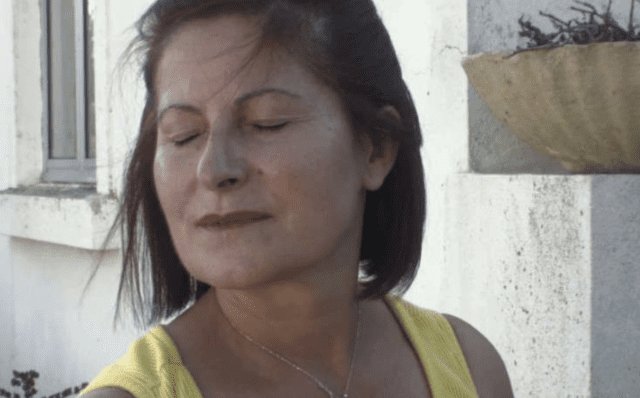
Very soon, in a film laden with symbols and metaphors (persistent winds, fire, smoke, even a partial eclipse), the director’s mother joins the ranks of the dead after recalling her dream of a black cat and a cloud that fragments, only to subsequently reform.
The director’s brother Carlos is a student with his head in the clouds and whose avoidance of work annoys and frustrates his industrious father Fernando, but the boy finds an ancient fossil-encrusted rock that takes on the symbolic significance of a Philosopher’s Stone.
Meanwhile, when Fernando suspects that there is an intruder on his land, director Tiago joins him at night to intercept, unsure as to what they meet will be human or supernatural.
“I wanted to make a kind of poem about my home town, a farewell poem,” Tiago explains of the film’s premise. “It’s a fragile place to be. I feel I don’t belong there in some ways. My grandfather had just died at the time, and I was looking at my family and our houses with this [sense of] longing. I was thinking about the fragility of our relationships and I had this sensation of wanting to make a farewell song.”
The director does not believe in the myths and folklore of his youth but his calling as a filmmaker informs his understanding of their potency. “They believe in those stories, I believe in cinema,” he underlines.
Nevertheless, Tiago concedes their effect on his psychological development, especially when twinned with another myth-laden creed, that of Catholicism. “They affected the way I look at the world. I find that in these mythologies there was a concept of evil. There were disputes about the land, and my paternal side of the family transformed those emotions into these energies, these figures, like werewolves.”
“There are contradictions between the Catholicism that I grew up with and this more pagan way of looking at things,” he continues. “And I grew up with these contradictions. The Catholic view is on my maternal side, the pagan view on my paternal side, and they co-exist in these places. I tend to be more sympathetic with the pagan view.”
Tiago stresses that a characteristic of his work is to explore “the imaginary side of reality for sure, not specifically the mythological but the way reality itself is imaginary.”
The film was a labour of love for all of the Siopa family, each of whom helped with tasks set by Tiago, and all of whom are listed as producers in the credits. And no, the director’s mother didn’t really die during the course of the production.
“In the film she becomes one of the ghosts, we can say she died in the film. I think each of the family members die in the film – all of us,” Tiago concludes.





