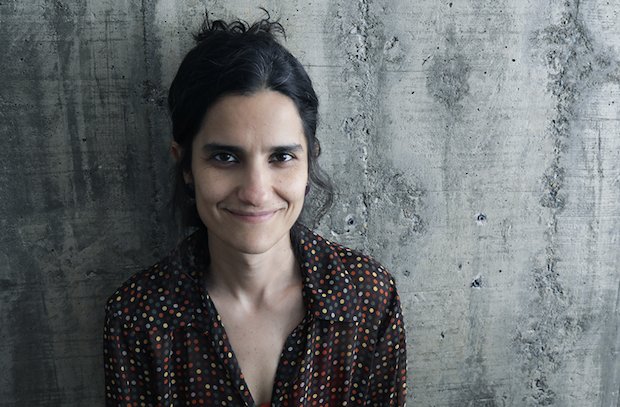
2024 marks the 6th edition of Nebulae, DocLisboa’s industry and networking event. Marina Thomé (an established photographer and documentary filmmaker in her own right) is coordinator. As a former participant in the festival’s Arché development and mentorship programme, she has seen at first-hand how the festival can “open doors” for new projects. She coordinated Arché last year – and so knows the workings of the programme inside out.
Last year, the festival partnered with ICAA. Spain’s Film and Audiovisual Arts Institute, for the first time, bringing four Spanish documentary projects to Nebulae. This year, the Spanish connection is even stronger, with Spain as the invited country. Eight Spanish projects are being presented, including Aser Álvarez González’s Graham Greene in Spain and Portugal, a road movie/detective story exploring revered English novelist’s relationship with the two countries, and Irene Baqué’s Oasis, looking at the lives of three generations of women in an urban settlement for the Tarahumara people in Chihuahua.
What do you hope these projects will achieve during Doclisboa? Is there a chance for Portuguese producers to collaborate more with their Spanish counterparts?
As this year’s guest country is Spain, which already has geographical proximity to Portugal and co-production agreements, we’ve had a strong response from the local market. A lot is already being produced through collaborations between these countries, so it was natural to get closer to our partners to design the activities. Spain also has a strong network of recognised film schools, which was also very interesting regarding the groups’ calendars and activities. We’ve been working with ICAA and ECAM for months, in a conversation that started as early as 2023 for this year.
This year, we held individual meetings with various regional government organizations in Spain. It’s incredibly diverse and it benefits from solid support across its different regions. The discussions were very productive, and I’m confident Spain will continue to impact Nebulae significantly.
You coordinated ARCHE last year. Now you’re overseeing Nebulae. How did you come into the role?
I think that coordinating Arché and Nebulae are complementary. Arché, a project from Apordoc — Association for Documentary, and the Doclisboa industry space both go beyond the market space. It’s a space for reflection on cinema. This year we have eight Constellations in Nebulae (round tables), which is more than double last year, and they are open to the public. It’s all related: the duration of the round tables and building partnerships with institutions, selecting Arché films and projects in collaboration with the ICAA (Spain), and some special events for the Portuguese market. All done with the Doclisboa team and director Paula Astorga, with a constant alignment with the Festival’s programming team. It’s all connected.
How did you choose the eight Spanish projects?
The selection committee was composed of Doclisboa and ICAA staff. We held extensive selection meetings to discuss each project individually. The wealth of good projects we received underscored the importance of diversity in our selection process. Besides the uniqueness of the projects, we made sure to include a variety of themes, regions, and genders.
How many sales agents and distributors do you have this year? Are there any new visitors?
Industry guests include directors and producers with selected projects, professionals who will participate in the Constellations (Round Tables), and players such as distributors, programmers and festival representatives. They also include the groups taking part in the seminars and workshops. We have a total of 230 confirmed and Nebulae accredited guests. If we think only of the players who will see the project presentations or see the WIPS (works-in-progress) and have individual meetings, we have around 30. We will also have around 20 Portuguese production companies taking part in the events.
Tell us a little about the festival’s Joaquin Jordà Residencies that support essayistic documentaries?
Yes, the Joaquim Jordá projects from 2023 are in the catalogue, and we will present their projects for the professionals. We’ll also be announcing the 2024 winners!
Further information taken from onsite: The Joaquim Jordà artistic residencies annual programme is meant for filmmakers and artists working in the field of essay film, experimental film and the various expressions of non-fictional film. The programme aims at supporting the inception, development and production of cinematic objects in the scope of non-fictional film, funding its execution and establishing international debating networks, and pays tribute to Joaquim Jordà (1935-2006), whose original work was a landmark of non-fiction film.
Can you say something about your collaboration with UnionDocs – Center for Documentary Art (New York, USA) Who are the artists and writers involved in this? How were they chosen?
The projects were chosen by members of the Doclisboa and Union Docs programming teams. Those selected really do make up a very interesting working group, enabling in-depth discussions about filmmaking. The program brings writers and directors together to discuss their works and their process, with a selected group of around 30 people. More info
Likewise, the Ibero-American projects in Arché. How were they chosen? What are their common themes?
Regarding Arché, we had a record number of applications, over 300. For Doclisboa, almost twice as many as in 2023. As we have a lot of Latin American projects, there is a lot of urgency about social issues, historical erasure, and bringing archives to light and positioning them in another political context.
How are your own projects going? What is happening to Red Skies for example?
My project, Céu Vermelho, was selected for Arché in 2021 at Porto/Post/Doc. Since then, it has taken part in many labs and festivals. In addition to an exhibition that we won funding [for] from the Portuguese government, it has received support from the Gulbenkian Foundation to finalize its development. In other words, the Arché experience was a watershed for me. A program that opens doors to projects that have not yet been discovered.