

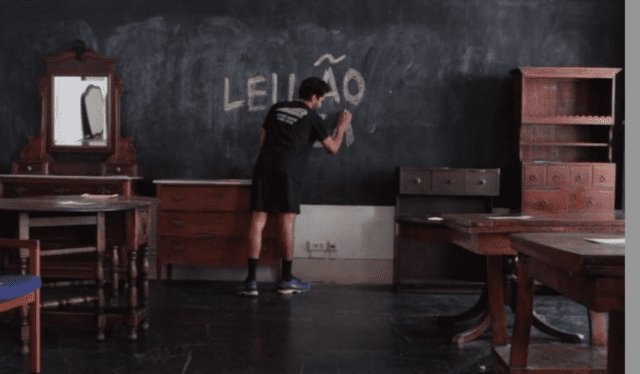
In Maria João Guardão’s documentary, an eviction notice served to leading dance choreographer João Fiadeiro, demanding that he vacate the Lisbon property that has served both as a dance studio and gathering place for artists for the past 30 years, sets in motion a poignant yet joyous month of farewells, reminiscences and artistic endeavour.
Leading Portuguese dance choreographer João Fiadeiro is something of a force of nature, larger than life, ebullient, expressive and articulate, and a magnet for Lisbon’s artistic community. And even now, in his mid-50s, he can still dance a bit.
But even magnets are subject to the whims of the property market, as well as the process of gentrification that all cities suffer. And so Fiadeiro is told to vacate the beautiful and vast house in central Lisbon that has been the location for his and others’ artistic pursuits and endeavours for the past 30 years.
Whereas the rest of us may meekly pack our stuff, load it and leave, Fiadeiro decides to leave on a high and invites friends and colleagues from the past three decades to revel in a month of celebration, dance, performance and memories, culminating in an auction of artistic ephemera and a series of expressive avant garde events and happenings. The result, as captured by the camera of feature doc debutant Maria João Guardão, plays like a bitter-sweet funeral wake, melancholy but joyful, lachrymose but ultimately life-affirming. But the wonderful thing about this wake, is that life continues afterwards.
“He wanted this to be documented,” the director explains of the loose brief she was given by Fiadeiro. “So when he asked me, actually it was a challenge he threw at me. He wanted to really celebrate that ending.” She adds that some projects may be low budget but this was strictly “no budget.”
Did Guardão have any preconception of how the next month of filming would turn out? I had no idea,” she responds. “I didn’t want it to be about something. Of course, there was gentrification happening in that neighbourhood. Of course, there was disaffection with cultural politics. But of course that was all in place already…But at the editing table, the film revealed itself as a film about endings, the ending of a performance in a dance company, the ending maybe of a certain Lisbon, and the ending of a certain way of building a community also. So this was it, it was all there. I didn’t originally set out to do it. It just was there.”
“And of course, the poetic irony is that while it is a film about the ending of several things, it’s also my first film,” she stresses.
In so many so-called fly-on-the-wall documentaries, progress can hampered by inexperienced and not-so-media-savvy subjects who are asked to carry on as usual despite there being a camera and a crew recording their every moment. Is this a problem for the characters in Everything Must Go? Not in the least. Artists are a different breed for whom the presence of a camera is in no way problematical. If anything, it is liberating. And they are, invariably, smart and opinionated, and very prepared to perform, as evidenced in the film when a touching conversation around a dinner table morphs seamlessly into a piece of Dadaist theatre. A dancer climbs on the table like a silverback gorilla before he is joined by another with whom he couples sinuously, and all the time Fiadeiro circles the table with a chair on his head.
“They are really into it,” agrees Guardão. “It’s not only because João Fiadeiro is an incredible artist and a pedagogue, but also because they are all absolutely into the celebration and very aware of the enormity of that moment, those days when they are together. It’s a moment for togetherness and then it’s the unknown. We know that that the house will be closed, and they will never set foot in there again.”
Of course, the director is “super, super, super elated” by the film’s selection for Doclisboa, “this particular festival that I have respected for a long time and been a spectator at for a long time,” she enthuses, adding. “I think that it’s important to show the film to a wide community of viewers…I don’t think it’s a film about dance, it’s a film about us, and how we deal with endings and life and people and saying goodbye, and preparing for new things.”





