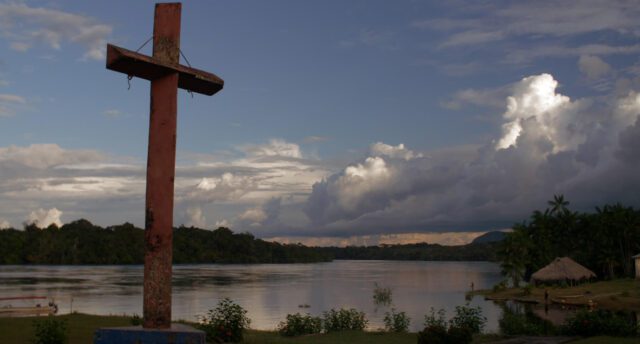
For the DocLisboa opener, director José Barahona took to the waters Fitzcarraldo-like on an odyssey into the Amazonian rain forest in search of the hybrid Nheengatu language, originally the language of the conquerors, now the language of resistance.
Nheengatu – The Language of Amazon Forest can be initially read in two ways, as a study of language and its usage or as a cinematic voyage into the wilds, a la Herzog or Coppola.
While director José Barahona sees the validity of both these interpretations, he adds a third, and one that is altogether more human. “More than the cinematic view, more than the language, I wanted to know these people who lived in these faraway places in the Amazon. I went there for the first time in 2006, and I was immediately sure that I wanted to go back and make a film there.”
Nevertheless, Nheengatu remains a core theme. It didn’t exist at all before the arrival of the Portuguese in the early 16thcentury. Deriving initially from the indigenous language spoken by the Tupi folk, it evolved as the conquerors made inroads into Brazilian territories, each new act of suppression adding more indigenous words to the lexicon. Of course, it retained more than a smattering of Portuguese in the process. Eventually it developed into a bona fide tongue with its own complex rules of grammar. In the face of contemporary and widespread use of Portuguese across Brazil, Venezuela and Colombia (along whose banks Barahona’s boat sails) Nheengatu remains the major indigenous language.
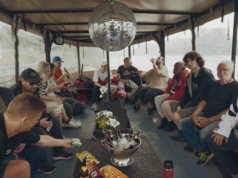
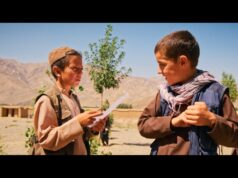
In the film, shot over a period of 28 days, Barahona voyages down the Rio Negro, together with a crew and guide Edson, stopping off at numerous points en route to film and interview the indigenous peoples. At each place he finds a local who can in turn shoot the episode from his or her perspective, using a smartphone donated by Barahona. One such person is Edmundo who adds his own commentary when shooting the film crew: “I am learning with them what I don’t know and they learn from me what they don’t know,” he says.
The further into the jungle they go the more they encounter the influence of the Catholic church, not so in terms of bars on Nheengatu usage, more the proscriptive doctrines that has outlawed alcohol, celebration and dance.
In fact, at a time when we fear the erosion or wilful prohibition of indigenous languages, as evidenced in films such as the Finnish Anerca, Breath of Life (2020), it is surprising that Nheengatu remains as widely spoken as it is.
“Yes, it is strange isn’t it, because we always feel that these languages are disappearing,” Barahona agrees. “And in a way it is very ambiguous. They say it is disappearing, but we hear all these people talking in Nheengatu. Maybe the young people don’t speak it so much. Maybe they are more in touch with the big cities.”
“But then you see this ethnic group called the Warekena [also within the Rain Forest] and they are losing their original language are now learning Nheengatu, so I think it is a living thing,” he continues.
He also notes that inaccessibility is a factor that may aid retention of the language’s usage. “You really don’t know what is going to happen in this place. It’s a very big area, with lots of languages [Wikipedia lists nearly 200 languages spoken in the Brazilian Amazon alone] and not just Nheengatu. And people are moving around and changing places and mixing between the ethnic groups through marriage and travel, so I’m not sure if it is really dying. Of course the culture is disappearing… but the language is one of the strongest things.”
In the film, engagement with the locals is always cordial (although we continually hear their jokes about, and suspicions of, the ‘white man’) but it comes at a price, albeit one that Barahona was willing to pay.
“They were friendly and they welcomed us, but it was tough in the way that we always had to negotiate,” he says. In the film an elder
tries to renegotiate the terms of his community’s involvement, asking for 100 litres of gasoline in addition to the food and money he has already won. “It’s something that comes from way back, because the ‘white man’ always went there, and always had something to sell or something to give, since the beginning. And they are kind of used to it, and also they don’t want to be exploited anymore. They know that the ‘white man’ has money – they don’t know how much – and sometimes they ask for amounts that are too much….There were these mixed feelings about being friendly and also ‘when are they going to give is the chicken for lunch?’.”
The film is a feast for the eyes, and Barahona happily concedes the comparison to Herzog’s Fitzcarraldo, adding Aguirre, Wrath of God into the mix.
“Maybe I shouldn’t say this, but it’s not hard to make beautiful shots in the Amazon. Of course you need a good DP and you have to wait for the light, but it is what it is. But it’s like in Fitzcarraldo and Aguirre, there is always this difficult and tough environment, a hard place to work with. You don’t have to go through the rapids or take the boat over the hill like Fitzcarraldo but people get sick, and there is a lot of heat and mosquitoes and malaria and dysentery. It makes it really adventurous to be on this shoot,” he ends.