Mladen Kovačević’s Merry Christmas, Yiwu
Entitled ‘Body of Work’, the new programme includes the work of filmmakers such as Harun Farocki, Carole Roussopoulos and Elisa Cepedal. ‘It’s a cinematic proposition that promises to pose important questions and stimulate debate on work and labour – a central thematic in our lives,’ says the doc fest.
‘Body of Work’ is a programme that arises from a partnership between Doclisboa and the European Agency for Safety and Health at Work (EU-OSHA), which aims to offer a platform for dialogue, through cinema, on human rights and social issues related to contemporary working conditions and practices.
The HWFA – Healthy Workplaces Film Award, created 11 years ago, for best work-related documentary film, will be presented during the Doclisboa festival. For this award, a selection of ten films featuring contemporary portraits of labour will be screened at Cinema São Jorge, Lisbon, during the first ‘moment’ of the festival (22 October to 1 November 2020).
On October 28, Doclisboa, in partnership with EU-OSHA, will also hold a ‘Thinking Labour Practices Through Film’ discussion on the relationship between cinema, work and its cinematographic representations. This will take place online to include participants from different contexts and territories.
At the same time, and as a complement to this contemporary programme, a selection of films will be presented on the DAFilms.com online platform, including a historical mapping of the evolution of the presence of work in our lives during the last century and its cinematographic representations. ‘Our aim is to establish new bridges between past and present through a diverse proposal of incisive and poetic cinematographic objects and representations of labour,’ says the festival.
This programme will also be part of the first ‘moment’ of Doclisboa, from October 22 and November 1.
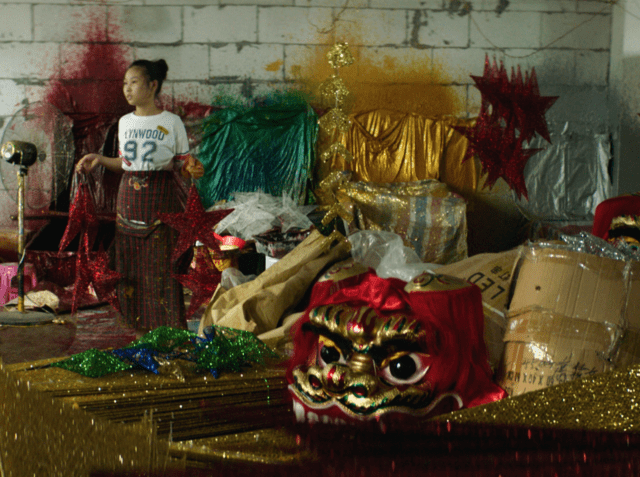
The festival statement continues : ‘From the progressive de-industrialisation portrayed in the mining town of Barredos in the Asturias region in Elisa Cepedal’s Work or to Whom Does the World Belong, to the social transformations illuminated in Merry Christmas, Yiwu (pictured) in which Mladen Kovačević explores the growing paradox of the Chinese city of Yiwu, where 600 factories dedicated to the production of Christmas ornaments are located and where, beneath the tinsel and lights, workers dream of a more luxurious life increasingly distant from the communist ideal, we are witnesses of global developments and economic crisis that slowly forge new landscapes and mindsets.’
The statement continues: ‘When we talk about work and social rights, we cannot forget the essential working role of women – the subject of cinematographic representation by so many filmmakers. Take for example La Mami, where Laura Herrero Garvin portrays a community of female dancers from a nightclub in Mexico City who, with steady hands, dictate the house rules… leaving some doubt in the air as to who is actually in control.’
‘But there is also space for resilience and optimism in the faces of the three protagonists of Sarah Colt’s The Disrupted, who refuse to be shaken despite America’s economic quakes.’
The 18th edition of Doclisboa takes place in six ‘moments’, between October 2020 and March 2021. The opening session will open on October 22 with the world premiere of Nheengatu – A Língua da Amazónia by José Barahona, when the festival will also introduce the retrospective ‘Permanent Travel – The Restless Cinema of Georgia’, and the ‘Body of Work cycle.’
The festival’s closing session will take place on March 7, presenting Ulrike Ottinger’s Paris Calligrammes.