Doclisboa has unveiled the titles for its Heart Beat and From the Earth to the Moon sections. The 22nd edition of the festival runs 16 – 26 October.
HEART BEAT
“Madonna, David Lynch, Boy George, Jeff Buckley…they all fit into the Heart Beat section, which brings together films that span multiple art forms and expressions, celebrating the creative act,” Doclisboa writes. Lynch is highlighted twice, first with the national premiere of Welcome to Lynchland by Stéphane Ghez, which delves into the work of the pop surrealist and which gives voice to Kyle MacLachlan, Laura Dern, and Isabella Rossellini, among other close collaborators. The festival also revisits Duran Duran Unstaged, a Lynchian experience in a ground-breaking concert film capturing British icons Duran Duran with a collection of special guests, live from the Mayan Theatre in Los Angeles.
Harking back to the same era, in Alison Ellwood’s Boy George & Culture Club, the singer and his bandmates share their story for the first time in an intimate and entertaining portrait of the band that revolutionized the era of the New Romantics and Margaret Thatcher.
Becoming Madonna by Michael Ogden draws on previously unseen images and recordings in a film that follows “the transformation of a young outsider from Michigan into the most powerful and controversial pop star in the world.”
Another national premiere is It’s Never Over, Jeff Buckley by Amy Berg. The film portrays Buckley, whose unique voice and promising career ended tragically with his death in 1997. With private images and testimonies, filmmaker Amy Berg “reveals the legacy and mystery of one of the most remarkable figures of the decade.”
Diogo Varela Silva returns to the festival with Punch for Punch. In the 1970s, Orlando Jesus was more than just a boxer: he became a symbol of a tough and marginalized Lisbon. “It is a portrait that preserves his memory and that of the city that shaped him, in stark contrast to today’s Lisbon,” the festival writes.
Pele Nómada, by João Fiadeiro and Aline Belfort, is a film about memory and transformation. Set in a Lisbon marked by gentrification, it follows Fiadeiro as he packs up and transports the RE.AL studio to be archived in Serralves. The film questions how the past resonates in the future and how places retain — or do not retain — the marks of artistic creation.
In It Was Dark Inside the Wolf, Joana Botelho accompanies Sara Carinhas on a journey through her personal memories (grandparents, wolves, parties, photographs, and imagination) that lead her to the creation of Última Memória, which premiered in 2023 at the São Luiz Theater. Between play and confession, the film — which will be accompanied by a performance by Sardinhas at Doclisboa — paints an intimate portrait of the artist, where memory inevitably intersects with the stage.
One to One: John & Yoko, by Kevin Macdonald and Sam Rice-Edwards, delves into the musical, artistic, and political universe of John Lennon and Yoko Ono, against the backdrop of (yet another) turbulent period in American history. At its heart is the One to One charity concert for children with special needs—Lennon’s only full concert after the Beatles. The film features rare and unpublished archives, from personal phone calls to home movies, as well as remastered footage of the concert.
The 22nd Doclisboa also celebrates the 100th anniversary of Italian composer Luciano Berio’s birth with a special program of four “rare and essential films that explore the relationship between music, image, memory, and experimentation.” Il canto d’amore di Prufrock (1967), by Nico D’Alessandria, inspired by T. S. Eliot’s poem of the same name, combines Carmelo Bene’s recitation with Berio’s music. Sirènes (1961), by Emile Degelin, is an experimental film based on James Joyce’s poem The Sirens, in dialogue with electronic music and maritime dreams. The Colours of Light(1963), by Bruno Munari and Marcello Piccardo, investigates light and color with the conceptual presence of Berio. Finally, Frank Scheffer’s Voyage to Cythera (1999) focuses on the third part of Berio’s Symphony, transforming musical quotations from Mahler, Stravinsky, and Boulez into a continuous flow of sounds and images, guided by the composer himself. “This program offers a unique journey through the intersections between cinema, literature, and music, revealing Berio’s radical and poetic gesture,” write organisers.
FROM THE EARTH TO THE MOON
From the Earth to the Moon features thrre heavyweights of world cinema — Werner Herzog, Lucrecia Martel and Laura Poitras.
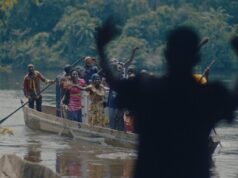
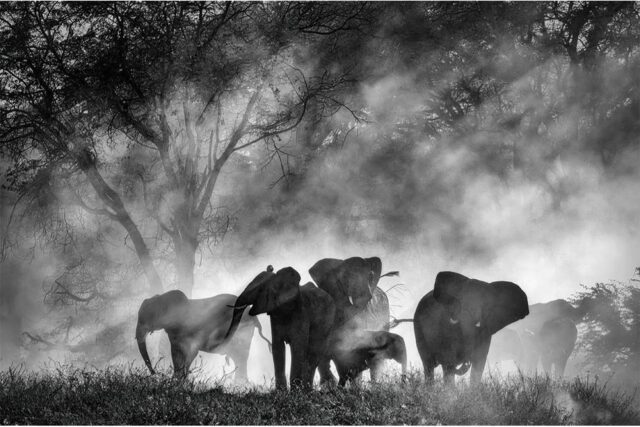
Werner Herzog returns to the festival with Ghost Elephants, a film that questions, in the German filmmaker’s own inimitable style, whether certain epics are not better left unfinished… In the film, explorer Steve Boyes sets off with three master trackers from Namibia on a Moby Dick-like quest for Angola’s rare ghost elephants. The film follows the mission, raising existential questions and reflecting on environmental and cultural conservation in Africa.
Lucrecia Martel’s Landmark deals with the murder in 2009 of Javier Chocobar, leader of the indigenous community of Chuschagasta, by three men who claim to be the owners of the land. The film follows the nine-year struggle for justice, combining voices and images from the community with court footage to explore the consequences of colonialism and land expropriation.
Also in selection is Cover-up, directed by Oscar winner Laura Poitras in collaboration with Mark Obenhaus. The film, fresh from the Venice Film Festival, explores the career of Pulitzer Prize-winning journalist Seymour Hersh, who revealed the US Army’s torture scandals in the Vietnam and Iraq wars.Back in Portugal, an “important and previously unseen film” is As Brigadas Revolucionárias na Luta Contra a Ditadura (The Revolutionary Brigades in the Fight Against the Dictatorship), completed in 1974 by Luiz Gobern Lopes. Between 1970 and 1972, the Revolutionary Brigades fought against the Portuguese dictatorship, capitalism, colonialism, and imperialism. The documentary traces their unique history, from the establishment of the dictatorship in 1926 to the emergence and action of this anti-fascist organization, the divisions between operatives, and the culmination of a history of resistance that led to the Carnation Revolution of April 25, 1974.