

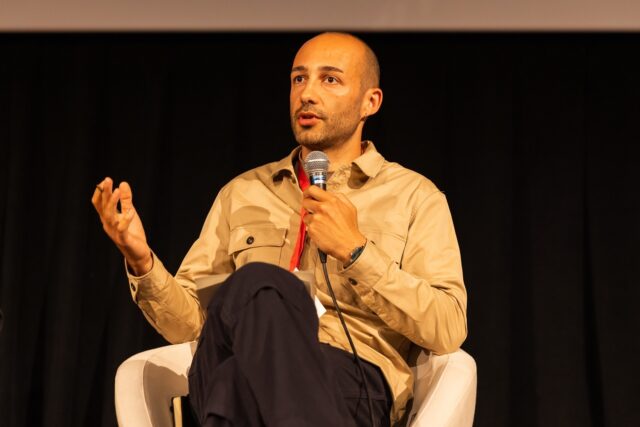
The 5-day DocsBarcelona Industry programme kicks off May 6 with new Head Èric Motjer at the helm, who this year oversees a smorgasbord of project presentations across 4 section sections (Public Pitch, Rough Cut Pitch, New Tech Pitch and Speed Meetings).
At the same time, the Catalan event will look to inform, enquire, challenge and inspire via expert case studies on recent high-profile docs; through masterclasses and conversations with the likes of Albert Serra, John Wilson and the creative pairing of Raymond Depardon & Claudine Nougaret, and via a series of talks and debates on the mechanics of the funding and production processes.
“DocsBarcelona Industry aims to be much more than a pitching forum. It’s intended to be a meeting point for multiple professionals of the non-fiction industry who are coming from different regions in the world,” Motjer tells Business Doc Europe. “Of course, the geographical position of Barcelona makes us a connection point between Latin America, Europe, and the Mediterranean. In this regard, it’s crucial that DocsBarcelona Industry aligns with a top-tier festival with such a significant trajectory in Southern Europe.”
“Both the great work of my predecessor Diego Mas Trelles leading the Industry department and the entire team that has shaped the festival in the past, have been clear that the direction to follow was to find a balance between a selection of creatively challenging projects with co-production potential, and ensuring that the market is, at the same time, a space for analyzing and debating the future ahead,” he adds.
When it comes to project selection, quality may be a determining factor – but it isn’t the sole criterion. The development of new talent, whether from Catalonia, Spain or beyond, has always been a “vital function” of the market, Motjer underlines.
“DocsBarcelona’s geographical position has also influenced the role of Industry in relation to the market,” he adds. “We have been both a natural space for many Latin American projects seeking co-production with Europe and a key point in the Mediterranean capable of connecting the north and the south, facilitating productions.”
“Our guiding principle is an industry-wide commitment to innovation, not only in terms of production or distribution but also in terms of equality. We must contribute to ensuring a future for documentary filmmaking with a more diverse social and class representation, with perspectives that bring us closer to the multiple realities of our world. This is the direction that DocsBarcelona Industry has historically pursued in order to have an equitable selection of projects in development.”
While many in the industry opine that the wider documentary market is overly packed with new projects that may struggle to gain a foothold, Motjer takes a different view, stressing that plurality of voice, form and subject are factors that must be embraced.
“It’s true that, like many markets, the number of submissions has significantly increased in recent years. However, I believe we would be mistaken to see this as a negative thing,” he says. “It’s not just about selecting high-quality projects with production and distribution potential as a market. We need to make an effort to promote projects that challenge classical narratives and preconceived forms of documentaries, and ensure they have a space within the industry. That is, they can be produced and distributed through one of the possible channels.”
“We believe that every project selected for our Forum should contribute something unique to the documentary landscape, whether it’s shedding light on underrepresented stories, challenging societal norms, or pushing the boundaries of non-fiction cinema itself,” he adds. “Our commitment is not only to facilitate professional connections and promote productions but also to become a safe space for the sector to analyze new formats and narrative approaches that will also be part of the documentaries of the future.”
This is evidenced by Motjer’s introduction in 2024 of i+Docs which incorporates the New Tech Pitch, dedicated to non-fiction projects that integrate new technologies, and a conference organized together with electronic music and advanced arts festival Sónar+D on the impact of AI on “the visual conception of truth.”
“There are still many questions to be resolved in the relationship between new technologies and, consequently, new documentary forms with classic documentaries,” he acknowledges. “Festivals will have to find, in the coming years, the most appropriate exhibition slots for these projects, but also the relevant forms of financing in a market that seems to suffer from constant crisis.”
“Personally, I am sure that in the not-too-distant future, this differentiation will be unnecessary, but at this moment of transition, I hope that i+Docs serves as a gateway for the sector to the new technologies integrated into the field of non-fiction.”
Of course, the Catalan industry is a core and necessary component of DocsBarcelona, and the festival serves to present its doc exponents on the global stage. “[It is] the professional window open to the world of local talent that has achieved multiple international recognitions in the last 20 years. This internationalization has also been driven by markets like ours that have facilitated the creation of networks, professional connections, and a creative exchange that is essential for the success of the sector,” Motjer says.
The Industry boss further expresses his excitement at three professional case studies this year, featuring “three very different kinds of projects.” One of these case studies concerns Light Falls Vertical, directed by Efthymia Zymvragaki and which screened at Docs Barcelona in 2023. “Together with Andrea Prenghyová from Dok.incubator, [she] will delve into the intricacies of the creation and production process of a project that initially had everything against it to succeed,” comments Motjer of the Spanish/German/Dutch co-pro.
“On the other hand, the multi-award-winning Catalan director Albert Serra will also participate in a case study where he will present his first foray into the world of non-fiction [Afternoons of Solitude], a project that is currently in the editing phase,” he adds. “We also have Piotr Winiewicz, director of About a Hero, one of the hybrid works that has generated the most anticipation, where an artificial intelligence trained with all the scripts of director Werner Herzog has created a script that has been reinterpreted by Winiewicz.”
Motjer further expresses how two masterclasses from Estephan Wagner and John Wilson are going to be particularly inspiring for the professional audience of DocsBarcelona.
With Wagner, the professional audience is invited “to learn from his award-winning expertise and gain insights into how he approaches stories, always from the point of view of their protagonists, to elaborate compelling narratives that resonate worldwide, as showcased in his latest acclaimed work as editor and co-writer, Daughter of Genghis, directed by Christian Als and Kristoffer Juel Poulsen.” The film is selected for DocsBarcelona 2024.
“Wilson is one of those few directors who combine two elements that I deeply admire,” Motjer adds of the US filmmaker. “One is an unlimited ability to bring storytelling wherever the work requires it, without limitations or preconceptions of form or theme, and to do so with an agreement of absolute sincerity between him and the viewer. The other is his own perspective, seemingly superficial but extremely profound, through which he reconnects us with human essence through the mundanity of life.”





