With incredible creativity, care and integrity, Maria Esteve Silvia has made a film that is as compelling as it is harrowing about the traumatic impact of abuse within the Catholic Church and the exhausting struggle for justice.
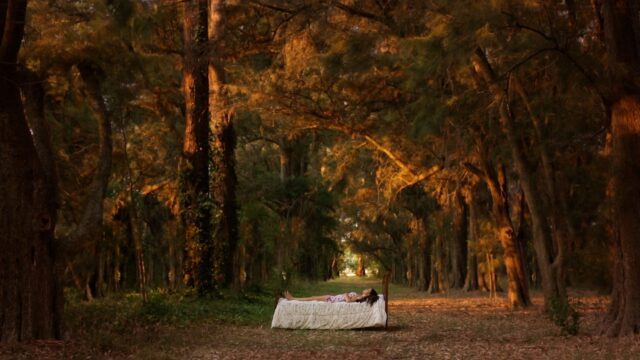
The documentary, which bears the name of its protagonist who is also the narrator, begins almost like a fairy-tale, with a voice-over announcing that it will tell a story. A story about a girl, born of pure, true love. The image is that of a beautiful forest in autumn colours, in which there is a bed with the young woman on, it telling the story to her daughter. But the image is disrupted and taken over by a threatening, dark presence…
Throughout the film, filmmaker María Silvia Esteve uses experimental visual forms to depict the trauma on which the documentary is based. The often-distorted images evoke feelings of threat, unrest and fear, without being explicit. They return in varying forms to accompany, support and even interpret the story of Mailin, who grew up in a loving family with her father, mother and younger sister, and became a victim of a priest in the Catholic church where the family worshipped.
To be able to raise her own daughter, and give her the childhood that she herself was so brutally denied, Mailin has to face her demons. She does it through therapy and her brave collaboration with director Esteve.
It is uncomfortable to watch the many video clips of Mailin as a child, at home with her family, but especially in church, where much of her social life took place. The images often linger on the appearance of Carlos José, the priest who managed to talk his way into the lives of many families in the Argentine community, presenting himself as a kind of special relative. With the knowledge we have now, it is almost impossible to watch without a knot in your stomach as he cheerfully dances and plays with the children and, in his priestly robes, proclaims how much he cares for them, the children he himself never had.
The personal archive material, which also shows the girls as teenagers, is interspersed with images of Mailin, her younger sister, her mother and her friend (and fellow victim), who talk about what happened, and the impact it had on their lives and their relationships. In addition, there are images and audio recordings from the courtroom where, after years of wrangling with the Catholic authorities, a trial against the abuser finally took place.
And there are recordings of Mailin with her daughter and sister in places where she tries to face her traumas. All of the different types of material are very masterfully edited into a flowing, gripping, balanced tale.
It is particularly impressive how Esteve, who spent eight years making the film, manages to convey the feelings of Mailin and her immediate family without any sensationalism or unnecessary drama. From the very first moment, you are gripped by the combination of images, the accounts of all those involved and the way in which – with enormous care – the search for justice unfolds.
Mailin could easily have focused primarily on that terrible injustice and the way in which it was (and still is) perpetuated by the church institutions and a failing legal system. But it focuses on the personal, deeply profound consequences of the trauma for the victims and those around them, who continue to struggle with feelings of powerlessness, guilt, shame and anger. The film should get a lot of attention, if only to raise more awareness and acknowledgement of the immeasurable trauma these crimes cause.
Argentine, 2025, 89 minutes
Director: María Silvia Esteve
Production: María Silvia Esteve for HANA FILMS, Alejandra López for Ikki Films, Cristina Hanes for deFilm, Radu Stanca for deFilm
Producer: María Silvia Esteve, Esteban Cuenca
Cinematography: María Silvia Esteve, Andrea Cabrera
Animation: María Silvia Esteve
Editing: María Silvia Esteve
Sound: María Silvia Esteve
Sound Design: María Silvia Esteve, Filip Muresan
Music: María Silvia Esteve, Ieronim Pogorilovschi, Codrin Lazăr
Screenplay: María Silvia Esteve
Narration: Mailin Gobbo
World Sales: The Party Film Sales