

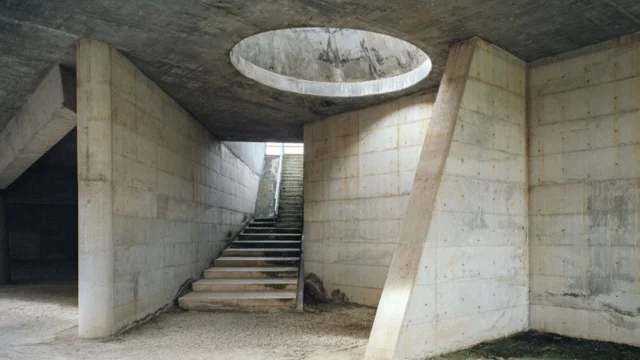
Enric Miralles was the visionary Barcelona-born architect whose commissions include the Scottish Parliament Building in Edinburgh and the Igualada Cemetery, famous for the way it seems to merge into the landscape. He died of a brain tumour age only 45 in the summer of 2000. Now, he is the subject of Miralles, the poetic and enigmatic new feature documentary from Italian director Maria Mauti, screening in Official Competition at Docs Barcelona.
“My meeting with Enric Miralles was determined by chance, by a lucky encounter with the character, like when Enric himself said, ‘you put your hand in the pocket of a second-hand jacket, and you find something you didn’t expect,’” the director says of the unlikely chain of events that led to her making her movie.
After Mauti’s film L’Amatore, about the Milanese architect Piero Portaluppi, was shown at the Locarno Film Festival, she had been looking for a subject in Barcelona. She remembers being very struck by the Gas Tower, a Miralles-designed building near the seafront that you can see from across the whole city.
“I was interested in this mutual and iconic relationship with the landscape. Then I started asking who Miralles was at ETSAB University and in an instant, I understood that his story and his creative process made him the character of a film.”
The fact that the architect had died young and was buried within his own architecture, in the Igualada Cemetery, touched her emotionally.
“From that moment it seemed to me that his life and his work were inextricably linked.”
For Mauti, Barcelona is the “city of Miralles.” His presence is felt there everywhere. Some of his buildings may be abandoned and close to ruin but his influence remains as powerful as ever. She met other architects who’ve taken inspiration from him, and worked alongside him, most notably his partners Benedetta Tagliabue and Carme Pinós.
The structure of the film is based on a text that Miralles wrote, inspired by Alberto Giacometti’s ‘Portrait of James Lord.’ This essay was published in a book Conversaciones Con Enric Miralles, edited by Carles Muro
“I was very impressed by this concept of Giacometti’s 18 variations to create the portrait of James Lord; if you look for them you will understand why. It’s like a struggle with the visible and the real. Giacometti stated: “Yes, art interests me a lot, but reality infinitely more… The more I work, the more I see differently, everything becomes bigger day after day, everything becomes more and more unknown, more and more beautiful.”
Miralles felt a connection between Giacometti’s process of creation and his own, “a process of variations on the same thing, in a musical sense” she says.
Mauti’s own film takes the form of 11 variations without an ending. “An unfinished film, as were his works,” the director reflects. I wanted to maintain the idea that Miralles is indefinable, he is a character who is at times elusive and incomprehensible.
Sara Mesa co-wrote the film. Mauti praises her “extraordinary” work in creating a multifaceted and multi-layered story.
The voice-over that runs through the documentary is deliberately that of a young man. It is intended to have the “liveliness of Miralles; because everyone who knew him has aged in these years, Enric has remained as he was, stopped in time by his premature death. And so we see him appear in the film.”
Music also features prominently. Anahit Simonian has composed original songs while the soundtrack also features baroque music from Bach and Purcell.
Mauti has made several other biographical documentaries on artists, musicians and dancers, ranging from Daniel Barenboim to Pina Bausch.
“My subjects always arise from an internal drive, a need to say something. For now, they are linked to biographies; there is something in the lives of others, extraordinary characters, that I feel can have a powerful message in the present,” she reflects on what draws her to such personalities.
Portaluppi, the subject of her doc L’Amatore, was an architect who did most of his ground-breaking work during the fascist era.
“Miralles is a completely different matter,” she says of the contrast between the two men. For Miralles, it didn’t always matter if the work wasn’t completed. The concept of ‘inacabado – unfinished,’ is essential in this story,” the director says. “Is there a life that is over? Is there a clear line that separates the visible from the invisible? Can architecture and the spaces we live in help us answer this dizzying question about our existence? The film’s journey tried to continue to question this appearing and disappearing, almost an infinite cycle in movement and transformation. The film ends with a joke: ‘y vuelta a comencar! – and start again!’”
The documentary is scrupulously researched and includes rare archive material made available to Mauti by Benedetta Tagliabue and by the Enric Miralles Foundation. “I was lucky enough to have great support and enthusiasm from everyone; they knew it was an important film because Miralles’ [life story] had not yet been told in a film.”
She speculates that the fact she was a foreigner, an Italian director, not an insider, may have given her extra creative “freedom and breadth” that a local would have lacked.
Ask about her favourite Miralles buildings and she replies that The Scottish Parliament, designed together with Benedetta Tagliabue, is “certainly one of Miralles’ masterpieces.”
“We studied it [the Parliament] thoroughly before shooting it, and then we were impressed when we saw it live. It is architecture of extraordinary complexity and at the same time unsettling, which in the film we relate to the complexity of the brain, the most mysterious organ.”
The film is a production between Spain (Oberon Media) and Mexico (Mostro Films), with the associated involvement of Film Mauti. It was financed through ICAA (National Funds) ICEC (Catalan Regional funds), TV3 (Regional TV), also with the collaboration of Barcelona Council and COAC (Col·legi d’Arquitectes de Catalunya). Mauti talks of trying to bring the film “to as many people as possible.” Madrid-based outfit Feel Sales is handling the international rights and leading arthouse VOD platform Filmin is already aboard.
Alongside her documentary work, Mauti has a parallel career as academic. “I was very struck by the fact that on the walls of Miralles’ tomb in the Igualada Cemetery there are many messages written by young students from all over the world, almost as if he were a pop star! So, for me they are two related activities, that of director and that of teacher, which feed each other…”





