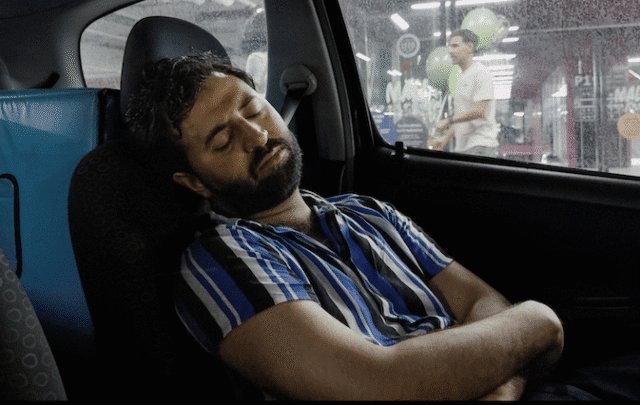
The life of a food courier can be a somewhat tedious one. They drive all day and all night in cities that never sleep. If couriers themselves get to sleep, it will be in their car in-between collections and drop-offs. What’s more, they get paid a pittance and virtually nobody gives a tip.
In feature debutant Joel Karppanen’s Labour Day, pitched in Barcelona by the director and Finnish producer Pasi Hakkio (Wacky Tie), we meet dozens of such couriers who, while retaining their individuality, together fuse into a kind of composite character – “a collective body of a modern worker.”
“Across the world, they [couriers] face eerily similar realities: the street is the factory, the algorithm is the boss,” the director writes in his notes for the film. “Through their windshields we observe middle-class workers all over the western world rushing to offices, to their families and to paid holidays – all oblivious to the ‘platform proletariat’ that provides their comforts.”
In the film, everything comes to a head on May 1, Labour Day, the day when the workers of the world unite in taking the day off – but nevertheless expect to be served by the couriers.
“Couriers begin to organize online and across borders. Resistance remains fragile. Some couriers glimpse the power of collective action, while others retreat into survival mode, yet their resilience plants a seed of change,” Karppanen writes.
“The film unfolds in hypnotic, long takes shot entirely in the moving cars of the couriers. It immerses us in the rhythms of their labour and city life, dissolving the boundary between worker and consumer, observer and participant. The film reframes the gig economy not as a distant phenomenon, but as a mirror reflecting social and economic forces shaping the lives of us all.”
“This is not just a film about food couriers but also about us. When I say us, I mean those in the middle class who have seen themselves as separate from workers; those who believed that ‘platform labour’ was something happening to others,” Karppanen continues.
“But we, too, are dictated by algorithms, surveilled, pressured to be ever-available, optimizing ourselves for the market. Our precarity, alienation, and dependence on platforms is part of the same system we sustain by not questioning it. Art’s most radical potential lies in form. Methods shape political significance, not just the subject matter. In this film, form and content are inseparable. The dual perspective — cameras inside and outside the car — is a structural reflection of the themes, and a metaphor for how we experience modern life: simultaneously participating in and observing the structures that control us.”
In Barcelona, Karppanen further underlined the socio-political implications of his story. “The platform economy is not just something that’s happening to others, it’s affecting the lives of us all. Labour Day is an immersive multi-character documentary where you are locked inside the cars of food couriers, riding along them through the bustling cities around the world. We want to show the new working class who are everywhere yet remain unseen – and through the windshields of their cars we will see ourselves in society.”
The budget on the project is 410,000 euros with 296,000 euros still to be raised. In Barcelona, producer Hakkio is looking for funding, co-pro partners and sales representation.
“Working with Joel…has been a very pleasant and productive experience. It is not often that a director has so clear a vision of his work, and that vision is also working in practice,” he enthuses of Karppanen. “We have been also very happy to notice that Joel is open listening other people’s opinions but can still separate which of the feedback is helpful for his work. He has also good attitude on documentary fil making, where the director’s voice can be seen and heard. Documentary filmmaking is about delivering subjective perspective, not just recording facts.”