

“The chaos of war not only tears apart the physical world but also fractures the Militantropos’ sense of self,” reads an intertitle early on in Ukrainian feature doc Militantropos (sold by Square Eyes and world-premiering in Quinzaine on May 21).
The film, the first part of an envisaged trilogy being made by the collective Tabor, was first conceived in late February 2022 – just a few days after the full-scale Russian invasion of Ukraine. Its title comes from a play on ‘milit,’ Latin for ‘soldier’, and ‘antropos’, which means ‘human.’ The directors are Yelizaveta Smith, Alina Gorlova & Simon Mozgovyi.
“We were in different places in the country. Filming was our initial response to all the horrible things that were happening to us,” Mozgovyi remembers that fraught period immediately after the invasion. They decided quickly to pool resources and to work on a project that would offer many different perspectives on the war.
Even before this, as part of filmmaking collective Tabor, Mozgovyi and co-directors Smith and Gorlova had been collaborating closely on each other’s projects. “We were working a lot together in different roles. We were kind of formed by each other,” says Smith. Other collaborators on Militantropos include Tabor co-founder Maksym Nakonechnyi (who was in Cannes with his fictional film Butterfly Vision in 2022).
The intention, Smith says, was to “look much deeper into the nature of war.” Gorlova adds that, “our intention to film was also connected to the idea of documenting war crimes.”
After an initial stint of shooting, the filmmakers assessed their material – and realised they already had a huge 70 terabytes of material, clearly enough for more than one movie. “We chose it like this, that the first film will be about the transformation of a human within the war. The second film will speak much more about death and how death influences society, and the third will be about the connection between the war in Ukraine and the world outside,” Gorlova stresses.
The three filmmakers acknowledge that their own sense of self has been shattered by the war. “This is how war works and this is how trauma works. It’s very important to rearrange everything in your life and in your mind, to rearrange your memory and to build a narrative,” Gorlova reflects on her own experiences over the last three years. “From a personal view, it was hard to accept all these events and it was important to see some love in all of this.”
Co-director Smith is a mother as well as a filmmaker. Her son is five years old and she finds it impossible to explain to him what is going on. “It puts you in a situation where you are questioning yourself all the time about what you should do: should you leave the country for your child to have a peaceful life, or should you stay and film the war and construct for him a normal life here [in Ukraine]?”
Filmmakers also have to ask themselves whether they should enlist and fight – or whether it is more important to chronicle the war. “We are very lucky to have this tribe, Tabor, of friends, of filmmakers. It really has helped us all stay ourselves. I would say that all of us working on the film had issues with mental health because the topics and scenes we were working on traumatised us and then re-traumatised us over and over again.”
Mozgovyi describes the process of working as a DOP as a “tool” that helped him hold onto his self-identity at a time when he felt caught in a “limbo” without a past or a future. “You start to block memories because it is so painful to think that these places where you were formed will be taken from you,” Smith observes.
Death seemed to be edging closer. “You really understand that on this night, with the shelling, this rocket can hit your house. You don’t know whether you will wake up the next morning or not,” notes Gorlova. “That’s why you start to find big values in very small things that you probably didn’t notice before.”
Nature took on an added resonance in all their lives. “It’s like when you’re in the middle of the battlefield and the shelling and you see a flower in the trenches. It is something that gives you a feeling you are alive and that you exist. Maybe this is underrated when you’re living your civilian life, not thinking about it.”
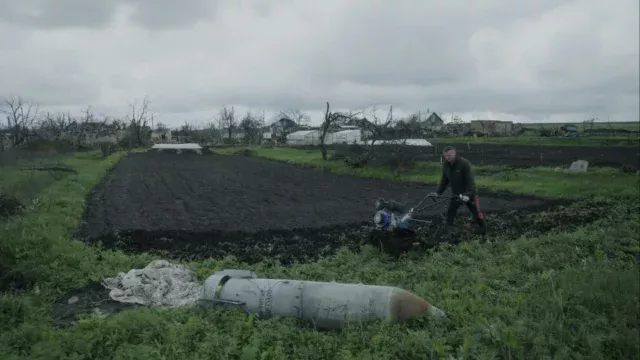
Miliitantropos provides vignettes of all parts of Ukrainian society in wartime. There are funerals, sequences of overcrowded railway stations, footage of farmers in the fields, scenes form the front lines, images of old ladies singing songs together and sequences showing youngsters on the verge of conscription. The filmmakers don’t reveal the names of the people we see on screen. They’re all part of a bigger collective experience. Life is carrying on. Kids still play in parks. Residents are coming back to their villages or destroyed cities even after they’ve been bombed. Their emotional connection to their homeland is obvious.
“Our main focus was the transformation of the human. The first part of the film is showing the chaos of the war when people decide whether they should go away or take [up] weapons. Our army is an army of civilians and we really wanted to reflect this. The second part of the film is about collective experience when the war starts to be part of your everyday life. The third part of the film is shot and edited in close-ups. We are very close to the person when war is part of him and he starts to be a part of war,” Smith explains the structure. “This was our concept that we crystallised from a huge amount of material in the editing.”
Ukraine is a huge country. The filmmakers try to give a sense of its size and variety. One goal of the filmmaking process was always to give subjects a chance to express themselves.
In one early shot, a frail old lady is shown walking slowly down the street as a group of foreign press walk alongside her, filming and photographing her. It’s a strong image for them but it also rises ethical questions about the sometimes predatory way in which western media are covering the war. Foreign news outlets can come into Ukraine and can then leave again. For the Tabor team, though, it was crucial to respect their subjects, to show empathy, and not to exploit their suffering in any way.
“It’s important to stay human,” says Mozgovyi. “That is what we are trying to do with this film. We use long lens optics so as not to come closer to the people affected by events happening to them. We are trying to help people. There were lots of times people wanted to say something on camera. We [know] we are probably not going to use this footage but we film it because we believe that it’s a way to help.”





