Uruguayan Agustín Flores’ highly personal documentary interweaves the story of Jorge Firpo, a legendary horse trainer, with the director’s own journey through the pain of his father’s suicide. As their paths intersect, the film becomes a reflection on resilience and the courage to keep going.
The Uruguay/Catalan feature project, which is presented as a Rough Cut at DocsBarcelona Industry, is produced by Raquel Ferreiro, Valentina Ferreira and Alejandra Linn for Trapecistas Producciones, Ramona Cine, Zona Cielo Films and Insumisa Films. In Barcelona, the team is looking to close the €86.976 budget.
“Suicide remains a taboo issue and one of the greatest challenges contemporary societies must confront,” director Flores tells BDE. In Uruguay, suicide rates continue to rank among the highest in the world. This documentary seeks to create a space to speak about mental health, the loss of a loved one, death, as well as resilience and healing.”
“At the same time, the film explores themes of family legacy and the father-son relationship: learning to honour those who gave us life while also choosing to live differently, and to face defeat and adversity in another way. Having a passion — whatever it may be — becomes essential in order to endure life’s most difficult moments.”
Producer Ferreira outlines the strength both of Flores, and the story that he is telling, in the process revealing her own personal interest in the story.
“The Curve (La Curva) is the second documentary by Agustín Flores. I joined the project as a producer because I was deeply moved by his genuine need to tell this story from an intimate and personal perspective,” she says. “In a context where men still struggle to speak openly about mental health, the fact that Agustín does so through his own experience, with honesty and sensitivity, feels both brave and necessary. It also resonates deeply with me on a personal level, as my father died by suicide too when I was a teenager.”
“The documentary moves between two narratives and seemingly opposite worlds, which ultimately intertwine in an art-house essay film reflecting on the meaning of life,” she adds. “From the very beginning, our goal was to achieve a high artistic standard. That is why we participated in several Work in Progress programs, which enriched the material and allowed us to reach a near-final cut that we are very satisfied with.”
The documentary was selected for Cannes Docs and previously at DocsBarcelona, and was highlighted as one of the six Spotlighted Projects at the Marché du Film 2025. “These recognitions validate years of work and encourage us to move forward with the next steps: finding a specialized sales agent and securing a premiere at a prestigious European film festival.”
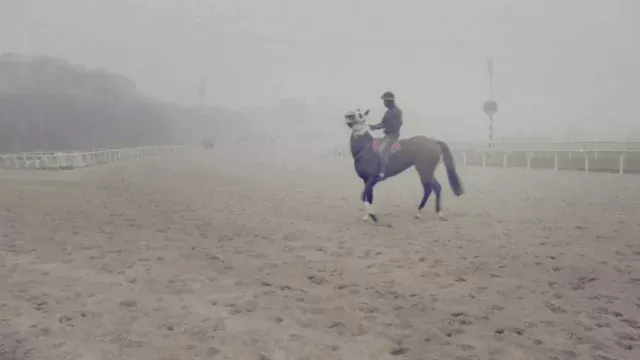
Director Agustín adds: “Our main character is Jorge Firpo, a legendary horse trainer. But beyond that, he became a symbol of emotional resilience. Someone who knew how to live with passion and wisdom. For twenty-five years, he trained an apprentice to carry on his legacy. This documentary follows his final great race.”
“At the same time, it traces my grieving process after my father’s suicide. The Curve explores the cycle of life within a fiercely competitive world where animals stand at the centre and people trade in illusions.”
“Leaving the track is inevitable — it will happen to all of us. The question is: how do we make life worth living before that moment arrives? Because a life without passion is a life without meaning,” he further advises.
The documentary will be infused with an art-house aesthetic, “through the combination of diverse cinematic resources that evoke and reflect on themes such as legacy, succession, passion and death,” Flores stresses.
Agustín further outlines the film’s lists cinematic qualities. “Its structure interweaves performative sequences built around my voice-over and still photographs from each character’s personal archive, primarily exploring the storyline surrounding my father; montage sequences composed of archival footage from different eras of the Maroñas racetrack, revealing how the same passion and fervour have endured among fans across generations; observational sequences within the world of horse racing, following the preparation for Jorge Firpo’s final race and the emotional and psychological strength involved in the generational handover to Mansito Varela, and slow-motion sequences and sound-driven passages with minimal musical presence, reserved exclusively for the horse races.”
Impact is, of course, a core element within the story and its telling. “Suicide is a global issue, but in Uruguay it has become an urgent crisis,” Agustín laments. “The country’s suicide rate is twice the average of the rest of Latin America. Every year, a thousand Uruguayans meet the same fate as our fathers. We know the facts, yet we remain silent. We hope this film can open new conversations about mental health.”