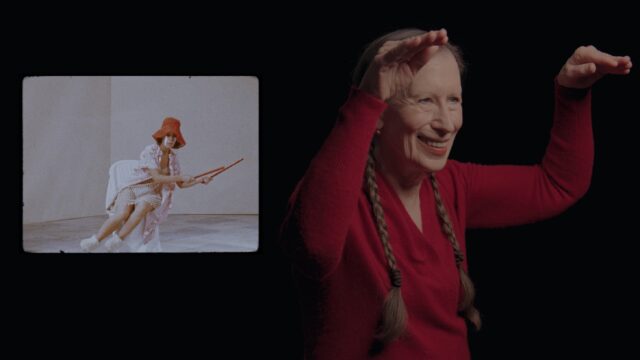
A New Yorker with an astonishing voice and the most vagabond of creative sensibilities, 82-year old Meredith Monk is the genius that few people have ever heard of.
“You’re not alone,” director Billy Shebar says of the subject of Monk in Pieces, sold by Cinephil and selected for Visions Competition at DocsBarcelona. “I mean, it’s a very common response from people who know a lot about music. I’ve talked to people who’ve had a whole career producing music documentaries, and the first question they ask is, ‘is she related to Thelonious?’”
Meredith inherited the instrument of her voice from a mother who was never out of work as singer of jingles , but as a young girl she had eye problems which meant she had a squint all her life. This also meant she had to develop a “tough mouth” to defend herself.
She also had a revelation in early life when she discovered her sense of musicality through her body. For Meredith the voice could be like a “spine” or a “hand.” Mere words were something that could get in the way of communication, whereas vocalising from the gut was primal. And as such, the voice was the “first instrument.”
She was also a fantastically expressionist dancer.
The 1960s and 790s in New York was a place of great creativity, expression, unity and ‘happenings.’ “I wished that I had been able to live through that period in New York because it was a time where rents were very cheap, and Soho and Tribeca and artists could get these big loft spaces and they could do performances there, and it was very experimental,” says director Shebar. “People were crossing over from one discipline to another. There were filmmakers writing poetry and poets making artworks. And so she was very much part of that scene. And I think that was a scene where people were pursuing it for the sheer joy of it.”
But Meredith also remained in control of her art. Her standards were exacting. And musical compromise was out of the question. “I love that singular decision that she took, that she wasn’t going to go down the same route that her mother took of being, as you say, the commercial jingle writer. Every subsequent decision was governed by that particular mantra that she had.”
Not that the New York critics (ostensibly male, and led by top dog Clive Barnes of the New York Times) were impressed by her experimental approach to the hallowed operatic form that they (obviously) understood better than most. Their reviews were condescending in the extreme, and downright nasty at other times. “One wonders does she really know what she’s doing,” wrote one, while another opined that she was “weighed down by her narcissism.” Barnes called her “a disgrace to the name of dancing.”
All of which affected both her audience numbers and her confidence – and her bank balance. So she modelled and danced for survival, at the same time that Philip Glass drove taxis around New York to fund his art.
“I was really fascinated with what it took for somebody to just keep going, keep going, who had an idea, who believed in it, and just kind of kept on with it,” says Shebar of his desire to make his film about Monk. “So it was kind of those two things. It was loving her music and also learning more about her and the kind of extraordinary resilience and single-mindedness that it took to do what she did.”
Shebar’s wife Katy auditioned for Monk’s ground-breaking ‘Atlas’ in 1989 and has been a close collaborator ever since. “So I’ve had this great front row seat, and that was the first time I heard her music. It really blew my mind, and more and more I appreciated what she does with the voice, the way that without using words for the most part, she manages to evoke all of these kinds of characters, scenarios, emotions, tragedy, comedy.”
The director was further determined to approach his film in a “modular” way, telling Monk’s story through her songs. “I knew I was not going to do a traditional biopic approach. I really started with the music. I was going to pick the songs that really affected me the most, and then look for ways through scenes or visual material that I felt went with a particular song, and then craft a piece of this mosaic that way.”
Call Monk ‘avant-garde’ and she will give you short shrift (albeit in a kindly way). “Meredith really hates labels and rightfully so. She wants to just be seen as an artist,” Shebar stresses. “She sees avant-garde as relating to a particular period in history…that it kind of automatically segregates you, like you’re really unapproachable by most people, and she doesn’t want to be thought of that way.”
Even though most people won’t know Meredith, they will have come across her music, whether in David Byrne’s directorial debut True Stories, in The Big Lebowski or in True Detective. The Canadian synchronized swimming team performed to one of her songs at the Olympics in 2000. A Star Trek audio book has used her vocal language for one of its characters and most recently her music features in the global streamer hit Baby Reindeer. “So whether she wants it or not, she’s being adopted by the culture at large,” says Shebar.
The film’s key interviewees were more than willing to participate, the director says, even if there were logistical problems at times. “With Björk, Meredith was able to get the ball rolling, but even then it took the better part of two years to finally pin her down for a 20-minute interview.”
For David Byrne, Shebar’s former business party had a direct connection. “He [David] was just incredibly gracious and wonderful. He came into that [New York loft] scene, I think, on the tail end of it. He was a bit younger, but he really looked up to her. I think he saw one of those early 70s productions of Meredith and was like, this is really interesting. As he says in the film, it kind of gave him permission.”
“It showed him possibilities that things you could do with a voice that weren’t just about the words.”