“I have spent more than fifteen years moving between the roles of documentarian, activist, and woman. Before arriving in Akbelen in 2021, I had been questioning why I was repeatedly drawn to documenting struggles shaped by questions of life and survival,” Turkish director Selen Çatalyürekli comments of her feature project Women of Akbelen Forest, selected for Docu Rough Cut Boutique, and presented this week in Sarajevo. where it won the Movies That Matter Award.
“Through Akbelen, I began asking why women so often stand at the forefront of ecological struggles. I want audiences to experience these transformations.”
The logline of the 80-90 minute project, mooted for completion in 2027, states how, “in a village on the edge of an expanding coal mine in southwest Türkiye, five rural women – olive farmers and housewives – transform from neighbours into forest defenders, public spokespersons, legal defendants, hunger strikers, and village chiefs, as their collective struggle reshapes both their lives and the landscape around them.”
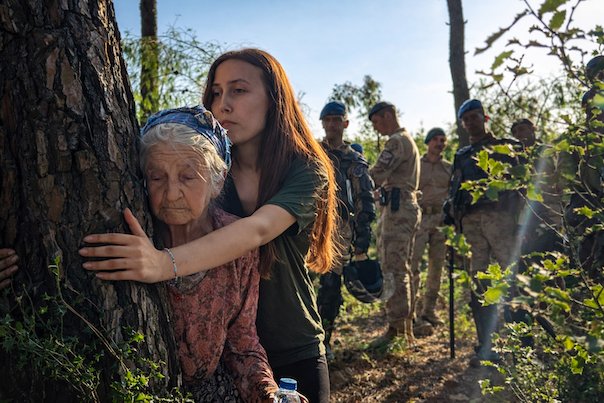
Akbelen Forest is “the last natural barrier” between the mine and the women’s community, and the film traces the women’s personal and collective transformation: from limited public action to galvanising press activity, non-violent direct actions, hunger strikes, and local elections.
“Weaving together observational footage, villagers’ mobile-phone recordings, archival material, and map-based strategy-game sequences, the film situates this local ecological struggle within a global ecofeminist framework,” the synopsis underlines. “Why do women so often stand at the forefront of environmental defence – and what does their resistance reveal about the possibility of living otherwise?”
Director Çatalyürekli adds: “Inside the forest encampment, I watched women become organisers, spokespersons, and leaders as their relationships with one another and their sense of themselves transformed. As the violence escalated during the 2023 tree-cutting, my own position also shifted – from observer to participant. Coming from urban activism, I knew the gender dynamics of ecological movements but very little about rural life, where land, livelihood, and resistance are inseparable. Through Akbelen, I began asking why women so often stand at the forefront of ecological struggles. I want audiences to experience these transformations.”
Fledgling Turkish producer Zeyneb Gültekin is looking to secure a sales agent after picture lock, as well as distribution and broadcast deals. She is also looking to close the budget during Sarajevo.
Gültekin may be a first-time producer, but as a civil society professional she has over fifteen years of experience in human rights, humanitarian assistance, and advocacy.
“Women of Akbelen Forest brings together many of the themes that have shaped my professional life – human rights, community resilience, and collective action in the face of powerful interests – and it was this connection that led me to join the project as a producer,” she comments. “Having spent my career working on human rights, humanitarian assistance, and civil society, the struggle in Akbelen immediately resonated: a community defending its rights, its environment, and its future against exactly the kind of powerful interests I have spent years working to hold accountable.”
She further underlines Çatalyürekli’s credentials in delivering the film. “What convinced me to join the project was not only the urgency of the story, but also the depth of director Selen’s relationship with the community. Over four years, she gained a rare level of trust and proximity, documenting not only a resistance movement but also the personal transformations taking place within it. The result is an intimate and nuanced portrait of women whose lives became inseparable from a broader fight for environmental justice.”
“At a time when environmental defenders face increasing pressure around the world, I believe this film offers a powerful testimony to the resilience, agency, and leadership of local communities. My hope is that it will connect audiences far beyond Türkiye and contribute to wider conversations about climate justice, democracy, and collective action,” producer Gültekin ends.