

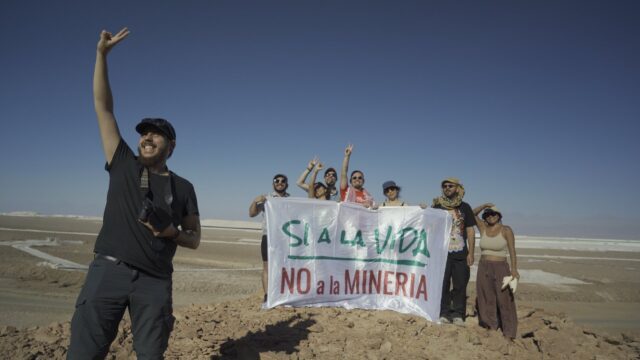
All We Have Is Us, which was the headline title of Sarajevo Film Festival’s Human Rights Day, traces a fragile line of connection between two fundamentally different communities on opposite sides of the globe: Chile’s Atacama Desert and Serbia’s Jadar Valley. The one thing that connects both is their existential struggle against lithium extraction, and the far-reaching ambitions of Rio Tinto, one of the world’s largest mining corporations.
In Chile we meet Leyla Noriega, an Aymara journalist and defender of her ancestral lands, whose radio broadcasts articulate and lead the resistance to the mineral extraction. Meanwhile Bojana Novakovic, a Serbian actress and environmental activist from the Mars Sa Drine resistance movement, confronts the potential destruction of the village that her mother calls home. Another core character is Chad Blewitt (CEO of Rio Sava, subsidiary of Rio Tinto) who tows the company line, all the time emphasising that such operations should be conducted “in my back yard,” so as to safeguard against unscrupulous lithium extraction being undertaken elsewhere by organisations he considers less trustworthy than Tinto.
As Leyla and Bojana’s worlds begin to intersect, distance gives way to solidarity. Farmers, activists, artists, and communities on both sides of the continent form an evolving network of resistance, bound less by ideology than by lived experience. In the face of institutional power, exhaustion, uncertainty, and the ever-present possibility of displacement, these human connections become a form of sustenance — and, ultimately, of resistance in themselves.
“As filmmakers who migrated from the Global South to Europe, we live inside a painful paradox,” directors Juan Francisco Donoso and Aline Juaréz underline in their film notes. “We walk down quiet European streets, powered by ‘green’ energy, knowing exactly what is being destroyed back home to sustain them. This film was born out of the need to confront that contradiction. All We Have Is Us is a film that captures the defence of life so that it is not mined away.”
Furthermore, the film shows how persistent, unified action can be effective in countering the ruthless activities of multinational companies who profess to be acting for the common good. After a demonstration in Belgrade by 140,000 marchers, the Serbian government cancelled all Tinto contracts – yet the EU continues to support lithium mining in the name of green transition. And while local protests may be successful around the salt flats of the Atacama Desert of Chile, the company can simply (and efficiently) move its profit-making operations to another part of the country.
After five years chronicling the activities of Leyla and Bojana, as well as other activists, such as Ramón Balcázar, a researcher, photographer and member of the Alliance for Andean Wetlands, and Vladan Jakovljević, a beekeeper from the Jadar Valley and member of the Ne Damo Jadar organization, how do Donoso and Juaréz feel on the film’s completion and selection for Sarajevo?
“It is a deeply emotional mix of satisfaction and grief,” they tell BDE. “On one hand, we feel immense relief, and proud that we overcame significant hurdles to bring this story to the big screen. We fulfilled our promise to the communities to present their struggle with dignity, rigour, and cinematic care.”
“On the other hand, we are very sad. Our dear friend and lead protagonist, Leyla Noriega, passed away before the premiere,” they lament. “Having her watch earlier cuts and guide us with her feedback was a gift, but her absence at the finish line is profoundly felt. Her passing, alongside the stark reality of what we witnessed while filming, such as mining giants like Rio Tinto making geopolitical pressure and European frameworks like the Critical Raw Materials Act [an EU regulation of May 2024], reminds us that our work is far from over. The premiere isn’t an end point; it is the launch of a new phase of struggle. That is precisely why we are launching a major impact campaign alongside the communities.”
In the film, beekeeper Vladan stresses how “we are facing a predator who has no compromises…for the sake of profit he will run over everything,” and there is no doubt that throughout the production, the Rio Tinto company was keeping a very close eye on the filmmakers.
“Filming in high-stakes extractivist zones naturally carries tension, [such as] the first time we were contacted by Rio Tinto via our translator for an interview,” Donoso and Juaréz recall. “We don’t know how that happened because we didn’t write anything on social media and just five activists knew that we were there. That was very weird and that was at the very beginning of the project. At one point in the Atacama Desert, we were directly threatened by mining security personnel. Given the contexts we operate in, we maintain strict physical and digital security protocols, remaining cautious about what we share and how. At the same time, we keep this in perspective: any pressure or risk we face as filmmakers it’s nothing in comparison to what local movements and land defenders endure every single day.”
The impact potential of the film is enormous, given the volatile subject at its core. Yes, it is a highly cinematic piece of work, but it also functions as a “central toolkit” to get the message across to wider public, governmental and policy-making audiences. The filmmakers list four key pillars of their campaign:
- Grassroots & transcontinental solidarity: Hosting community screenings across mining-affected regions (from the Atacama Desert to the Jadar Valley, and beyond as funding allows) to reinforce mutual support, shared learning, and collective agency between Latin America and the Balkans.
- Policy & institutional accountability: Bringing the film directly into power corridors, including the European Parliament, policy forums, and Annual General Meetings of mining companies and pension funds. An aim to confront decision-makers with the human, ecological, and democratic costs hidden behind energy supply chains, digitalization, and militarism.
- Disrupting the “green” narrative: A need to engage with sustainability summits, universities, and climate spaces to challenge the myth that sacrificing sacrifice zones is acceptable for Western decarbonization, digitalization and national security. This means to go to spaces where they still think that technology can solve the environmental and climate crises in these time-sensitive political moments.
- Coalition building: Partnering with civil society allies (such as the Bertha Foundation, Rosa Luxemburg Stiftung, Heinrich Böll Stiftung, Friends of the Earth Europe, and The Good Media Network) for targeted advocacy, legal defence, and digital interventions and even fundraising.
All of which underline Donoso and Juaréz’s compulsion to continue the struggle, both in the immediate field of lithium mining and furthermore to associated environmental concerns. “Our engagement will extend beyond lithium to broader issues, such as wetland and salt flat conservation in Chile and farmers’ rights in Serbia,” they say. “While our next creative project might not be a direct sequel, our immediate focus is executing our impact campaign, remaining active in socio-environmental communication, movement-building, and workshops with grassroots leaders to track how resistance evolves against shifting global resource demands. As filmmakers, we will explore new topics and storytelling formats, but probably it will be very related with the construction of new realities and narratives that feel more than ever, extremely necessary.”
In their notes, Donoso and Juaréz quote the late Leyla Noriega, whom they describe as the “moral compass” of their 5-year odyssey. “We don’t want to be a territory of sacrifice, but a territory of life,” Leyla said. “At any moment they can come back, but on this ground where we walk, in this land of my grandparents, I tell you that if they show up again, we will stand up. And we will stand up alongside the new generations too.”
The filmmakers further underline their admiration and love for the woman to BDE. “As an Aymara journalist, community radio broadcaster, and territorial defender, she led with radical generosity, sharp political clarity, and an unwavering commitment to Indigenous land sovereignty,” they say.
“Watching her defending life until her very last moment was deeply humbling. It was a reminder of our shared mortality, but more importantly, of the urgency felt by those on the front lines of environmental defence. This documentary is dedicated to honouring her memory, her voice, and her enduring legacy.”





