Afsaneh Salari’s new feature documentary Tehran, Under the Skin scrapes away at a side of Iranian life you won’t see in many other documentaries, namely the booming world of cosmetic surgery. Thousands of Iranian women every year are heading to surgeries to get noses sculpted, stomachs tucked, breasts lifted or skin tightened. The film, sold by CAT&Docs, has its world premiere in TIFF Lightbox this weekend.
Salari grew up in Iran. She has been based in Paris for the past 15 years but continued to return to Tehran at regular intervals – at least until the mass killing of protesters by Iranian security forces earlier this year, and the Iran-US war.
“The whole obsession with beauty surgery started quite some time ago, in the early 2000s,” the director observes.
At first, she recalls, the emphasis was on nose jobs, but soon the scope of the surgery broadened and women began to explore reshaping every part of their bodies. Salari herself had paid little attention to the phenomenon. At least initially, she dismissed it as narcissistic and superficial. “I always regarded it as something like vanity.”
That changed, though, when her elder sister announced she wanted to have her nose done. “That was pretty shocking for all of us, especially for me,” she remembers. It wasn’t just her sister. A cousin also had cosmetic surgery. Salari then began to realise that this was much more than a passing fad. Procedures became so commonplace that it was no longer taboo to say in public that you had just had your nose done or had been given botox. “It is so normal that people don’t necessarily feel shame around it.”
Salari’s sister is a literature teacher. “You are not being a good role model for your students,” she chastised her. Other family members were also critical. The only one who supported the sister was her husband. “He was, like, this makes her happy and I want her to be happy.”
As she thought about it more and more, Salari realised that there were many layers to the beauty obsession. It was as much about politics and social history as about looking good on Instagram. “It is very much linked to our body autonomy in Iran. Today, after the Women, Life, Freedom movement, the question of the body is very important.”
The focus of the film is on the middle-class women who flock to two clinics. Salari films both their consultations and their procedures. The surgeons are among the most famous in Tehran. They are sometimes very brusque with their patients, telling them that they don’t need the surgery or that it won’t do them any good.
Salari was making the documentary for an international audience. It is backed by France Télévisions, the French national public TV broadcaster. “I wanted to expose this part of Iran, the part not directly associated with politics, not directly associated with war or with older conflicts and miseries,” the director emphasises her desire to give viewers a new perspective on Iranian society. The film is about a “quest for beauty and happiness.” The politics are there but, for once, they are sublimated and are in the background.
There are some stark contrasts between the beauty and elegance of the women and the invasive brutality of the procedures they endure.
“We filmed a lot in operation rooms. It is true that cosmetic surgery is very violent. You open the body. There is blood, there is flesh. It can be very ugly, it smells bad and it is very contradictory to what happens afterward and what people are there to look for.”
The director talks of her “metaphoric” approach to this violence. “You want it to be felt but not necessarily to expose it. You don’t want people to scream when they watch the film. For me, the operation room became like a space in transition where these women, when they sleep, they drift into another universe – the universe of this common nightmare, these collective historical wounds. When you open the body, you open these wounds – and everyone has memories of this violence which is social, political or cultural.”
The cost can also be exorbitant although, as observers point out in the documentary, beauty treatment is not any more expensive than buying a cell phone – and everyone can afford those.
Salari identifies strongly with her subjects. “I belong to that class. It is my sister, it is my cousin,” she insists. “Some may go out on the streets to ask for body autonomy [with the Women, Life Freedom protests]. Some may go to beauty surgery. It is not as an act of resistance, it is more passive than that, but for me these [aspects] are all connected.”
One of the paradoxes exposed in the documentary is that Iranian notions of beauty are strongly influenced by the American fashion industry and yet, politically, the US is still regarded in Iran as ‘the Great Satan.’
“It is very complex,” the director reflects on US-Iranian relations. “There is a lot of emotion around America but I think for Iranian people, American people, culture and the American dream is not necessarily directly connected to the US political agenda and international politics.”
Not that this is a dark, politically-driven movie. Salari has tried to keep matters light and to introduce plenty of playful humour. “2026 has probably been the most difficult year that we have had as Iranians,” Salari says of the never-ending war, death and destruction in recent months. “It’s still going on and we’ve just faced another round of very brutal sanctions. But when we read the news about a country of 82 million people from outside, everything looks very harsh and radically horrible…when I read the news, I am like, oh my god, the country is burning and everything is so miserable. But when you go there, there is life – there is humour, there is love, there is joy, there is beauty, there is sexual beauty.”
Women, she adds, are continuing to resist – and making themselves beautiful is part of that resistance. She hasn’t been back to Iran for over nine months but insists there are “a lot of layers” to life in the country. “I see things in Tehran that I don’t see in Paris in terms of things like open relationships and polyamory,” she says of some sides of Iranian private lives which would take most westerners by surprise.
“If you read my very first dossier from 2023, I wanted to make a very light film. I didn’t want anything tragic. I wanted to go for beauty. But I edited this film when the war was happening and when Tehran was being bombed. Still, with my editor [Audrey Maurion], we did our best to create a certain balance between the violence and tragedy of the situation but also a bit of the layers of life.”
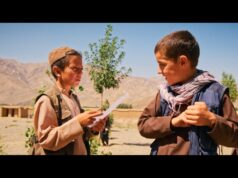
Tehran, Under the Skin is produced by Christian Popp of Tanjo Films alongside Yani 2 Productions. Salari also worked with Popp on Writing Hawa (2024), the Afghan-set documentary she co-wrote and edited.
And, no, the documentary wasn’t made underground. “I did ask for permission because I was working with the public; I was working in clinics, I had all these protagonists exposed in the film and it was important that everyone felt safe.”
There is little chance of Tehran, Under the Skin being released officially in Iran. “The law of hijab is still there and in the clinics, no-one is wearing the hijab.” Nonetheless, the director is hopeful that Iranian society is now changing and that Gen Z women are demanding their freedom to dress and behave as they please.
“The ones who are in their early 20s, they did not grow up with the strict Hihab [rules] that I grew up with. I see that that generation looks like the generation here [in Paris]. The law says they have to be arrested, but there are so many that you can’t arrest them!”