DOK Leipzig has unveiled the full DOK Industry Programme for the 68th festival edition (27 October – 2 November). The DOK Industry Programme “presents a range of formats and events that address timely industry topics, encourage creative exchange, and give filmmakers a platform to showcase their work and connect with peers and potential collaborators,” write organisers. The following text is supplied by DOK Leipzig.
This year’s Industry Programme affirms a continued shared commitment to supporting film professionals working in precarious conditions.”As part of the festival’s Doc Together joint initiative with the Thessaloniki International Documentary Festival to advocate for filmmakers whose livelihood and vital work is under threat, DOK Leipzig will host the Doc Together Think Tank. Guided by solidarity and collaborative principles, the dedicated invite-only event will bring together a curated group of professionals (filmmakers, funders, festival representatives, NGOs, lawyers, and members of the wider documentary community) for a closed-door discussion on supporting documentarians, including those who are displaced or exiled, unable to access national support due to political or structural barriers, or working at risk in their home countries beset by political strife and crises. During the event, small working groups will address recurring challenges such as funding gaps and visa restrictions, map out resources, and identify sustainable, long-term solutions to safeguard filmmakers’ work and its visibility.
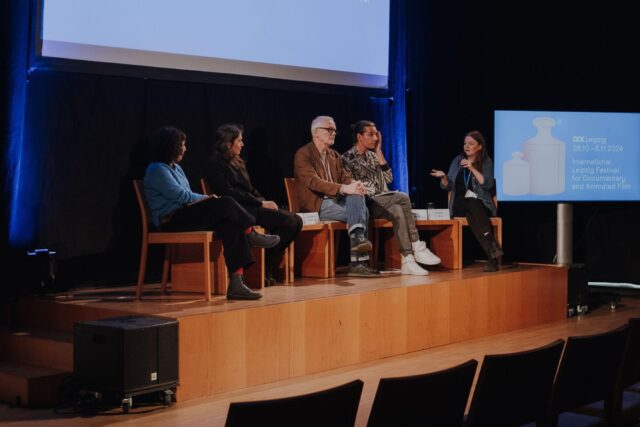
The DOK Industry Talk Doc Together: Documentary as Resistance will also take place as part of Doc Together, highlighting filmmaking as a gesture and statement of solidarity in politically charged times. The event will spotlight case studies on the Palestine Film Institute and the making of the award-winning Myanmar Diaries by the anonymous Myanmar Film Collective. This will be followed by a panel featuring directors and producers from Georgia, India, and Hungary who will shed light on the challenges and perils they face in their countries, as well as joint strategies for building support and resisting the suppression of creative effort.
Also born from the urge to support filmmakers working in politically volatile and vulnerable contexts, ARTE’s ‘Generation Ukraine’ programme bolsters the realisation and distribution of Ukrainian projects since the onset of Russia’s full-scale invasion. Drawing attention to this initiative for the third time, this year DOK Leipzig presents the DOK Industry Talk Case Study: Documentary Production in War. ARTE – Generation Ukraine, which will examine the reality of making films in wartime and how documentary productions persevere despite the destroyed infrastructure and ongoing uncertainty. It will also delve into the international collaborations, exploring the role of broadcasters, funding bodies, and co-producers in championing the essential documentary work in times of adversity. Two Ukrainian documentaries will be in focus, developed through ARTE’s Generation Ukraine: Olga Gibelinda’s Queens of Joy and Dmytro Sukholytkyy-Sobchuk’s Silent Flood.
Among other highlights in the Industry Programme is the DOK Industry Talk “Documenting Queer Realities: Representation on Screen.” In collaboration with Queer Media Society, the panel will reflect on non-fiction cinema as a space that can reimagine queer expression and representation, offering more honest, complex, and empowering portrayals of LGBTQIA+ lives. Three filmmakers participating in this year’s DOK Co-Pro Market will share their experiences navigating the questions of visibility and censorship as they embrace new narrative modes and forms: Julia Fuhr Mann (Germany), Zijian Zeng (China), and Jan Eilhardt (Germany). The panel will be moderated by Therese Koppe. In the DOK Industry Talk Accessibility – Opportunities and Challenges for Film Productions and Festivals, industry experts will discuss the current state of accessibility and how to embed it holistically in festival operations, from accessible film formats to barrier-free venues and inclusive communication. The panel will highlight concrete approaches to advancing inclusion in film and festival practices.
On the animation front, DOK Industry continues to deliver a vibrant programme of animation activities and events, mainly unfolding during the festival Thursday and Friday. In close collaboration with GRAP, the Association of German Researchers and Archive Producers, DOK Industry continues its focus on archives and archive research at this year’s edition. TheDOK Archive Market Talk How Did They Do It? Sports Footage Licensing for the Documentaries FC Hollywood and Mädchen können kein Fußball spielen, will present a practical session, moderated by archival producer, visual researcher, and clearance specialist Elizabeth Klinck. Her colleagues in the field, Thorben Bockelmann and Janne Gärtner ,will join the Talk, mapping the rights landscape through the two case studies.
Keynote presentations will also take place at the DOK Archive Market. In his keynote Archival Tools: What Happens After the Rough Cut? Kasimir Marks will provide insights into the crucial final stages of a project from an archive producer’s point of view. Archive producer Gregor Murbach will give another keynote titles Archival Process in Productions which will unpack the current and evolving realities of archive production.
DOK Exchange XR (Conference, Showcase, and Prototyping Zone) will again showcase an exciting programme on interactive and immersive storytelling with a focus on XR works. Among this year’s themes are the role of immersive practices in reshaping collective memory and cultural narratives, XR and technology literacy, and responsible creation and ethics in XR design.
Short n’ Sweet, the festival’s short film pitch, has announced this year’s crop of projects. The selection presents eight exciting short film projects, encompassing short documentaries, animated documentaries, and animated films.
This year’s projects for DOK Preview Germany and DOK Preview International will also be announced shortly.
The Industry Programme also features several events organised by DOK Leipzig’s trusted partners. In Documentary Film Meets Film Education – We Have a Match! (held in German), AG DOK will examine film education as a form of sustainable audience development. In a roundtable discussion held by AG Festivalarbeit ver.di, labour conditions of festival workers will be in focus, along with best practices and steps to make festival work more sustainable for festivals and their increasingly international teams. The conversation will be followed by the launch of the 4th Fair Festival Award survey. AG Animationsfilm’s AI in Animation: Curse, Blessing, or Both will ponder the implications of the use of AI in animation.
At Industry Intros, accredited guests will have the chance to gain insights into the specific roles in the industry, such as sales agents and distributors. A case study will zero in on the distribution of Daniel Abma’s The Family Approach, which enjoyed a successful run in German cinemas. The film’s producer Britta Strampe and impact producer Lisa Nawrocki (both of Bandenfilm) will speak alongside Abma. Industry Connections will offer accredited attendees the opportunity to meet with experts in the field, including archive researchers and producers (one-on-one), sales agents and distributors (one-on-one), representatives of training initiatives (roundtable), and festivals and markets (meet-up). The DOK Toolkit for First Timers will help newcomers navigate various festival and DOK Industry’s offerings and learn more about the international markets.
The virtual world is not as immaterial as it seems. It consumes water and energy, is used in wars, exploits human creativity and labour, has a real effect on bodies, and influences social structures and political power relations. Under the title Immaterial, this year’s edition of DOK Neuland presents a total of eight works that explore the materiality of digital technologies.
Curated by Dana Melaver, the exhibition consists of four VR experiences, one 360° film, two media art works, and one AR installation. While one of the VR experiences will once again be presented at the Museum of Fine Arts Leipzig, DOK Neuland is heading west, presenting the other seven works in the Plagwitz district of Leipzig. The public exhibition will be accessible free of charge from 28 October to 2 November 2025 at Westkreuz/Heilandskirche.
The experimental science-fiction film Geomancy (2024) by French artist and filmmaker Sybil Montet changes based on real-time weather data from around the world. This interaction between computer graphics and nature reveals data streams as invisible structures of our physical world.
Based on an anti-feminist conspiracy theory in South Korea in which a hand gesture was supposedly degrading men, the VR experience Downfall of the Virtual Human (2025) exposes patriarchal structures in both terrestrial and digital spaces. In this digital fever dream of numerous (pop) cultural references, director Jimmy Vu explores the self-reinforcing dynamics within online platforms.
In the documentary VR experience Another Place (2025), Swiss-Thai director Domenico Singha Pedroli tells the story of trans woman Renée, who fled her home country of Thailand to France in 2022 and applied for asylum there. While invisible to the immigration system and the passers-by of Paris, Renée and her impressions take centre stage in Pedroli’s work. With the help of VR headsets, exhibition visitors can take on Renée’s perspective as their own.
The walls in The Dollhouse (2025) may be made of paper, but they bear a heavy load. In deceptively delicate animation, Charlotte Bruneau and Dominic Desjardins invite visitors into 9-year-old Juniper’s home, which she shares with her parents and housekeeper Magnolia. In this interactive VR story, disobedience and play open up a new perspective on how power relations arise within the intimacy of our homes.
A train ride into total abstraction: In the 360° film Volume (2025), Niklas Poweleit uses short AI-generated clips to create a hypnotic experience which beautifully demonstrates that AI images are abstract architectural structures rather than mere replicas of reality.
In the augmented reality installation For Iron I Gave Gold (2025), German-Ghanaian 3D artist and fashion designer Keke Opata addresses electronic waste as an expression of neo-colonial dependencies and the physical implications of our digital world.
The video sculpture Blindspot (2025) makes visible what cannot be seen with the naked eye: using high-resolution cameras that no longer capture light and movement in individual frames but process them as a continuous data stream. In poetic images, artist Justin Urbach imagines the future of seeing as hybridised, while the monitors scarred by laser etching also raise questions about machine vision and overly detailed perception. The DOK Industry Get-Together on 31 October will feature a musical performance by Alexander Koenig and William East who did the sound design for the work. The event is open to accredited guests, with a limited number of tickets available to the general public.
In the hyper-sarcastic VR-Experience Revival Roadshow (2025), 17th-century Dutch explorer Abel Tasman returns to conquer new land for Dutch climate refugees after a devastating flood. Between satire and criticism, a collage-like narrative about colonial history unfolds in a museum of the future – overflowing with stories and clashing perspective. The story follows the viewer’s gaze, compelling them to decide, amid the flood of images, what to pay attention to and what to ignore. Revival Roadshow was presented in 2024 while still in development at the DOK Exchange XR Prototyping Zone and can now be seen as a finished piece at the Museum of Fine Arts in Leipzig.
Find the full Industry Programme and Timetable on the festival’s website.