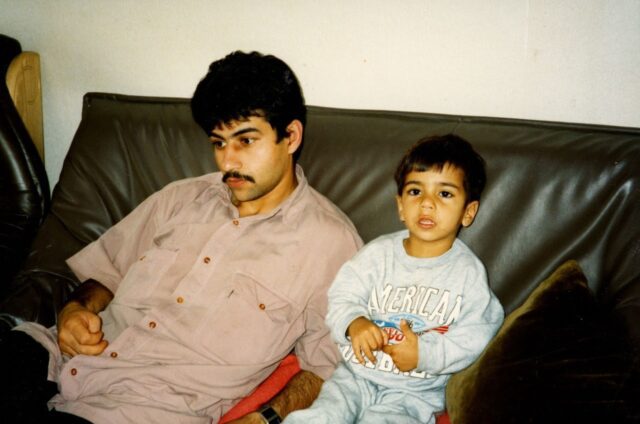
Few people are as qualified to chronicle the ongoing catastrophe in Palestine as Sakir Khader. “Born and raised in the Netherlands as the child of Palestinian parents from a homeland under occupation, I am torn between two worlds and carry with me traumas passed down from generation to generation,” he says.
“As the occupation in Palestine continues and the violence escalates, I have no choice but to capture the injustice through my lens,” he further articulates his compulsion to make Through the Eye of the Falcon, pitched at NLWave 25. “[It] is a raw and intimate family epic in which I explore how the occupation of Palestine, and the physical and psychological violence inextricably linked to it, has been drawing and disrupting my family for decades – both in Palestine and in the Netherlands.”
The film is produced by mint film office, whose staff respond as a collective to questions posed by Business Doc Europe. “Throughout the years of working as a photographer and later as a filmmaker, Sakir has built close relationships with people in all kinds of communities. When he films in Syria, in Jenin, Gaza, Nablus, Afghanistan, you feel that people connect with him on a personal level. They interact with him by sharing stories, posing as if it’s Instagram, telling jokes, making fun of him, but also tell about their sadness, fears and dreams,” says mint.
The company illustrates this with an intriguing reminiscence, as recorded by Khader’s camera. “We are in Jenin. A man is making cotton candy in the trunk of his car, children are flocking around, counting their last money; one young girl looks up at Sakir’s camera as if checking out what the apparatus is, who Sakir is. She looks straight at us, and says ‘I will never leave my country. This is my land. I will die a martyr before I leave.’ The message is casual and clear and the camera moves on. It could be sentimental, it could be bombastic. For [us] it is a sneak view on how living in the camps also is.”
Cut to the remarkable discovery in 2009 of the only ever found footage of Anne Frank, comprising a mere four seconds as she leans out of a window to watch the wedding of her neighbour. “For [us], the girl eating cotton candy could be an Anne Frank. Or better said, why don’t we see her as a possible Anne Frank? This is why [we] steadfastly believe that Sakir’s work is of national and international importance. The work of Sakir gives us the unique opportunity to have a look in a world that is his, that is troubled, that is living a world that we are complicit in.”
“Sakir has the power to go somewhere and to connect and to spot what makes normal daily life special under often severe political circumstances. And it is often in these small things that his work is intriguing, painful, touching,” mint underlines.
In his notes for the film, Khader explains the film’s title. “In Arabic culture, the falcon is synonymous with generosity, freedom, courage and dignity. The falcon flies alone and higher than all other birds. It is a hunter and not prey. In Palestine, they say that my work – making visible the injustice, humanity and dignity of the Palestinian people – is ‘captured by the eye of the falcon.’”
More than 90% of the finance already secured, mint confirms. Financiers on board are Netherlands Film Fund, NPO Fund, CoBO Fund and OCW. Dinema Delicatessen will release the film in the Netherlands, while VPRO (NL) will broadcast the film.
With a mooted delivery of October 2027, mint aims to launch Through the Eye of the Falcon at a major international festival that will highlight the film’s “artistic quality and global relevance…to position the film for broader theatrical and media engagement.” The company is also planning a focussed impact campaign, in collaboration with Cinema Delicatessen, to actively engage with organizations, ambassadors and other partners to reach diverse Dutch audiences “beyond traditional channels.” Targeted screenings will take place in universities, community centers, diaspora communities, and in collaboration with Dutch human rights and nonprofit organizations.
But that is for later. “First, we want to begin filming and assess how the current situation in Palestine affects the production,” mint stresses, confirming that clear measures are in place to minimise risk. “Travelling and filming there is becoming increasingly dangerous, and that is something we have to deal with.”