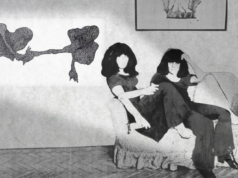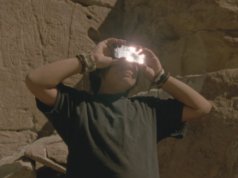
Constructed from home videos from the 1990s and early 2000s, Love Is Not An Orange, which world-premiered in Leipzig, paints a fascinating portrait of the impact independence had on Moldova, formerly part of the Soviet Union, a country that struggled to make the transition from communism to capitalism, and all seen through the prism of family relationships.
Following independence in 1991, women left Moldova in large numbers as illegal migrants seeking to provide for their families. Unable to return home, they found a way to stay in touch – sending cardboard boxes filled with gifts, and in return, their children would send videotapes. This exchange became a ritual among many families.
Writer/director Otilia Babara pieces together some intimate and often tender images from a selection of these video messages between a handful of families, with the film dwelling on how family bonds have been tested in this new look country. At the same time it exposes a post-Soviet set-up whereby women were forced to head overseas to try and provide.
The film opens with footage of eggs and baby birds (metaphor anyone?) as Moldovan friends and families bond and dance in the woods just a year before the country gains independence.
A voiceover states how, ”Moldova gained independence in 1991, but entered a profound economic crisis – money lost its value. We stopped receiving our salaries…men were ruling the country while we, the mothers, migrated to the west to feed our families. The country gained its independence but lost its mothers…we started leaving one by one.”
What follows is a montage of video material from over the years, with a mother’s early voice-over saying that she is waiting to get papers so she can come back to visit her family. Packages feature toys, clothes and food (one family becomes ‘officially’ tired of Italian food), while the video messages back show families at play; husbands tending to their young ones or embarking on building work on houses. As a man comments: “Italians will not believe we are poor – look at this huge house.”
Towards the end of the film a mother comments: “Our children stopped sending us tapes. Images lost their purpose because they lost their hope…it became easier to stay in touch but there’s not much to say. Time wiped out many things. We gave you everything but we never asked you what you need. We never talked about our feelings, we talked about objects. We tried to heal the trauma of our generation but we created another one. We sent, we built, we accumulated. Monuments for better days.”
A closing onscreen message adds: ”Most mothers spent more than 10 years abroad. Some never returned. Many of their children became migrants themselves. Moldova lost 32.7% of its population to migration since its gained its independence.”
In her director statement Babara astutely adds: “Moldova is one of the countries with the fastest declining populations: four people leave the country every hour. The film offers a delicate insight into the domestic environment, shaped by the exchanging of boxes… I want to show how they physically relate to each other; to show the signs of affection – or lack of affection.”
Belgium-Netherlands-France-Moldova, 2022, 72mins
Dir/scr: Otilia Babara
Production: Clin d’oeil Films, Algeria Productions, Basalt Film, ALT Film, Shelter Prod
International sales: Taskovski Film
Producer: Hanne Phlypo
Editor: Pierpaolo Filomeno