

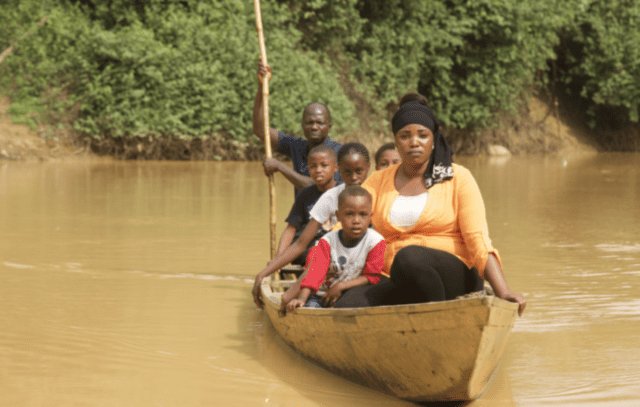
The poignantly titled Fati’s Choice (like Sophie, the biggest decision of Fati’s life concerns the fate of her children) is part of the Generation Africa initiative, which aims to shine a light on the future of youth in Africa through the topic of migration. In the film, Ghanaian Fati is a returnee migrant who is subsequently stigmatised and deemed a failure by the folk in the town to which she returns.
The irony is obvious, points out director Fatimah Dadzie of the film selected for DOK Leipzig International Competition. Ghana is a country in which children are revered, and children are the reason why Fati returns to her home country after initially setting off for the paradise of Europe. But she soon realises that her kids are better served by a mother back home in situ, rather than a mother on another continent trying to eke out a living in the company of a feckless husband.
So Fati comes home again, but she was not expecting to encounter such a chorus of sly whispers and harsh disapproval, nor indeed direct in-your-face criticism. “You betrayed your husband,” one woman tells her. “No wonder he’s ill-treating you.”
But Fati is tough. Yes, she is often forced to tears and the camera captures her pain as she is rendered speechless by the hurtful accusations, but she has kids who need loving, as well as clandestine delivery from the home of her husband’s family, a sequence that we see recorded on a mobile phone.
Even members of her own family criticize her, at least the younger ones. Fati had become pregnant after she met up with her husband again, thereby increasing their chances of staying in Europe. The fact that she then came home is met with incredulity by her siblings. “How can you come from a poor family, get an opportunity like this and waste it?” they ask. “She should have taken advantage of her pregnancy to regulate her stay.”
Director Fatima Dadzie tells of her first encounter with Fati. “This is somebody who, regardless of her difficult economic situation is strong enough to stand for her ideals, and then move ahead with life,” she says. “So that alone intrigued me. And her independence, that independent quality to take this bold decision to return, regardless of the obvious people who will criticize you, because it’s a very small close-knit community where everybody knows your story. But for her to take that decision and try to live a life full of positivity? I said no, this is someone who doesn’t play the victim.”
Dadzie points out how Europe is considered a “paradise” in Ghana, an impression that is continually fed by mass media, she adds. “Before Fati left, she thought everything was free in Europe, because in the movies we hardly see people using hard cash to buy anything, just cards,” she says. “In the media, Europe has been painted in such a desirable way. So they believe what the media is saying, rather than people coming to tell them that, look, this is not a reality. It’s in a way delusional.”
She also says how some of the migrants abroad, as well as returnees, feel a pressure “to create an impression that they have made it in life. They don’t want to say to you that there are problems. So they need to impress.” The journey to Europe is considered a sign of “status,” she adds.
But Fati is seeking an altogether different type of status, that of mother to children who were starved of maternal care when she was away. And so her choice seems to be a sound one, as evidenced by the happy cohesion that the family exhibit in closing scenes, as well as a new-found lightness of being.
Plans are afoot to launch an impact campaign of public screenings in Ghana during which Dadzie and Fati will present and discuss the film. “This film is talking to the likes of Fati,” says the director of people who may be weighing up their own life-changing decision, as well as other activists around the issue of migration. “Those who really want to make a change will find a bigger message in this film.”
“This is one of the most exciting periods of my life, because I have tried so much to tell an important story, and this is my first film,” Dadzie continues. “Generation Africa really gave me a chance. We did a lot of workshops and mentorships and all of that [resulted in] this film, something that will make a powerful statement and will probably change attitudes.”





