Family, heritage, religion and identity are playfully but astutely examined in Cléo Cohen’s DOK Leipzig International Competition world-prem May God Be With You (Que Dieu te protège), as the young filmmaker attempts to tackle her identity crisis and try and get a sense of herself within the context of her family story.
Is Cléo Arab? Or is she Jewish? Throughout the film she struggles for clarification, aided – sometimes reluctantly – by her grandparents, all of whom emigrated from the Maghreb to France as Jews. Can Cléo really get a sense of who she is, based on where she originally came from?
In a series of conversations with family members – but most specifically her grandmothers Denise Houri and Flavie Cohen – she playfully, but with a gentle determination, sets about trying to find out the specifics of their family, their origins and their feelings about both where they came from and where they ended up after emigrating to France in the 1960s.
Cléo’s is a process of discovery and her grandparents play a vital role in this. While some of the family came to France as Algerian Jews, others relocated from the neighbouring country of Tunisia, also as Jews. Cléo is confused. Denise’s native tongue, for example, is Arabic, and she favours Arabic cuisine (there is a lot of talk about couscous), but she’s not an Arab?
Cléo asks her grandmother Flavie whether she’s “sedje,” ie able to marry….or as Flavie defines it, “capable,” but she doesn’t seem entirely convinced by the answer. Denise seems more happy to talk about her family’s past, but Flavie is at time strangely reluctant and worn down by Cléo’s enthusiasm and the many family photographs (and associated questions) she is shown. At one point Cléo asks Flavie if she considers herself exiled, and rather plaintively the older woman admits that she does.
The film is interspersed (though perhaps in a rather self-aware manner) of footage of Cléo seemingly mulling over her life. She includes footage of herself lounging in a bath; listening to Philippe Katerine’s song ‘Juifs arabes’ and – multiple times – scenes of herself reading Albert Memmi, a writer who grew up in Tunis as the son of Jewish parents under French colonial rule.
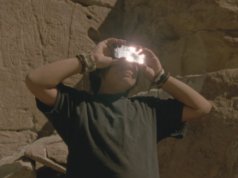
Towards the end of the film she heads to Tunis both to get a sense of the world her grandmother came from and also to investigate significant dates from her family’s past. This allows for some impressive observational footage and some lovely audio of her phone conversations with Denise (who has been teaching her some Arabic) who is worried about her wandering the streets of Tunis and wants to make sure she locks her door properly at night.
It is a gently absorbing journey through a family life, with Cléo Cohen an inquisitive but also warm-hearted narrator (scenes of Denise cutting her hair, or chatting in the garden with Flavie are delightful) and while it offers no final answers to Cohen’s journey of self-discovery, the scenes linked to the final credits of her dancing tend to indicate she has found a sense of her Arab past to link to her contemporary life.
France, 2021, 77mins
Dir Cléo Cohen
Production Petit et Petit
International sales Pascale Ramonda
Producers Rebecca Houzel, Maria Knoch
Cinematography Cléo Cohen
Editor Saskia Berthod
Music Patrick Bismuth
With Denise Houri, Flavie Cohen, Richard Cohen, Daniel Shebabo