Swedish filmmaking duo Alexander Rynéus & Per Bifrost, who are now 38, have known each other since they were five years old – and they’ve remained best pals ever since. They were 11 or 12 when they started making films together and they then went on to study documentary filmmaking together at Biskops Arnö, Sweden.
The fledgling auteurs grew up in Falun, a small community most famous for its old copper mines and not so different from Malmberget, the troubled town they depict in their new feature Once You Shall be One Of Those Who Lived Long Ago (the only documentary in competition in the 78th Edinburgh International Film Festival, 14-20 Aug).
Malmberget has been disappearing in front of the filmmakers’ eyes since they started filming there in 2010. The town is built above a huge iron mine. After centuries of mining, the land is collapsing and the town itself has effectively been condemned. Everybody has to move out before it vanishes into the ground. Buildings are all being demolished. Nature is reclaiming the urban spaces where offices and homes once stood.
2013 saw the premiere of the filmmakers’ first Malmberget documentary, The Home And The Cavity. “It was quite conflict-oriented…the mining company against the people somehow,” Rynéus says of this earlier effort. Since then, he and Bifrost have stayed in touch with the inhabitants of Malmberget – at least those who remain.
“I think we will always continue filming in Malmberget in one way or another. I think it’s some kind of life calling,” Bifrost says of the magnetic pull of the disappearing town on them both. “We had the underlying feeling that we had to, in some way, portray the last epoch of this place,” Rynéus adds.
The new film concentrates on the people, not the politics. It has a light, deadpan humour as it depicts the mainly elderly townsfolk dealing with not only the loss of their homes but often with bereavement too. The trumpet-based soundtrack from Nils Petter Molvær adds to the gently elegiac feel of the storytelling.
“To tell a story with deep feelings, you need the contrast,” Bifrost explains why they leavened their movie with plenty of wry moments. He adds that the “people themselves cope with their situation also with humour.”
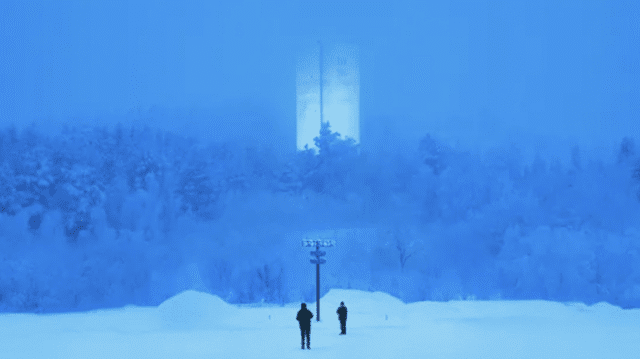
Certain tableau-like images of characters standing alone against the landscape rekindle memories of the stylised, surrealist movies made by the renowned Swedish director, Roy Andersson, for instance Songs from the Second Floor or You the Living.
Not long after they left high school, the budding young directors went to a screening of You the Living attended by Andersson himself – and they admit Andersson may influence them unconsciously. “We watched Roy Andersson when we were younger….we didn’t think so much about it when we did this film but, of course, we have some parts of Andersson with us when we make films,” Rynéus says.
The two directors were working with a very small team. They spent many months in the town, getting to know their protagonists. The longer the filmmakers were there, the more comfortable these protagonists became about opening up on camera. “The way we work is very much a collaboration with the people we portray…we like these very long timescales,” they say.
The directors knew that explosions in the mine often happened at night and therefore filmed the townsfolk as they sat up late, waiting for the blasts. (They’d go to bed afterwards knowing they wouldn’t be woken up).
They describe Malmberget as “an in-between place.” However, they themselves have put down such strong roots there that they know more people there than in their own village. “In a way, it has become a second home to us.”
It was almost impossible for the filmmakers to find accommodation. They stayed in apartments that were soon to be demolished, inside an abandoned pizza restaurant, or on campsites.
“When we made this film, for the first three years, we didn’t want to apply for traditional film funds,” Bifrost recalls of a period when they wanted complete creative freedom but funds were very low. They had released their first feature together, Giants and the Morning After, in 2018. Both felt “quite tired by the whole machinery of making a film,” and were keen to work in a different and more free-spirited way.
Death registers very strongly in the documentary. The town itself is dying. The old-timers who lived there know their time on earth is limited and are often shown discussing the transitory nature of life.
“But I have the feeling that when something ends, something new comes. I have some kind of comfort in that sense,” Rynéus insists there in some optimism amid the gloom.
“When you meet people in this particular situation where everything is soon to be gone, you see their acceptance toward losing their home and place,” his directing partner adds a philosophical note.
All of the protagonists share deeply personal reflections about life, love and loss. “Everyone has a story within them that we want to connect to these topics,” Rynéus reflects.
A woman is mourning her husband and talking about the rocking chair in which he used to sit. Elderly friends who like to do embroidery together will be shown talking to each other about just how they cope with bereavement and loneliness. “Weekends were the worst,” says one.
Edinburgh may seem an unlikely destination for the premiere of a highly anticipated new Nordic feature doc. Nonetheless, the directors are very happy to be in Scotland. “They have a great programme. With this documentary, we wanted to make a cinematic film. There are a lot of fiction films in Edinburgh and they take care of the films very nicely.”
It helps, too, that the directors already have a history with Auld Reekie (a local nickname for the Scottish capital) and showed a short film, Autonomous, at the festival in 2014.
Next month, Swedish audiences will have the chance to see the new feature film in competition at the Nordisk Panorama (18-23 Sept). A sales agent is yet to be appointed but the Swedish release is set for 2026.
The documentary was part of North Pitch – Below Zero and Visions du Réel Industry 2024. It was produced by Iris Film, Andreas Emanuelsson, Sweden; in co-production with SVT, Filmpool Nord and Film i Dalarna; in association with Intakt, and with support from The Swedish Arts Grants Committee and Swedish Film Institute.
The project is dedicated to its original producer Jonas Selberg Augustsén, 1974-2024, who died suddenly last summer just as post-production was getting under way.