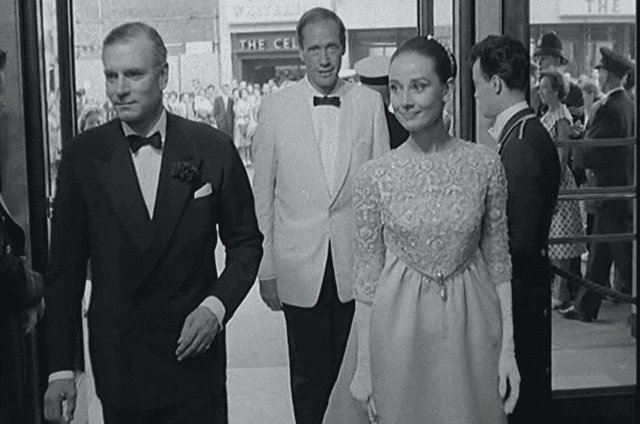
Laurence Olivier and Audrey Hepburn © British Pathé
Last year, Simon Witter, Business Development Manager at British Pathé, was an enthusiastic attendee at the very first European Film Market Archive Day. “It seemed pretty promising,” he says. Aside from anything else, the event is an opportunity to boost awareness of British Pathé in Germany, a market where “awareness is far lower than it could be.”
This year, he’s back – as a Zoom presence. “I am making myself available for three blocks of hours to talk to whoever is booked to see me,” he says, adding. “I can’t wait for this whole lockdown thing to be over so we can get back to being at these events ourselves.”
Covid has turned the festival calendar upside down. However, at British Pathé, business continues to boom.
The world’s fascination with the British Royal Family shows no signs of abating – and British Pathé continues to license vast amounts of material to filmmakers with the royal bug.
During lockdown, there has also been a surge in biographical documentaries about figures from the entertainment, arts and sports world, everyone from Audrey Hepburn to Charlie Chaplin, from former Man Utd and St Mirren manager Sir Alex Ferguson to Formula One driver Stirling Moss. British Pathé is often the first port of call for the filmmakers behind such projects.
On the darker side, films and TV programmes continue to be made in vast numbers about the Nazi period and the Holocaust. For example, British Pathé provided a large part of the footage for Channel 5’s acclaimed recent documentary The World’s Biggest Murder Trial: Nuremberg.
“It is obviously a subject of enormous importance,” Witter points out. “A recent survey of young Americans (aged 18-39) revealed that 63% of respondents did not “know that six million Jews were murdered,” while 48% could not name a single death camp. Previous reports have also found “critical gaps” in Holocaust knowledge among French and Austrian young adults.
During the lockdown, British Pathé has also been busy making an inventory of its film stock and carrying out maintenance on its (highly flammable) nitrate films, repairing damage and ensuring the material is in good shape.
“Actually, the nitrate has held up very well considering some of it is incredibly old,” he says of film which dates back as far as the 1890s, and the birth of cinema. The London office may have opened in 1910 but Pathé itself is older and the British Pathé archives have material that dates back well before that.
There are thousands of canisters, some of which haven’t been open for decades. He admits that he “feared the worst” and that “you go on slight trepidation on expeditions like that, wondering what you are going to find.” To his relief, nearly all the material was still in reasonable condition.
“It has not been cheap to do but it has been worth doing. If we did find anything that looked like it was about to decay, we would immediately scan it to 4K so it would be preserved for the future.”
The British Pathé archives have almost all been digitised already. “But obviously, the point where it was digitised slightly pre-dates the world of HD,” Witter explains. A 35mm film will sustain a scanning of 5.5K. To put it in lay terms, that means the quality and resolution will be “in really spectacular quality…people are always amazed by what comes out of these old films which they couldn’t see on the website.”
The British Pathé archive is already huge but, Witter says, it is still expanding. “We are absolutely interested in new collections. We are definitely growing,” he says.
The Reuters Collection, which British Pathé has represented since 2018, was recently added to the company’s YouTube channel. “We wish people would go to our website but a lot of people find us through YouTube,” Witter says of what is now the main gateway for the public to the British Pathé riches. “Our YouTube channel, which we don’t think of as a very big thing, is now averaging 1.7 million views a day!”
Witter is confident that British Pathé will remain as busy as ever once the lockdown is finally over. “I don’t think what people like archives for will end when people can travel again,” he reflects. “It’s’ something people like, the idea that you are not constantly seeing talking heads.”