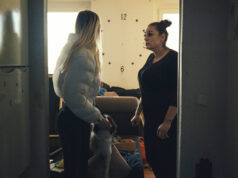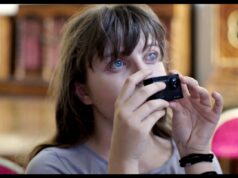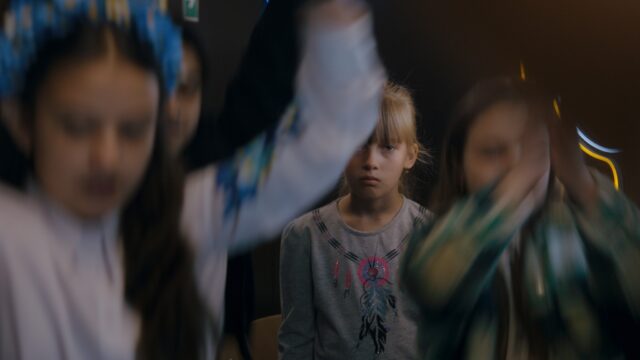
A February 17 Doc Salon panel, moderated by Deadline’s Matt Carey, explored the making of Timestamp, the only documentary selected for the Berlinale’s main competition. The feature, helmed by Ukrainian filmmaker Kateryna Gornostai and produced by Olha Bregman and Zoya Lytvyn, delves into the experiences of educators and students living through the war in Ukraine.
Gornostai recalled the overwhelming moment when Berlinale head Tricia Tuttle informed them of the pic’s selection. At the time, they were still finalising post-production, making the news even more unexpected. Lytvyn, an educator and the founder of the online education portal Osvitoria, explained that the idea stemmed from “countless stories shared by teachers and students, highlighting their resilience in the face of war.” For her, it was a deeply personal project, given her long-standing friendship with producer Bregman and her commitment to education.
Bregman acknowledged the historic significance of their selection, noting that it had been nearly 28 years since a Ukrainian documentary featured in the Berlinale competition. She expressed both “pride and a sense of responsibility,” particularly in light of the on-going challenges faced by the country’s film industry.
Gornostai explained how, from the outset, the team aimed to highlight the lives of teachers through an observational approach. Rather than conducting interviews, they chose to capture the everyday school environment as organically as possible. The film, shot between 2023 and 2024 in cities such as Kamianske, Bucha, Cherkasy, Zaporizhzhia and Kharkiv, presents a holistic view of school life, extending beyond classroom lessons to include interactions between students and teachers.
Filming in a war zone posed immense challenges. Bregman described the constant presence of air-raid sirens and drone alerts, making safety a top priority. The production team worked closely with Lytvyn’s organisation Osvitoria (lit. “Territory of Education” in Ukrainian), the Ministry of Education and others to ensure the well-being of both crew members and participants. Some schools were located dangerously close to the frontlines, requiring careful planning to avoid jeopardising their safety.
Gornostai revealed that the team initially began filming in central Ukraine, where the threat was relatively lower, before moving to areas closer to active conflict. Despite the harrowing reality, she noted that on some days, no air-raid sirens sounded, which led to concerns about whether the film would effectively convey the tension of daily life. However, as filming progressed, the alarms became a near-constant occurrence, forcing them to take shelter underground during lessons.
Lytvyn underscored the broader implications of the war on Ukraine’s education system. With seven million children affected and two million displaced, schools had to adapt to extraordinary circumstances. She outlined three broad categories of schooling: fully remote institutions; hybrid learning environments where students split their time between classrooms and bomb shelters (with other pupils studying online); and those still able to operate fully in-person. In Kharkiv, metro stations had been converted into makeshift schools to ensure continuity in education.
The war has also reshaped curricula, introducing new subjects such as tactical medicine and drone operation. Gornostai explained the significance of the film’s title, Timestamp, referencing the timestamp printed on tactical bandages, indicating how long a wound can withstand bleeding (usually about two hours). She emphasised the emotional weight of documenting these moments, including commemorations for fallen soldiers and close ones, and the ways in which schools serve as cultural strongholds.
Carey asked how the film captured “seemingly ordinary school activities” – math lessons, language classes, sports – within the extreme context of war. Bregman explained that the education system had shown “remarkable adaptability,” but the dangers remained ever-present. Lytvyn added that many schools had only seconds of warning before missile strikes, making traditional learning nearly impossible in some areas.
Gornostai touched on one of the most difficult aspects of filming: representing occupied territories. With teachers among the first groups targeted by Russian forces, many were forced to flee or go into hiding. She noted that “history and language teachers were particularly at risk, as education plays a crucial role in national identity.” Reports indicated that some teachers had been killed, while others faced forced assimilation programmes in occupied areas, where children were taken from their families and subjected to Russian propaganda.
Despite these adversities, the filmmakers sought to highlight the unwavering determination of Ukrainian educators. Bregman pointed out that “over 40,000 teachers had been displaced, with many volunteering for the army.” The most pressing challenge, however, remained the need for trauma-informed teaching to provide students with emotional stability amidst the chaos.
On the other hand, financing went relatively smoothly. With no public film financing available in Ukraine, the team relied on Osvitoria as their initial backer. As the project expanded, they sought additional support, ultimately securing partnerships with producers from Luxembourg, Netherlands and France, as well as funding from the CPH Forum’s Eurimages Award and Denmark’s International Media Support, among others.
Bregman noted that once potential partners saw the footage and understood the film’s significance, securing financing became relatively swift. The documentary was completed in under two years—an unusually fast turnaround for an observational film.
Looking ahead, the filmmakers are confident of the potential impact of Timestamp. With Think-Film leading the outreach campaign, they hope to extend the film’s reach beyond traditional audiences, ensuring that the resilience of Ukrainian teachers and students continues to be recognised on a global scale.