

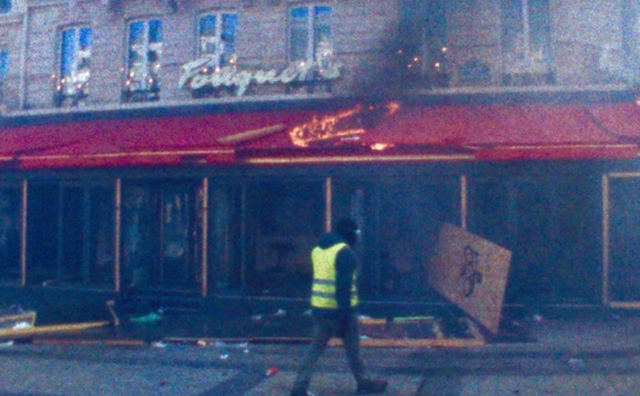
In Yellow Saturday (or Les rendez-vous de samedi) there is somewhat of the ‘when gilets jaunes met Jules et Jim,’ as the recent French yellow jacket protests are graphically chronicled alongside the fictional story of Pierre Bolex and his endeavours to date Paris’ most beautiful women.
Shot on 35mm both in 2D and 3D, and presented much of the time across two frames throughout its 54-minute duration, Antonin Peretjatko’s Yellow Saturday examines the gritty social reality of recent French protest before it segues into the even grittier reality of national lockdown and the inevitable restrictions placed on the right to demonstrate.
The gilet jaune (yellow jacket) protests began in earnest in November 2018 in response to rising crude oil and fuel prices, the general high cost of living and perceived economic inequality resulting from the disproportionate burden of taxation in France among the working and middle classes. Peretjatko started filming on December 1 of the same year when he was in situ with his camera at the Arc de Triomphe to record the infamous attack on the city’s iconic monument.
“These people were at the top of the Arc de Triomphe, and they were burning buildings. I couldn’t believe my eyes,” he says. “So I came back the day. That was early on Sunday morning. I was lucky because that was the day that I met Emmanuel Macron in the street [inspecting the damage]. When I came back home, I said, ‘I think we have a movie because I done only two days of shooting and I already have the Arc de Triomphe and President Macron.’”
The rebellion was both unusual and intriguing in that protesters came from all sides of the political divide, whether from the extreme left or the far right, and all shades in-between. “The only thing that they had in common was the yellow jackets…Some didn’t want to pay taxes, some were there because they were against Europe, others because they were anarchists, there were plenty of reasons,” says the filmmaker.
“But what all these people wanted to change was the way of doing politics, and they wanted to be listened to. They wanted to say ‘our life is difficult, and you have to take that into consideration, to see how much we work and we don’t earn money. We all know how to live [but] we don’t know how to live in this world.’”
As in Aliaksei Paluyan’s Courage, that chronicled the protests in Belarus following the country’s rigged 2020 elections, or Anders Hammer’s Hong Kong pro-democracy doc Do Not Split (also 2020), Peretjatko’s footage is thrilling, dramatic and very cinematic. What’s more he accompanies the action with an evocative orchestral score culled from the likes of Vivaldi, Beethoven, Saint-Säens and Albinoni.
But it’s a bubbly pop soundtrack that accompanies the film’s fictional aspect, that of the intriguingly-named Pierre Bolex and his failing attempts desire to date a string of beautiful and idealised Parisian women, much of the time beside the Eiffel Tower. A date with Sophie doesn’t happen because the riots delay his progress across town by 5 hours. Domino, who communicates from her rooftop in Paris by reflecting the sun on a hand mirror, is eventually more interested in a neighbour who climbs the rooftop to join her.
Peretjatko was determined to widen the appeal of a film that was originally only about the protests. “These kind of movies are a bit boring after 10 or 15 minutes. If I want to speak to everybody, maybe it would be a good idea to have a fiction character in this crazy, crazy world.”
“In this movement, there are a lot of things to say, but you can’t say everything,” he adds of the use of Pierre Bolex as a mouthpiece (as well as a hapless romancer). “I think that with a fiction character, maybe the movie is easier to watch and to appreciate. And then you are not [placed into] a kind of militant movie.”
That said, Bolex is not without political (and critical) nous, and at the film’s close his personal narration offers up a damning indictment of Macron and the political era that the French are living through.
“I am approaching 41 years old. I’d like to return to the 14th of July of my childhood. The celebration of the people’s and of man’s freedom,” says Bolex. “His name is Emmanuel Macron. He is approaching 42 years old. He too must be looking for something from his childhood. Is it Margaret Thatcher, or maybe Ronald Reagan? An ideology leaving behind injustice, inequality and on its own [path] of self destruction…”
And then, as we see a protester beaten senseless by police with batons, he ponders reflectively, “Is not all our life the story of a stifled revolt, the tragedy of something that wanted to emerge and never could…”





