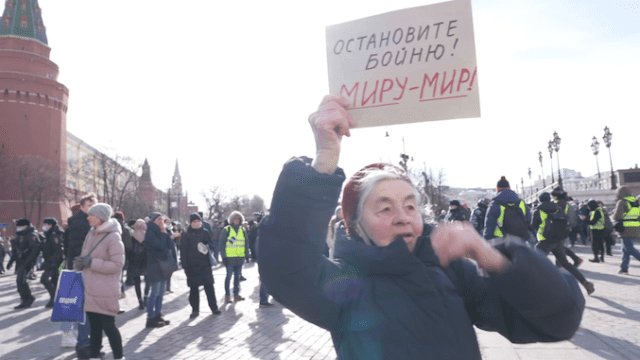
Being designated as a ‘foreign agent’ can have a terrible impact on journalists and activists in contemporary Russia as Putin looks to curb any kind of criticism or agitation against his special military operations in Ukraine. The provocative documentary Of Caravan and the Dogs, which world-premieres at FIFDH, astutely documents the personal danger, and severe punishment meted out to, those wanting to take a stand and defend the truth.
With a joint directing credit shared by Anonymous 1 and Askold Kurov (THE TRIAL – The State of Russia vs. Oleg Sentsov, Children 404) the film paints a disturbing portrait of the last defenders of democracy in Russia and offers only the vaguest glimpse of hope for a different future.
Since 2012, a series of repressive laws have been passed by the Russian Government labelling everyone who publicly disagreed with the official narrative as a ‘foreign agent’, a traitor of Russia. The film follows a group of independent Russian media and activists (among them two Nobel Peace Prize winners – Dmitriy Muratov of Novaya Gazeta and the NGO Memorial) who are trying to resist and continue with their work.
The film opens with Muratov accepting his Nobel Prize, and commenting from the stage how “Journalism in Russia right now is going through a dark alley – over 100 journalists, media outlets, human rights defenders and NGOs have recently been branded as foreign agents. In Russia this means enemies of the people. Many of our colleagues have lost their jobs.”
“Some have to leave the country. The dogs bark but the caravan goes on,” he continues. “The government often speaks sarcastically of journalists, [that] they bark but don’t affect anything…the saying has an opposite meaning. The caravan drives forward because the dogs bark…Yes, we growl and bite. Yes, we have sharp teeth and strong grip, but we are the precondition for progress. We are the antidote against tyranny.”
But Putin had been preparing his country for the war and subsequent media repression for some time. At a press briefing Muratov asks Putin directly about someone being branded a ‘foreign agent.’ Putin replies: “I will not waffle. Look, this law is due to receiving financial support from abroad – as part of political activities inside the country. But the law doesn’t forbid to continue those political activities, only this money coming from abroad should be marked. The Russian society should know, yes, this person has such and such opinion, this is his view on political processes, but he is receiving money from abroad. The danger of this law is highly exaggerated.”
Sadly it is not exaggerated. Some 90 days before the war the Supreme Court of the Russian Federation, place Memorial on the foreign agent list, accusing the NGO of not marking itself as a foreign agent. Members of Memorial say it is a politically motivated decision to close the oldest Russian NGO which researches the crimes of the Stalin regime. Staff arrange for a lorry to pick up their research material, but later in the film their offices are raided and all computer equipment taken away.
Within days of the special operation, the radio station Echo is closed down, swiftly followed by the independent television news operation Rain TV. Live on air the staff enter the studio and announce they have been forced to close. At Novaya Gazeta staff are told they may be able to get round reporting restrictions by focussing on culture and events inside Russia, but soon they are shut down by the government and listed as an extremist organisation, with the media losing its media license and being blocked.
Some staff – including Muratov – stayed in Russia and continued work on YouTube and social media, while others left Russia and founded Novaya Gazeta Europe with Kirill Martynov elected editor-in-chief. The publication is labelled ‘undesirable’ in Russia. Dimitry Muratov auctioned off his Nobel Peace Prize medal for UNICEF to help displaced Ukrainian children, amazingly raising-$100 million, but in September 2023 he was put on the ‘foreign agent’ list. Ironically the NGO Memorial then received the Nobel Peace Prize.
Shot during one strikingly decisive year, before and after the invasion, the film portrays the trials and tribulations of those wanting to make a stand, but ultimately finding that Putin’s hard line will not abate and any kind of criticism harshly repressed. Since the war 100 media and about 640,000 websites were blocked in Russia, and 500 people and organisations placed on the ’foreign agents’ list, about two thirds being journalists.
With striking access to the newsrooms and workplaces of the media organisations and Memorial, the film is both matter-of-fact and movingly passionate as it recounts the losing battle in which they all engage. The mere fact that some many of the credits are labelled as ‘Anonymous’ speaks volumes about the fear of reprisal people still feel. Of Caravans and the Dogs is a powerful and important documentary.
Germany, 2024, 89mins
Dirs: Anonymous 1, Askold Kurov
Production: Anonymous Production
International sales: Rise and Shine World Sales
Producers: Anonymous 3, Anonymous 1, Askold Kurov
Cinematography: Anonymous 1, Askold Kurov
Editors: Anonymous 2, Kirill Sakharnov